



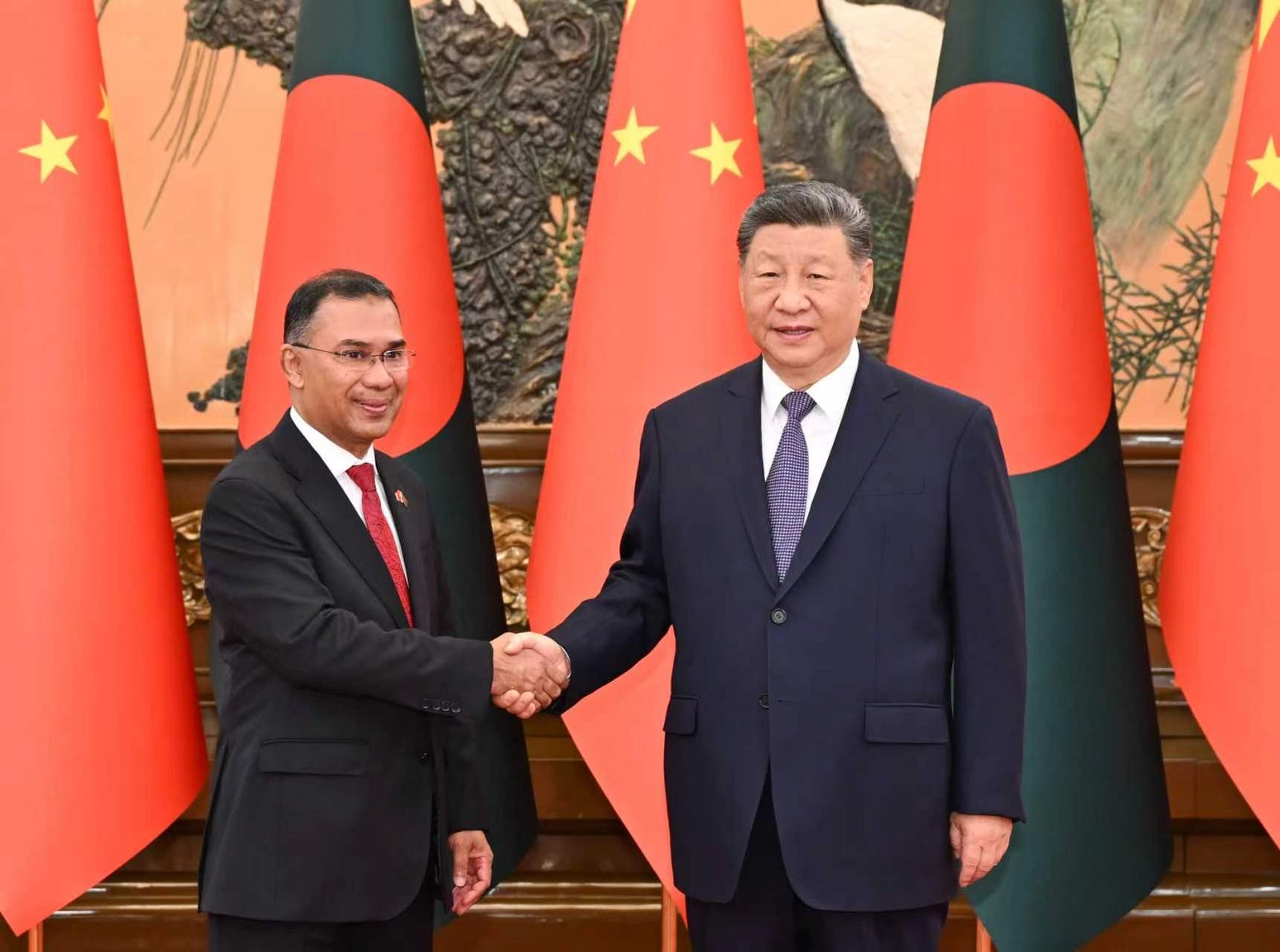
BEIJING, China: Diplomatic communiqués are often dismissed as carefully negotiated documents filled with ceremonial language and predictable declarations of friendship. The Joint Communiqué issued at the conclusion of Bangladeshi Prime Minister Tarique Rahman’s visit to Beijing, however, deserves far greater attention. Read closely, it is less a record of a successful state visit than a strategic blueprint for the future of South Asia. Behind its references to trade, infrastructure, water management and cultural exchanges lies an unmistakable message: China is moving beyond transactional diplomacy to build a durable strategic architecture in Bangladesh, while Dhaka is repositioning itself as one of the most consequential middle powers in the emerging Asian order.
The significance of the agreement lies not in any single project but in the way it integrates diplomacy, economics, security, technology, water governance, industrial policy and multilateral institutions into one coherent framework. Beijing is no longer investing only in roads, ports or power plants. It is investing in institutions, governance mechanisms, strategic dialogues and sectors that will shape Bangladesh’s development trajectory for decades. This marks the transition from infrastructure diplomacy to systems diplomacy, where influence is secured not simply by financing projects but by becoming embedded in the policy ecosystem of a partner country.
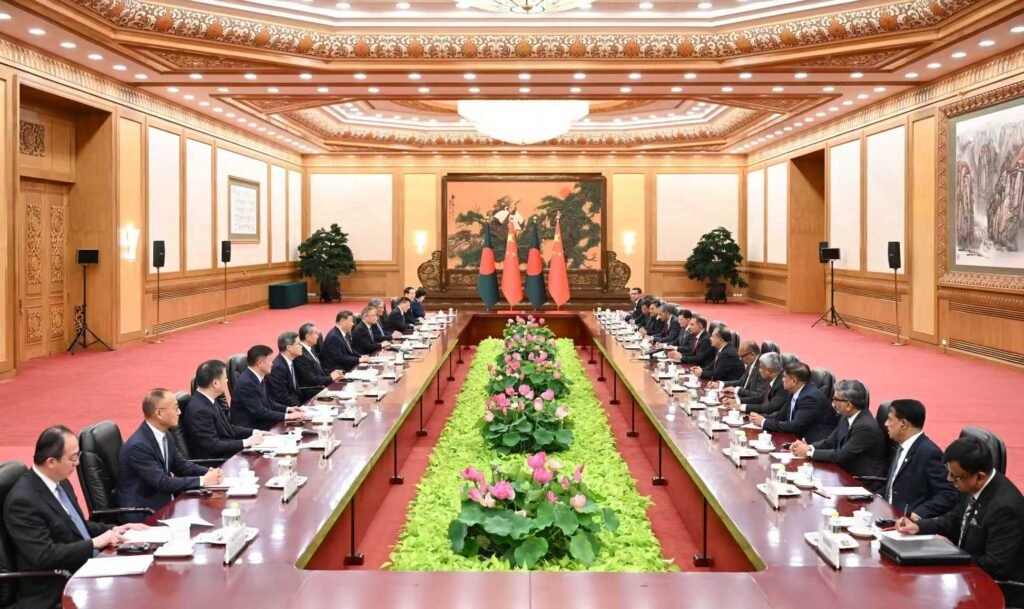
The elevation of bilateral ties into a “China-Bangladesh Community with a Shared Future in the New Era” is perhaps the clearest indication of this transformation. Within Chinese diplomacy, such terminology carries considerable strategic weight. It reflects Beijing’s intention to institutionalize long-term political alignment with countries that occupy critical positions in its vision of a multipolar world. Bangladesh’s inclusion in this framework demonstrates that China now views the country not merely as a Belt and Road participant but as an indispensable geopolitical partner connecting South Asia, Southeast Asia and the wider Indian Ocean region.
Geography has always been Bangladesh’s greatest strategic asset, but for much of its post-independence history, that advantage remained underutilized. Today, the geopolitical value of the Bay of Bengal has risen dramatically. The region has become a focal point of strategic competition involving China, India, the United States, Japan, Australia and several ASEAN countries. Energy routes, maritime trade, undersea digital cables, critical mineral supply chains and naval mobility increasingly converge in this maritime space. By expanding its presence through Mongla Port, the Chattogram Economic and Industrial Zone and enhanced maritime cooperation, China is steadily positioning Bangladesh as an integral node within its broader Indo-Pacific economic network.
Unlike Cold War alliances that relied primarily on military commitments, China’s approach emphasizes economic interdependence as the foundation of strategic influence. Ports evolve into logistics hubs, industrial zones become manufacturing ecosystems, digital connectivity creates technological dependence, and supply-chain integration generates long-term political leverage. The communiqué demonstrates that Beijing’s regional strategy increasingly rests on creating interconnected economic systems rather than formal security blocs. This model is proving attractive to developing countries because it promises growth without requiring exclusive geopolitical alignment.
Perhaps the most geopolitically sensitive provision concerns China’s commitment to support the Teesta River Comprehensive Management and Restoration Project. At first glance, the initiative appears to focus on flood control, river dredging and water management. In reality, it signals China’s entry into one of South Asia’s most strategically sensitive domains. Water security is rapidly becoming one of the defining geopolitical issues of the twenty-first century as climate change accelerates glacial melt, alters river flows and intensifies competition over transboundary water resources. By participating in hydrological planning, river restoration and disaster management, China is expanding its influence into an area that directly intersects with food security, agricultural productivity, environmental resilience and national security.
For India, this development carries profound strategic implications. The Teesta has long been an unresolved bilateral issue between New Delhi and Dhaka. China’s growing involvement introduces an external strategic actor into a domain that India has traditionally regarded as part of its immediate regional sphere of influence. More broadly, the agreement illustrates how Beijing is steadily widening its engagement across sectors that were previously dominated by bilateral regional diplomacy. This trend is likely to reshape strategic calculations not only in Bangladesh but throughout South Asia.
Equally significant is the communiqué’s emphasis on industrial cooperation and technological transformation. China’s earlier engagement with developing economies often centered on financing large infrastructure projects. The latest agreement reflects a notable shift toward integrating Bangladesh into China’s evolving industrial ecosystem. Cooperation in advanced manufacturing, e-commerce, green energy, photovoltaic technology, digital communications and scientific innovation indicates that Beijing sees Bangladesh as an emerging production base within reconfigured global supply chains. As geopolitical tensions encourage multinational corporations to diversify manufacturing beyond traditional hubs, Bangladesh stands to benefit from its strategic location, competitive labor force and expanding export capacity.
The agreement also reflects China’s broader ambition to reshape global governance. Beijing’s endorsement of Bangladesh’s participation in BRICS and its application to become a partner of the Shanghai Cooperation Organization demonstrates a long-term strategy of expanding alternative multilateral institutions led increasingly by the Global South. These organizations are gradually evolving beyond political forums into platforms for financial cooperation, infrastructure development, technology partnerships and strategic coordination. Bangladesh’s deeper integration into these institutions would diversify its diplomatic options while reinforcing China’s effort to construct a more multipolar international order that reduces dependence on Western-led institutions.
The security dimension of the communiqué is equally noteworthy. Although framed in modest language, the agreement to deepen defence exchanges, military training, maritime cooperation and explore a future “2+2” dialogue reflects an important institutional evolution. China appears to be cultivating strategic trust incrementally rather than pursuing overt military alignment. This measured approach minimizes regional confrontation while gradually expanding Beijing’s security footprint in the Bay of Bengal. Over time, such institutional engagement could evolve into broader cooperation in maritime domain awareness, humanitarian assistance, disaster response, defence technology and regional security coordination.
Bangladesh, meanwhile, is demonstrating an increasingly sophisticated foreign policy built around strategic diversification rather than strategic dependence. The government’s “Bangladesh Before All” doctrine reflects a recognition that the emerging international system rewards states capable of engaging multiple major powers simultaneously. Dhaka is seeking Chinese investment, Indian connectivity, Japanese infrastructure, Western export markets and Gulf capital without becoming exclusively aligned with any one geopolitical camp. This model of multi-alignment is becoming characteristic of successful middle powers navigating an increasingly fragmented international system.
The broader implication of the communiqué extends well beyond China and Bangladesh. It illustrates how geopolitical competition is entering a new phase in which influence is measured less by military deployments than by technological ecosystems, industrial integration, financial connectivity, water governance and institutional partnerships. Infrastructure is becoming strategy, supply chains are becoming instruments of statecraft, and development cooperation is emerging as a central arena of great-power competition.
For India, the agreement should serve as a strategic reminder that geography alone no longer guarantees regional influence. Sustaining leadership in South Asia will increasingly depend on delivering competitive economic opportunities, technological partnerships, infrastructure connectivity and long-term developmental cooperation. For China, the communiqué represents another step toward constructing a regional order centered on economic interdependence and institutional engagement. For Bangladesh, it is an affirmation that its growing geopolitical importance provides unprecedented diplomatic leverage in a rapidly changing world.
History may ultimately remember this communiqué not because of the projects it announced, but because it marked the moment when Bangladesh emerged as a pivotal strategic actor in the evolving balance of power across the Indo-Pacific. As the international system moves steadily toward multipolarity, the choices made in Dhaka may prove as consequential for the future of Asia as those made in Beijing, New Delhi or Washington.
– Ryan Wang