

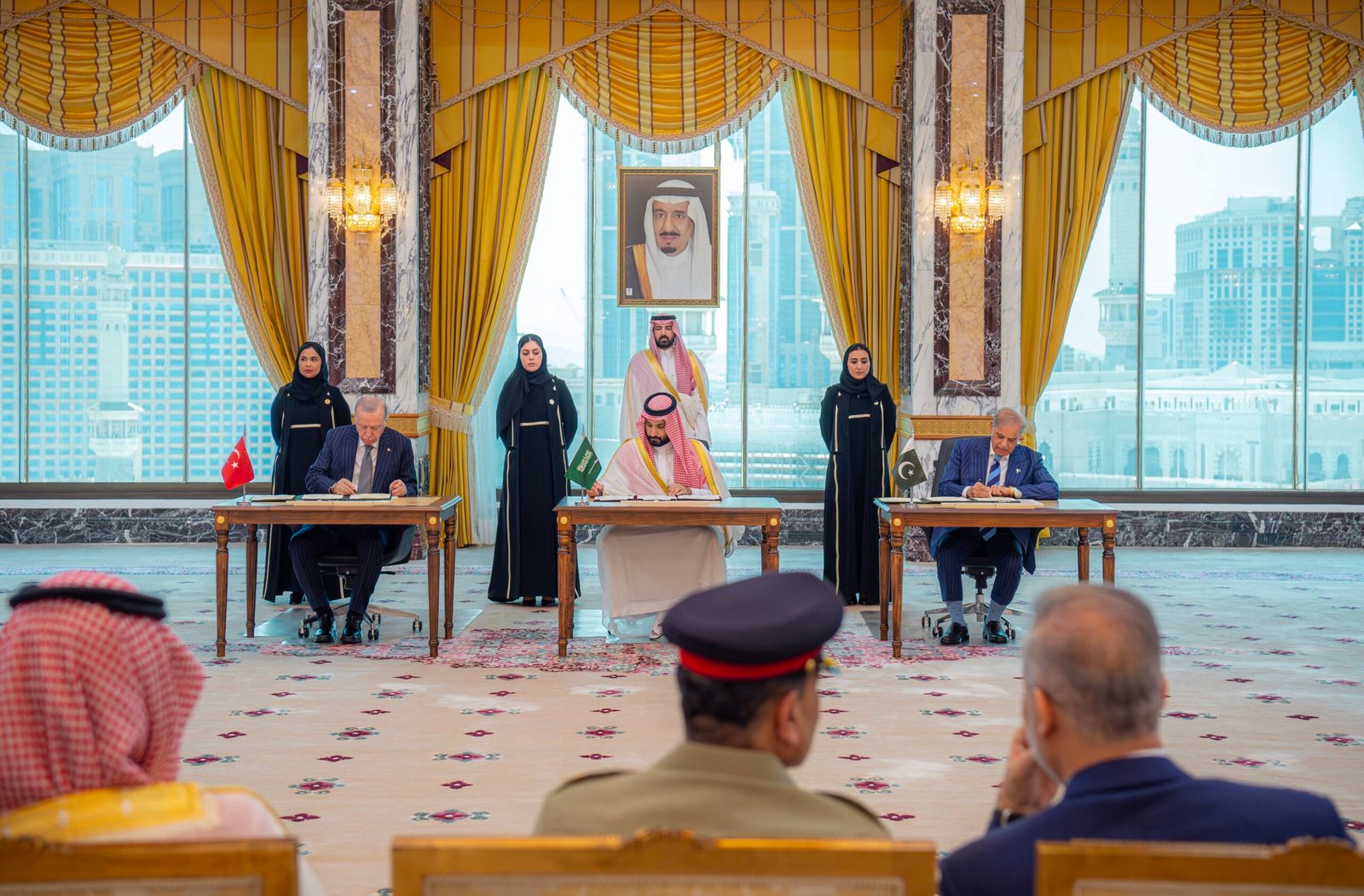
MECCA, Saudi Arabia: Three folders – two green and one crimson red changed hands beneath the portrait of Saudi King Salman at Al-Safa Palace in Mecca. Saudi Crown Prince Mohammed bin Salman, Turkish President Recep Tayyip Erdogan and Pakistani Prime Minister Shehbaz Sharif stood together as they signed the Makkah Joint Defence Agreement, declaring that an armed attack against any one of the three countries would be regarded as an attack against all. The image was carefully choreographed, but the strategic message was far more consequential than the ceremony itself. At a moment when the Middle East is being reshaped by conflict, missile and drone warfare, threats to energy infrastructure, disruption around critical maritime routes and uncertainty over the future role of the United States, Saudi Arabia, Türkiye and Pakistan have chosen to place a new layer of collective security at the centre of their relationship. The pact does not create an “Islamic NATO”, nor does it establish a NATO-style military command or guarantee an automatic military response to every attack. Its significance lies elsewhere: it signals that important regional powers are increasingly unwilling to leave their security entirely dependent on a single external guarantor.
Mecca
The choice of Mecca as the venue gives the agreement a significance that goes beyond conventional diplomacy. Mecca is the spiritual centre of Islam, home to the Kaaba and Masjid al-Haram and the destination of the annual Hajj, bringing together Muslims from across the world. Signing a defence agreement in such a place allows Saudi Arabia to surround a hard-security arrangement with the language of solidarity, responsibility and collective stability. It is important, however, not to confuse symbolism with ideology. The agreement is not a religious military alliance, and the three signatories have different strategic interests, relationships and threat perceptions. Türkiye remains a NATO member; Pakistan shares a border with Iran and has an interest in preserving diplomatic channels with Tehran; Saudi Arabia remains a major US security partner. Yet the symbolism of Mecca matters because it places the agreement within a broader narrative of regional ownership. Riyadh is effectively signalling that the security of the Muslim world’s most important political and economic centres cannot forever be treated as an issue to be managed primarily by external powers. Mecca therefore becomes more than the backdrop to a treaty. It becomes the political stage on which Saudi Arabia is presenting itself as a central actor in shaping the region’s future security architecture.
Why Now
The timing is impossible to ignore. The Middle East has entered a period in which war no longer respects conventional borders or traditional assumptions about geographic distance. Missile and drone attacks can reach energy infrastructure; attacks by non-state actors can affect sovereign governments; instability around the Red Sea and Strait of Hormuz can rapidly translate into higher oil prices, shipping costs, insurance premiums and inflation across the global economy. For Saudi Arabia, this vulnerability is especially significant because its economic transformation depends upon stability. Vision 2030 is built around investment, tourism, logistics, technology, industrial development and global connectivity. None of these ambitions can flourish in an environment where regional conflict repeatedly threatens energy infrastructure or commercial routes. Riyadh therefore has an increasingly sophisticated understanding of security: military security, economic security and supply-chain security are no longer separate categories. They are parts of the same national strategy.
This explains why the Mecca pact should not be interpreted simply as a reaction to Iran. Iran is clearly part of the strategic environment, but the deeper Saudi calculation is about uncertainty itself. Riyadh has watched the region change rapidly and has seen how quickly assumptions about deterrence can collapse when conflicts escalate. The lesson is not necessarily that Washington has become irrelevant. Rather, it is that Saudi Arabia does not want its security to depend entirely on what another capital decides to do during the next crisis. The kingdom is therefore pursuing strategic diversification: maintaining its relationship with the United States, strengthening ties with Türkiye and Pakistan, working through the Gulf Cooperation Council and developing its own military and industrial capabilities. This is not a rejection of alliances. It is an attempt to create more choices.
Riyadh’s Hedge
For Saudi Arabia, the pact represents a move from dependence towards strategic hedging. The United States remains indispensable in several areas, particularly advanced defence technology, intelligence and military cooperation. But Riyadh increasingly appears determined to ensure that American support is one pillar rather than the entire structure. The Saudi-Pakistani defence relationship already provided a foundation, while Türkiye adds military-industrial capabilities that could become particularly valuable as Saudi Arabia seeks to localise defence production. The kingdom is no longer thinking only about buying weapons. It increasingly wants to build an ecosystem in which technology, manufacturing, investment, training and military capability reinforce each other. Türkiye can contribute to that ambition through its growing defence industry, while Pakistan brings military expertise, manpower and strategic weight. The long-term Saudi objective may therefore be less about creating a battlefield coalition and more about building a diversified security ecosystem that supports the kingdom’s economic transformation.
Türkiye
Türkiye’s participation changes the strategic weight of the agreement. Ankara combines NATO membership, a substantial conventional military and an increasingly successful defence-export industry. Its growing capabilities in drones, missiles, naval systems and other military technologies have expanded Türkiye’s geopolitical reach well beyond its immediate neighbourhood. For Riyadh, closer defence cooperation with Ankara offers access not only to military hardware but also to industrial expertise and potentially joint production. For Türkiye, Saudi Arabia represents a major economic partner and a powerful gateway into the Gulf. The relationship therefore carries commercial consequences alongside strategic ones. Defence cooperation can create investment flows, technology partnerships, industrial supply chains and long-term economic interdependence. The Mecca agreement may eventually prove as important for defence industries and regional commerce as it is for military planning.
Ankara also gains something more intangible: strategic depth. Türkiye does not have to choose between NATO and its regional partnerships. Instead, it is building a network of relationships that gives it greater room to manoeuvre. Its partnerships with Qatar, Saudi Arabia and Pakistan complement rather than automatically replace its Western alliances. This reflects a broader transformation in international politics, where middle and regional powers increasingly resist the idea that strategic loyalty must mean exclusive alignment. Türkiye wants to remain inside NATO while simultaneously expanding its influence across the Gulf, South Asia and the wider Muslim world. The Mecca pact fits comfortably into that model.
Pakistan
Pakistan’s role is perhaps the most strategically delicate. Islamabad has longstanding defence and economic ties with Saudi Arabia and deep social connections with the Gulf. Millions of Pakistanis live and work across the region, while Gulf states remain essential to Pakistan’s economic and energy interests. Pakistan’s military capabilities and nuclear status also give it a strategic significance that few other Muslim-majority countries possess. Yet Pakistan shares a border with Iran and has sought to maintain its role as a diplomatic bridge between competing powers. The Mecca pact therefore creates a paradox: Islamabad gains influence by joining the security arrangement, but it must work harder to preserve the diplomatic credibility required to mediate between Iran and its partners.
Its inclusion may nevertheless be one of the agreement’s cleverest features. Pakistan’s participation makes it harder to define the pact as simply an anti-Iran coalition. Islamabad has a direct interest in preventing a confrontation with Tehran from spiralling out of control. That diplomatic connection could provide the agreement with an additional layer of insulation. But the test will come during a crisis. If the collective-defence clause is ever activated, Pakistan may have to reconcile its commitments to Saudi Arabia and Türkiye with its geographic proximity to Iran. The agreement increases Islamabad’s regional influence, but it also increases the cost of strategic ambiguity.
The Iran Factor
Iran is not named as the target of the agreement, and the three governments have stressed that the pact is defensive. Yet Tehran remains the unavoidable strategic reference point. Saudi Arabia faces Iran across the Gulf, Türkiye shares a border with Iran and Pakistan shares one as well. The collective-defence clause therefore changes the strategic calculation even without explicitly identifying an adversary. Any potential attack against Saudi Arabia must now be considered in a wider context: what happens if Türkiye becomes involved? What happens if Pakistan provides military or logistical support? How would the United States respond? How would the Gulf states react? And how would Iran manage the possibility of a confrontation expanding across several strategic theatres?
The Iranian response will therefore be crucial. Tehran can dismiss the pact as symbolic, strengthen its deterrence capabilities, seek assurances from Pakistan and Türkiye or attempt to deepen diplomacy with Saudi Arabia to prevent the new arrangement from becoming institutionalised as a permanent anti-Iran structure. The most effective Iranian response may be a combination of diplomacy and deterrence. Iran has little interest in creating the very threat perception that could unite Saudi Arabia, Türkiye and Pakistan more closely.
The Test
The central question is whether the Mecca pact will make the Middle East safer or simply more heavily armed. Collective defence can strengthen deterrence by increasing the potential cost of aggression, but it can also produce the classic security dilemma in which one side’s defensive preparations appear threatening to another. If the agreement develops into a system of intelligence-sharing, air and missile defence, joint exercises, maritime security and crisis consultation, it could contribute meaningfully to regional stability. If it becomes primarily an instrument for military signalling without equally strong diplomatic mechanisms, it could deepen existing divisions. That is why the pact’s greatest challenge is not military capability. It is strategic discipline. The three governments must demonstrate that they can deter without provoking, prepare without escalating and cooperate without closing diplomatic channels. A successful security architecture should make war less attractive, not merely make retaliation more powerful.
Beyond Three
The future may lie in expansion, but expansion should not be confused with success. Qatar, Kuwait and Egypt are among the countries that could potentially become part of a wider security network, given their strategic relationships and military importance. Yet every additional member would bring its own relationships with Iran, Israel, the United States and other powers. A rigid alliance could therefore become politically difficult to manage. A more flexible model may ultimately prove more effective: a regional security network built around specific areas of cooperation rather than a single military command. Air defence, maritime security, intelligence, counter-drone capabilities, cyber security, defence manufacturing and logistics could provide practical cooperation without forcing every participant into identical foreign-policy positions. Such an architecture would better reflect the realities of a multipolar Middle East.
Washington
The Mecca pact also presents Washington with a strategic choice. A stronger regional security architecture does not necessarily weaken American interests. In fact, it could support the long-standing US objective of encouraging allies and partners to shoulder more responsibility for their own security. But successful regional autonomy will inevitably change the nature of American influence. Washington may increasingly become an enabler rather than the sole guarantor, providing advanced technology, intelligence and strategic support while regional powers assume more responsibility. That is not necessarily American retreat. It is a transition from a security model centred on American primacy towards one in which American power operates through a network of capable regional partners. The United States will therefore need to decide whether it wants to manage this transformation or resist it.
India
India has equally strong reasons to watch the emerging security architecture. The Mecca agreement does not automatically represent a Saudi-Türkiye-Pakistan bloc directed against New Delhi. Saudi Arabia has built increasingly important economic and strategic relations with India, spanning energy, investment, trade, infrastructure and technology. Riyadh has every reason to protect those ties. But the deeper Türkiye-Pakistan defence relationship will remain significant for India, particularly as Gulf security becomes increasingly connected with South Asian strategic dynamics. New Delhi’s response is likely to be deeper engagement rather than confrontation. India’s relationships with Saudi Arabia, the UAE, Qatar and other Gulf states will become increasingly important across maritime security, energy, technology, investment and supply-chain resilience.
The Gulf is no longer simply an energy supplier for India. It is becoming part of India’s wider strategic neighbourhood.
The New Equation
The Mecca pact should therefore not be judged by whether it eventually becomes an “Islamic NATO”. That benchmark misunderstands what is happening. The more important development is the emergence of a new regional logic in which states are building overlapping partnerships to reduce strategic vulnerability. Saudi Arabia wants greater autonomy without abandoning Washington. Türkiye wants greater regional influence without leaving NATO. Pakistan wants greater strategic relevance without losing its diplomatic relationship with Iran. Their interests are not identical, but they overlap sufficiently to create a new platform for cooperation. The deeper significance of the Mecca agreement may ultimately lie outside the military sphere. Defence cooperation can lead to industrial cooperation; industrial cooperation can create economic interdependence; economic interdependence can reinforce diplomatic relationships. If managed carefully, the pact could become part of a much wider network connecting the Gulf, Türkiye and South Asia.
But there is another possibility. More alliances can create more fault lines.
The Middle East has spent decades demonstrating that deterrence without dialogue can become escalation, while diplomacy without credible deterrence can become vulnerability. The real test of the Mecca pact will therefore be whether its three architects can escape that cycle. The symbolism of Mecca is unity. The substance of the agreement is deterrence. The future challenge is to make the two compatible. The Middle East is entering an era in which regional powers increasingly want to protect themselves rather than simply be protected by others. That is a major geopolitical transition. It could produce a more balanced region, where local powers assume greater responsibility for stability. Or it could produce competing security networks, accelerating an arms race and making future crises harder to contain.
The difference will depend on what happens after the signing ceremony. The cameras have captured the moment. Now comes the harder task: turning a political declaration into credible deterrence without turning deterrence into confrontation.
Mecca has provided the symbolism. The next regional crisis will determine whether the pact provides security.
-Dr. M Shahid Siddiqui