



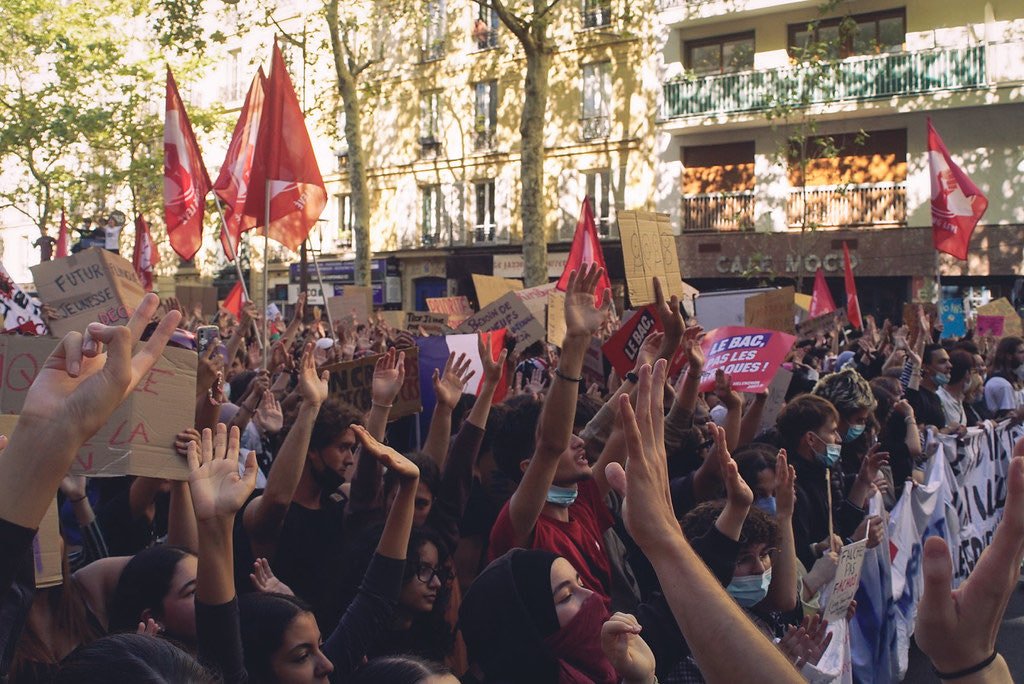
PARIS: France’s schools have become the latest battleground in a country already facing political uncertainty, fiscal pressure and deep public frustration. More than 250,000 people took to the streets across France on October 6, turning a student-led campaign over deteriorating school conditions into a nationwide protest movement that is increasingly challenging the government’s ability to balance public order with demands for greater investment in education, according to government figures and reporting reviewed by Media.

The demonstrations, which began with school blockades in the Paris region in September, have spread across the country. Students, teachers, parents and unions are demanding better-funded schools, more teachers, safer and properly maintained buildings, and greater equality between affluent and disadvantaged communities. In Paris and several other cities, largely peaceful demonstrations were punctuated by clashes between protesters and riot police. Officers used tear gas to disperse crowds, while hundreds of people were detained during Tuesday’s nationwide mobilization. The Interior Ministry estimated that 256,000 people participated nationwide, including 56,000 in Paris.
What began as an education dispute is now becoming a wider political test for the French government.
Students have complained about teacher shortages, overcrowded classrooms, deteriorating infrastructure, unequal educational opportunities and demanding school schedules. Some schools have reportedly faced basic infrastructure problems, reinforcing the perception among protesters that public education has been allowed to deteriorate. The timing is particularly difficult for the government. France is approaching another presidential election, while the administration is simultaneously confronting weak economic growth, high public debt and pressure to control public expenditure. That leaves Prime Minister Sébastien Lecornu with limited room to satisfy demands that could require substantial new public investment.
Yet the political cost of inaction may ultimately be higher.
The government has acknowledged that students’ concerns are legitimate. Lecornu has promised proposals by the end of October addressing issues including school buildings and teacher availability, insisting that solutions must be concrete and fully funded. Student representatives, however, have criticized the absence of immediate commitments. The widening gap between government assurances and visible improvements could transform a protest over school conditions into a broader expression of political distrust.
The most politically sensitive dimension of the crisis is increasingly the use of force.
The controversy intensified after a 15-year-old boy lost his hand during a confrontation involving police in Lens. Authorities have not yet established all the circumstances surrounding the incident, and investigations are underway. Interior Minister Laurent Nuñez subsequently ordered a temporary suspension of stun-grenade use in the high-school protest movement pending clarification of what happened.
The government argues that police intervention has been necessary when demonstrations have involved violence, vandalism or attacks on officers. At the same time, rights groups, unions and opposition politicians have questioned whether some crowd-control tactics have been disproportionate. Nuñez has said 18 incidents have been referred for investigation, while hundreds of police officers have also reportedly been injured during the unrest.
The political danger for Paris is clear: an education protest can be negotiated, but a confrontation over police legitimacy is considerably harder to contain.
There is also evidence that the students’ concerns reflect a deeper problem within French education. The OECD’s PISA 2025 results show that French 15-year-olds recorded weaker performance in mathematics and reading compared with earlier assessments, while France continues to face significant disparities in educational outcomes linked to socioeconomic background. The figures do not prove that every complaint made by protesters is justified, but they reinforce the argument that France faces a genuine educational challenge rather than merely a temporary political disturbance.
The issue is also one of equality. Socioeconomic circumstances continue to have a significant influence on educational outcomes, raising questions about whether France’s education system is providing comparable opportunities to students regardless of where they live or their family circumstances.
For young protesters, therefore, the debate is not simply about classrooms. It is about whether the state is providing them with a credible pathway into adulthood. President Emmanuel Macron cannot seek a third consecutive term, but the political consequences of the unrest will extend well beyond his presidency. France’s political establishment faces a familiar dilemma: respond forcefully and risk deepening resentment, or compromise and risk appearing unable to maintain public order. The government has already attempted to address the movement by creating an online platform through which students can anonymously report problems and propose changes. But symbolic gestures will not be enough if young people continue to encounter understaffed schools, ageing facilities and unequal opportunities.
Meanwhile, the destruction of schools presents another contradiction. Twenty-four high schools have reportedly suffered fire or vandalism serious enough to keep them closed for weeks, potentially affecting around 30,000 students, with repair costs estimated at up to €30 million. Such damage risks undermining public sympathy for the movement even as many people continue to support the substance of students’ demands.
A reported Elabe poll for BFM TV found that 72% of French people considered the students’ demands legitimate, although 55% believed the protests should end. That distinction is important. French society appears sympathetic to the message but increasingly uncomfortable with the methods being used to deliver it.
The deeper lesson is that education has become a proxy for France’s broader struggle over opportunity, public services and trust in government. Students are asking whether the state can deliver the basics. Parents are asking whether their children will receive better opportunities than previous generations. Teachers are demanding workable conditions. And politicians are confronting the increasingly expensive consequences of accumulated pressures on public services.
The government can restore order with police. It cannot restore confidence with tear gas.
France now needs to demonstrate that listening to its youngest citizens means more than managing the streets. It means rebuilding classrooms, strengthening teaching capacity, addressing inequality and protecting the right to peaceful protest while firmly responding to violence and destruction. The education crisis may have started at school gates. Politically, however, it has already moved far beyond them. The question confronting France is no longer simply how to stop the protests. It is whether the state can convince a generation of young citizens that their future is worth investing in.
–Christopher Freed