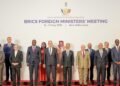




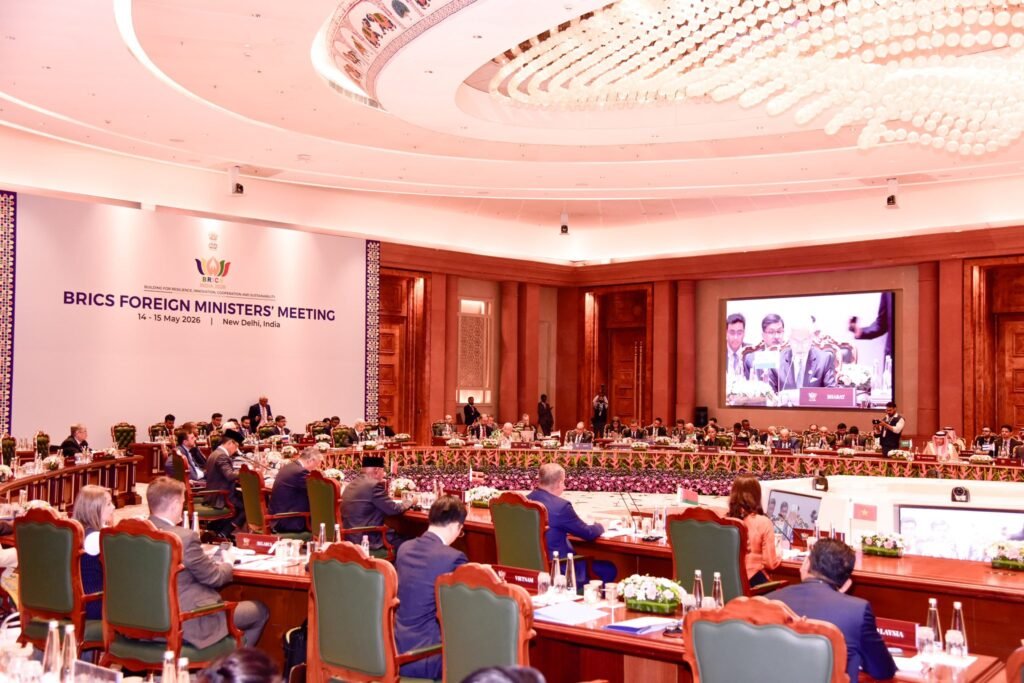
NEW DELHI, India: The opening day of the BRICS Foreign Ministers’ Meeting 2026 in New Delhi may ultimately be remembered less for its formal diplomatic language and more for what it revealed about the accelerating transformation of the international system itself. Beneath carefully crafted statements on cooperation, sustainability, innovation, and resilience lay a deeper geopolitical message: the emerging powers of the Global South are no longer merely demanding reform of the existing order, they are gradually preparing to build parallel centers of global influence.
At twenty years of existence, BRICS is entering perhaps the most consequential phase in its evolution. What began as an economic grouping of major emerging economies has now become an increasingly political platform shaped by dissatisfaction with Western dominance over global governance, finance, trade architecture, technology standards, and strategic decision-making. The New Delhi ministerial demonstrated that the bloc is moving beyond symbolic resistance toward institutional ambition.
India’s External Affairs Minister S. Jaishankar articulated this transition with unusual clarity. His statement that “BRICS must move beyond being a forum for discussion and become a platform for delivery” was not simply a diplomatic slogan. It reflected a growing realization among BRICS members that the credibility of the grouping will no longer be measured by declarations of intent or rhetorical solidarity, but by its ability to produce alternative mechanisms of power, finance, development, and governance.
That distinction matters enormously in the current geopolitical climate. The world entering 2026 is structurally different from the world in which BRICS was founded in 2006. Globalization is fragmenting into competing geopolitical and economic spheres. Supply chains are increasingly securitized. Technology has become a strategic weapon. Energy transitions are reshaping alliances. Financial sanctions have emerged as instruments of geopolitical coercion. Institutions created in the post-World War II order are facing growing legitimacy crises among developing nations that believe they remain underrepresented in decision-making structures.
Against this backdrop, BRICS is attempting to redefine itself not simply as a coalition of emerging economies but as an institutional expression of multipolarity.
Jaishankar’s repeated emphasis on “resilience, innovation, cooperation, and sustainability” therefore carried a deeper strategic meaning than the developmental language initially suggests. Resilience, in today’s geopolitical vocabulary, increasingly refers to reducing dependence on vulnerable global systems dominated by rival powers. Innovation is no longer merely technological advancement; it is strategic competitiveness in artificial intelligence, digital governance, semiconductors, fintech, and industrial ecosystems. Cooperation increasingly means building intra-BRICS and Global South connectivity independent of Western-centered frameworks. Sustainability extends beyond climate concerns into long-term economic and political survivability in an era of disruption.
India’s approach to BRICS in New Delhi revealed a calibrated attempt to balance three overlapping strategic objectives simultaneously. First, New Delhi seeks to position itself as the principal political bridge between developed economies and the Global South. Second, it aims to shape BRICS into a pragmatic, development-oriented platform rather than an overtly anti-Western bloc. Third, India is using the grouping to reinforce its own emergence as a leading power within a multipolar international structure.
This balancing act explains the careful tone of India’s messaging. Unlike some members that frame BRICS primarily as a counterweight to Western power, India continues to present the grouping as an inclusive platform based on “mutual respect and sovereign equality.” Yet beneath the moderate rhetoric, India’s strategic calculations are unmistakable. As geopolitical competition intensifies between major powers, New Delhi increasingly sees diversified partnerships and institutional pluralism as essential to preserving strategic autonomy.
Iranian Foreign Minister Abbas Araghchi delivered perhaps the most ideologically direct intervention of the day. His call for ending Western hegemony and preventing “political manipulation” of international institutions reflected the perspective of states that view the current order not merely as unequal but structurally coercive. For Iran, BRICS represents more than an economic platform; it is part of a broader geopolitical effort to reduce vulnerability to sanctions, financial isolation, and diplomatic containment.
Araghchi’s remarks resonated because they tapped into a wider frustration across many developing nations. Increasingly, countries in the Global South argue that international norms are selectively enforced, global financial systems are disproportionately influenced by Western interests, and geopolitical crises are interpreted through unequal standards of legitimacy. Whether universally accepted or not, this perception is becoming a major driver behind the growing appeal of alternative institutions and coalitions.
China’s participation also drew attention, although Chinese Foreign Minister Wang Yi did not attend the New Delhi meeting. China was represented by Ambassador Xu Feihong while Wang Yi remained in Beijing during U.S. President Donald Trump’s visit to China. Beijing nevertheless reiterated its support for multilateralism, economic cooperation and expanded engagement with the Global South.
China continues to view BRICS as an important platform for strengthening economic ties across Asia, Africa, Latin America and the Middle East. Beijing has also strongly supported BRICS expansion in recent years.
For Beijing, BRICS also serves another function: mitigating strategic pressure from the United States and its allies by strengthening alternative economic and diplomatic networks across Asia, Africa, Latin America, and the Middle East. This explains China’s strong support for BRICS expansion and broader Global South engagement.
Russia’s Foreign Minister Sergey Lavrov reinforced similar themes but from the perspective of geopolitical confrontation with the West. Lavrov argued that “the architecture of global governance can no longer reflect the realities of the twentieth century,” while advocating greater use of national currencies, alternative payment systems, and independent financial mechanisms.
For Moscow, BRICS has become strategically vital following years of Western sanctions and diplomatic isolation. Russia increasingly sees multipolarity not simply as an ideological concept but as a geopolitical necessity for preserving strategic relevance and economic resilience.
Yet despite shared rhetoric on multipolarity, BRICS remains far from a unified geopolitical bloc. Internal contradictions persist. India and China continue to compete for influence across Asia. Brazil’s priorities remain heavily centered on development and climate governance. South Africa focuses on representation and infrastructure partnerships for Africa. Gulf and Middle Eastern entrants bring entirely different strategic calculations linked to energy markets and regional security.
This diversity simultaneously strengthens and complicates BRICS. Unlike military alliances built around ideological conformity, BRICS derives legitimacy precisely from its heterogeneity. It represents countries with different political systems, civilizations, economic models, and strategic orientations united primarily by a shared desire for greater representation and policy autonomy within the international system.
The challenge now is whether that shared dissatisfaction can evolve into coherent institutional capability.
The repeated references in New Delhi to the New Development Bank and the Contingent Reserve Arrangement were therefore highly significant. These institutions symbolize BRICS’ ambition to move from critique to construction from protesting the inequities of the existing order to creating alternatives that can function independently and credibly.
This institutional dimension may ultimately determine the future significance of BRICS more than summit declarations themselves. If the bloc succeeds in deepening trade settlement mechanisms, infrastructure financing, technological cooperation, development partnerships, and strategic connectivity, it could gradually reshape the balance of global influence. If it fails to translate political rhetoric into operational coordination, it risks remaining an aspirational coalition constrained by its internal divergences.
What became increasingly clear in New Delhi, however, is that the demand for multipolarity is no longer confined to diplomatic speeches. It is now tied directly to economic security, technological sovereignty, supply-chain resilience, development financing, energy transitions, and geopolitical survival.
The BRICS meeting in New Delhi was therefore not merely about commemorating twenty years of a grouping. It reflected the early institutional contours of a world moving away from singular centers of power toward a far more fragmented, competitive, and decentralized international order.
Whether BRICS can truly become one of the principal architects of that emerging order remains uncertain. But after the opening day in New Delhi, one conclusion appears increasingly difficult to ignore: the geopolitical center of gravity is gradually shifting, and the Global South intends to play a far larger role in determining where it ultimately settles.
-Dr. M Shahid Siddiqui
READ THE FULL E-MAGAZINE | WorldAffairs: For Decision-Makers Who Need More Than Headlines