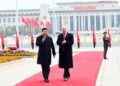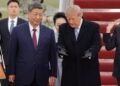



WASHINGTON/BEIJING: The image was carefully choreographed. The ceremony opened with the American national anthem and a 21-gun salute. U.S. President Donald Trump stood saluting while Chinese President Xi Jinping watched beside him. Then came the Chinese anthem, the red-carpeted steps of the Great Hall of the People, synchronized schoolchildren waving flags, soldiers carrying the banners of both nations, and the unmistakable symbolism of two rival powers attempting to project stability amid a rapidly fragmenting world order.
But beyond the carefully staged diplomacy in Beijing lies a far more consequential reality: the expanding U.S.-Israeli confrontation with Iran is now reshaping global geopolitics, accelerating new alignments across the Middle East, and pushing China into the center of a strategic crisis it can no longer comfortably avoid.
The timing of Trump’s China visit could hardly be more significant. While trade, tariffs, and technological rivalry remain important, the shadow hanging over the summit is unmistakably the Iran conflict and the growing instability surrounding the Strait of Hormuz, the world’s most strategically important energy chokepoint.
What is unfolding is not merely another regional war. It is the emergence of a new geopolitical architecture.
For decades, the Middle East operated under a relatively predictable security order dominated by the United States. Washington guaranteed Gulf security, protected shipping lanes, and acted as the principal external arbiter of regional power balances. That system is now visibly under strain. The Iran war has exposed the limitations of American power while simultaneously encouraging regional actors to diversify their strategic options. The reported, though denied, contacts between Israel and the United Arab Emirates demonstrate how Gulf states increasingly view security cooperation with Israel as a strategic necessity rather than a political liability. The Abraham Accords, once seen largely as diplomatic normalization agreements, are evolving into the foundations of a broader anti-Iran security framework.
At the same time, the conflict has also revealed the fragility of these alignments. Iran’s harsh warnings toward the UAE underline how vulnerable Gulf states remain to retaliation. Tehran’s strategy is clear: raise the costs of regional cooperation with Israel high enough to fracture the coalition forming against it. Saudi Arabia’s alleged military operations against Iran-backed militias in Iraq further indicate that Gulf states are becoming more directly involved in regional confrontation than publicly acknowledged. This is a profound shift. For years, many Gulf governments preferred indirect engagement and strategic ambiguity. The current conflict appears to be eroding that caution. Yet the most important development may not be military at all. It is economic and maritime.
Iran’s tightening grip over the Strait of Hormuz represents one of the most consequential strategic moves in recent years. Control over the waterway offers Tehran leverage not only over oil markets but also over global supply chains, shipping insurance, commodity prices, and energy security calculations from Asia to Europe.
Iranian officials openly describing the strait as a long-term revenue and leverage mechanism signals a major doctrinal evolution. Tehran increasingly sees maritime control not simply as deterrence, but as geopolitical power projection.
This explains why the war is drawing China deeper into the crisis.
China’s economic rise depends heavily on stable energy imports from the Gulf. Beijing has long attempted to balance close relations with Iran, Saudi Arabia, and the UAE simultaneously while avoiding direct entanglement in regional conflicts. But that balancing strategy is becoming harder to sustain. Trump’s visit to Beijing is therefore not only about diplomacy, it is also about pressure.
Washington wants China to use its influence over Tehran to restrain Iranian escalation and preserve freedom of navigation in the Persian Gulf. Secretary of State Marco Rubio made that objective explicit when he warned that any Chinese support for Iran would damage U.S.-China relations. The message is unmistakable: neutrality is becoming unacceptable in an increasingly polarized geopolitical environment.
China now faces a strategic dilemma. Supporting Iran too openly risks worsening tensions with Washington and threatening access to Western markets at a time of economic slowdown. Distancing itself from Tehran, however, could weaken Beijing’s influence across the Global South and undermine its carefully cultivated image as an alternative power center independent of American alliances.
The symbolic significance of the Chinese supertanker crossing the Strait of Hormuz during the crisis should therefore not be underestimated. It reflects Beijing’s determination to demonstrate continuity in energy flows and strategic confidence despite mounting instability. But it also highlights a deeper truth: China’s era of enjoying the benefits of Middle Eastern stability without assuming major security responsibilities may be ending. Meanwhile, the global economic consequences are becoming increasingly severe. Energy markets are already reacting to supply disruptions, with fears of prolonged shortages driving volatility across oil and shipping sectors. If instability around Hormuz intensifies further, the effects will extend far beyond fuel prices. Food security, industrial production, fertilizer exports, and global inflation could all face renewed pressure.
This is why the current conflict matters far beyond the Middle East.
What is taking shape is a contest over the future structure of international order itself. The United States seeks to preserve a rules-based maritime system under its strategic leadership. Iran is attempting to leverage geography and conflict to reshape regional power balances. China wants stability without confrontation, influence without military entrapment, and energy security without alliance commitments. Those objectives may no longer be compatible.
The carefully choreographed ceremony in Beijing may project diplomatic calm, but the geopolitical reality is far more turbulent. Behind the red carpets and military bands lies a world entering a new phase of strategic fragmentation, one where wars are no longer confined to battlefields, but increasingly fought through shipping lanes, energy corridors, sanctions, alliances, and economic coercion.
The Iran conflict is no longer simply a regional crisis. It is becoming a defining test of how power, influence, and global order will be negotiated in the twenty-first century. And as Trump and Xi meet inside the Great Hall of the People, both leaders understand the same uncomfortable truth: the world is moving toward a more divided, militarized, and economically uncertain era and no major power can remain untouched by its consequences.
-Lewis, Ros and Daniel Weir