


NEW DELHI, India: At a moment when the international system is being reshaped by wars, trade fragmentation, artificial intelligence disruption, energy insecurity and industrial realignment, the Confederation of Indian Industry (CII) Annual Business Summit 2026 became far more than a domestic business gathering. It evolved into a revealing snapshot of how global policymakers, diplomats and industry leaders increasingly view India’s role in the emerging geopolitical and economic order.
What made the summit particularly significant was not merely the presence of Indian ministers or corporate executives, but the convergence of international voices from Europe, East Asia, Southeast Asia and global economic institutions, all reflecting a growing recognition that India is becoming central to future debates around manufacturing, trade, technology governance, energy resilience and strategic diversification. The summit’s underlying message was clear: as the world searches for stable economic anchors amid geopolitical volatility, India is positioning itself as both a market and a strategic platform.
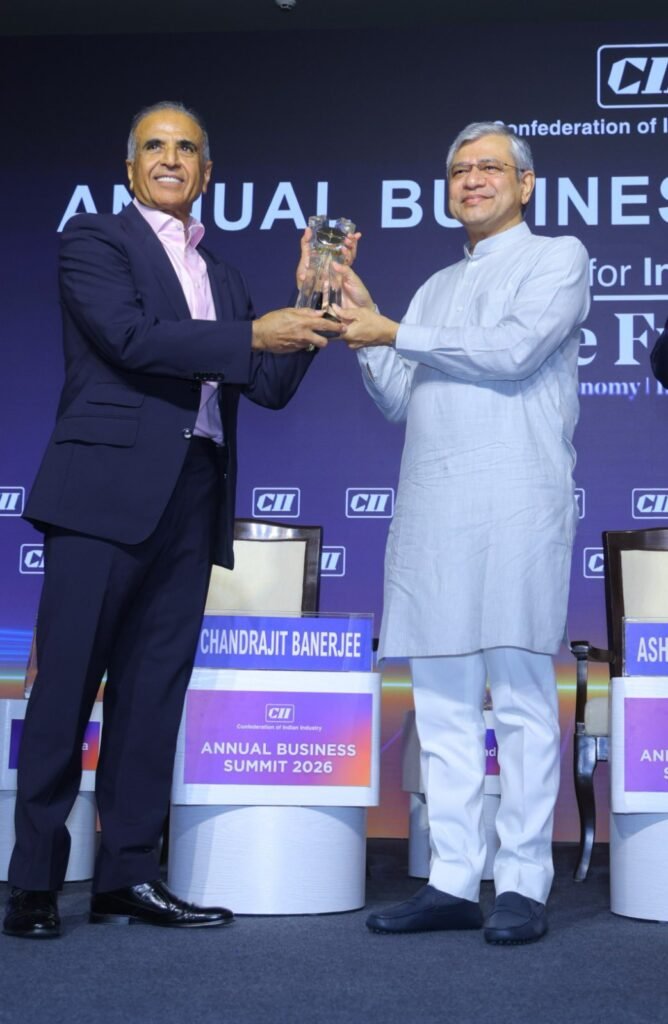
Ashwini Vaishnaw, India’s Union Minister for Railways; Electronics & Information Technology; and Information & Broadcasting, framed India’s transformation around three pillars rail infrastructure, electronics and semiconductors, and artificial intelligence. But the significance of these sectors extends well beyond domestic development priorities.
Around the world, governments and multinational corporations are increasingly reassessing supply-chain concentration risks exposed by the pandemic, geopolitical rivalries and disruptions in critical trade corridors. India’s push toward freight corridors, electronics manufacturing and semiconductor ecosystems reflects its attempt to capture this global industrial rebalancing.
The summit also demonstrated that international stakeholders increasingly see India as an indispensable participant in that transition.
Mr Hervé Delphin, Ambassador of the European Union to India, described trade as “a tool for stability,” arguing that diversification through Free Trade Agreements reduces economic dependence and strengthens global competitiveness. His remarks reflected the European Union’s broader strategic thinking, where economic engagement with India is increasingly viewed not only through commercial lenses but also as part of Europe’s effort to build resilient partnerships outside traditional dependency structures.
Delphin emphasized that the proposed India–EU Free Trade Agreement could significantly expand trade and investment ties while strengthening the strategic agenda between Brussels and New Delhi. In geopolitical terms, such agreements are no longer simply about tariffs. They are increasingly about trusted partnerships, technological alignment and long-term economic security.
This broader transformation in global trade policy was echoed by Ms Mikiko Tanaka, Head of the Subregional Office for South and South-West Asia at UNESCAP. Tanaka observed that modern Free Trade Agreements have evolved beyond tariff reduction mechanisms into multidimensional frameworks involving digital trade, labour standards, environmental sustainability and supply-chain resilience. Her remarks highlighted a critical reality of the post-pandemic economy: globalisation itself is not disappearing, but it is becoming more selective, strategic and politically shaped.
India’s ongoing trade engagements with the European Union, the United Kingdom, Oman and New Zealand therefore reflect a larger geopolitical repositioning. New Delhi increasingly seeks diversified economic linkages capable of insulating the country from external shocks while simultaneously expanding access to capital, technology and export markets.
The European dimension of this shift was reinforced further by Mr João Rui Ferreira, Secretary of State for the Economy of Government of Portugal, who argued that the India–Portugal relationship is no longer aspirational but operational.
Ferreira emphasized that Indian companies are increasingly choosing Portugal because of its engineering talent, institutional predictability and access to European markets. His remarks also reflected how smaller European economies increasingly see India as a long-term strategic economic partner rather than merely an emerging consumer market.
Portugal’s growing role within technology and innovation ecosystems was further highlighted by Ms Philomene Dias, Chief Investment Officer of AICEP Portugal Global. Dias pointed to Portugal’s startup ecosystem and university-driven AI innovation model, where artificial intelligence is increasingly integrated across multiple sectors through close collaboration between academia and industry. Her comments underscored a broader international trend: future industrial competitiveness will likely depend less on isolated national innovation and more on transnational ecosystems linking universities, startups, governments and advanced manufacturing networks. Artificial intelligence itself emerged as one of the summit’s defining geopolitical and economic themes.
Yet unlike the often polarised AI narratives emerging from the United States and China, discussions at the summit reflected a more governance-oriented and industrially pragmatic approach.
Mr Chan Meng Khoong, Chief Executive Officer of NUS-ISS, stressed that policy standards and governance frameworks are becoming essential as companies seek to deploy AI safely across industries.
“When we talk about AI, we have to take into consideration the norms and how companies can adopt AI safely,” Khoong observed, emphasizing that industrial AI adoption must be accompanied by institutional safeguards and strategic implementation. His remarks highlighted one of the central dilemmas now facing governments globally: how to balance technological acceleration with regulatory oversight and societal trust.
India appears increasingly interested in positioning itself within this debate as a country capable of combining technological scale with democratic governance frameworks, a positioning that may appeal to many developing economies seeking alternatives to both unregulated technological disruption and overly centralized digital control systems.
The summit also revealed how deeply energy security has become intertwined with geopolitical strategy.
Ambassador Sanjay Sudhir, former Ambassador of India to the UAE, argued that India must diversify beyond traditional energy dependency, expand Strategic Petroleum Reserves and strengthen long-term resilience through broader energy partnerships and infrastructure integration. His remarks reflected a growing consensus among policymakers worldwide that energy security can no longer be separated from national security or economic stability.
That concern has become particularly acute following continuing instability in West Asia, shipping disruptions and fluctuating energy prices.
Mr Tom Orlik, Chief Economist at Bloomberg, acknowledged that India has so far managed global volatility relatively effectively due to its refining capability, diversified sourcing strategy and fiscal flexibility.
“India has capable policymakers and sufficient fiscal space to absorb uncertain shocks,” Orlik stated, suggesting that India’s macroeconomic management has strengthened its resilience amid global uncertainty.
Meanwhile, discussions on clean energy transition increasingly framed renewable infrastructure not merely as climate policy but as industrial strategy and geopolitical insurance. The transition toward renewable energy, green hydrogen, storage systems and electrification is increasingly being treated as part of a broader effort to reduce import vulnerability while simultaneously creating new industrial ecosystems.
The summit also showcased the expanding strategic convergence between India and advanced Asian industrial economies.
Mr Stephen Kim, Chief Executive Officer of DeltaX Company Limited, South Korea, argued that future India–South Korea relations would increasingly revolve around AI infrastructure, advanced manufacturing systems and next-generation industrial innovation. His comments reflected how Asian economies increasingly view India as a potential long-term technology and manufacturing partner within evolving Indo-Pacific industrial architectures.
Similarly, Dr George Young, Vice President at Rockwell Automation, United States, emphasized that advanced manufacturing globally is shifting from isolated digital experimentation toward long-term operational transformation powered by AI, IoT systems and workforce integration. Young stressed that technology transformation must remain human-centric, requiring simultaneous investment in workforce upskilling alongside industrial automation. That emphasis is particularly important for India, where policymakers are attempting to balance automation-driven competitiveness with large-scale employment generation and workforce inclusion.
The summit even extended discussions beyond urban industrial transformation toward questions of digital inclusion and rural resilience.
Mr Luis Guimaraes, Chief Commercial Officer of Portugal’s Development Bank (BPF), argued that access to technology increasingly provides dignity, mobility and economic participation for populations previously isolated from broader economic systems.
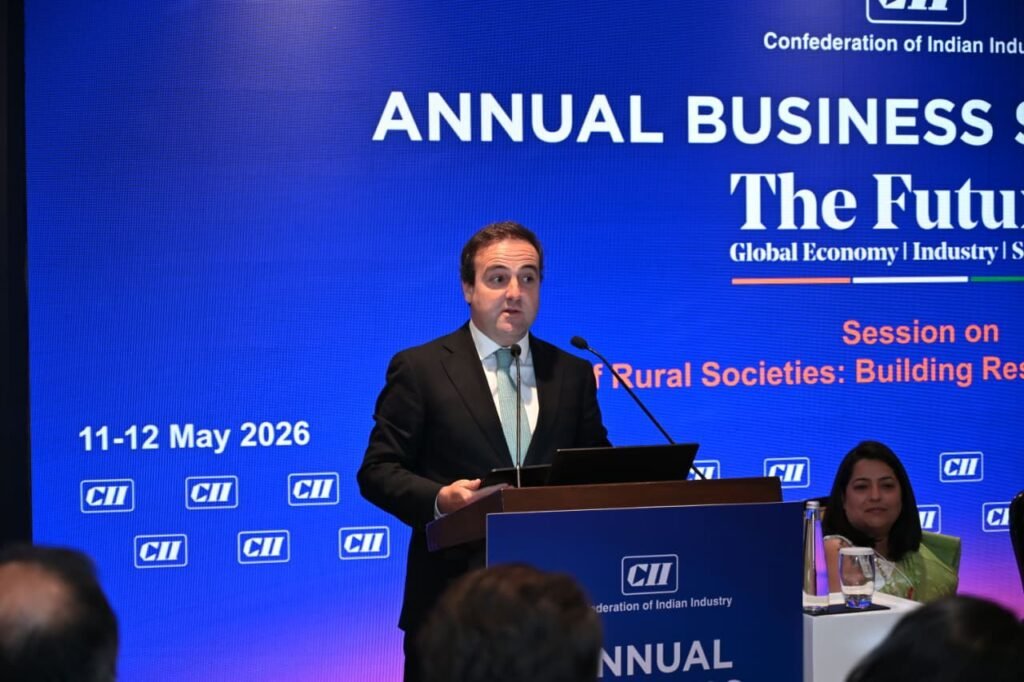
His remarks reflected the widening international recognition that digital infrastructure is becoming as socially transformative as physical infrastructure.
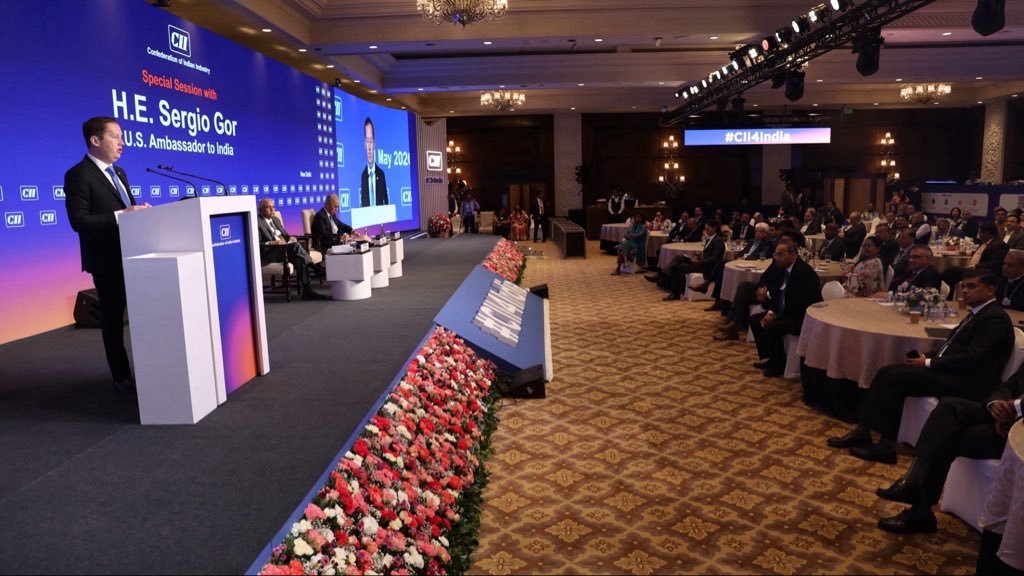
Meanwhile, U.S. Ambassador Sergio Gor highlighted the strengthening trajectory of U.S.–India economic relations, emphasizing trade expansion, regulatory cooperation and growing two-way investment opportunities between the two democracies. Taken together, the international interventions at the CII Summit 2026 revealed something deeper than routine diplomatic optimism They demonstrated that many global actors increasingly view India not simply as a fast-growing market, but as a pivotal balancing power in an unstable global system.
The world economy is entering an era where resilience, technological sovereignty, diversified supply chains and trusted partnerships may matter as much as efficiency and scale.
India’s leadership appears acutely aware of this transition.
The CII Summit ultimately reflected a country attempting to simultaneously industrialize, digitize, decarbonize and expand geopolitical influence while navigating one of the most uncertain international environments in decades. Whether India can fully realize that ambition remains uncertain. Structural challenges remain substantial. But the summit demonstrated that the conversation around India has fundamentally changed.
India is no longer being discussed only as an emerging economy. Increasingly, it is being discussed as a system-shaping power.
– Dr. M Shahid Siddiqui