



ASTANA, Kazakhstan: The Regional Ecological Summit 2026 marks a pivotal moment not because Central Asia lacks environmental forums, but because it has too many that have failed to deliver structural change. What is unfolding in Astana is an attempt to elevate ecological stress from a technical concern to a defining pillar of regional politics.
Backed by the United Nations and convening an unusually broad coalition of leaders, institutions, and financial actors, the summit reflects a growing recognition: environmental breakdown in Central Asia is no longer a peripheral issue. It is reshaping national security, economic planning, and interstate relations.
President Kassym-Jomart Tokayev first proposed this initiative at the United Nations in 2023, but its evolution into a comprehensive ecological platform reveals a deeper strategic recalibration. This is not merely about climate change in isolation. It is about integrating water security, energy transition, food systems, and public health into a single geopolitical framework.
That shift is overdue.
Central Asia today faces a convergence of environmental threats with few global parallels. Water scarcity remains the most destabilizing. The long-term collapse of the Aral Sea managed under institutions like the International Fund for Saving the Aral Sea continues to reshape livelihoods and ecosystems. Meanwhile, upstream interventions such as Afghanistan’s Qosh Tepa Canal threaten to reduce downstream water availability, adding a new layer of uncertainty to an already fragile system.
Air pollution presents a parallel crisis. Heavy reliance on coal has pushed several regional cities into the upper tiers of global pollution rankings, with public health consequences that are only beginning to be fully understood. Desertification, sandstorms, and glacier retreat further compound the pressure, creating a feedback loop of ecological degradation.
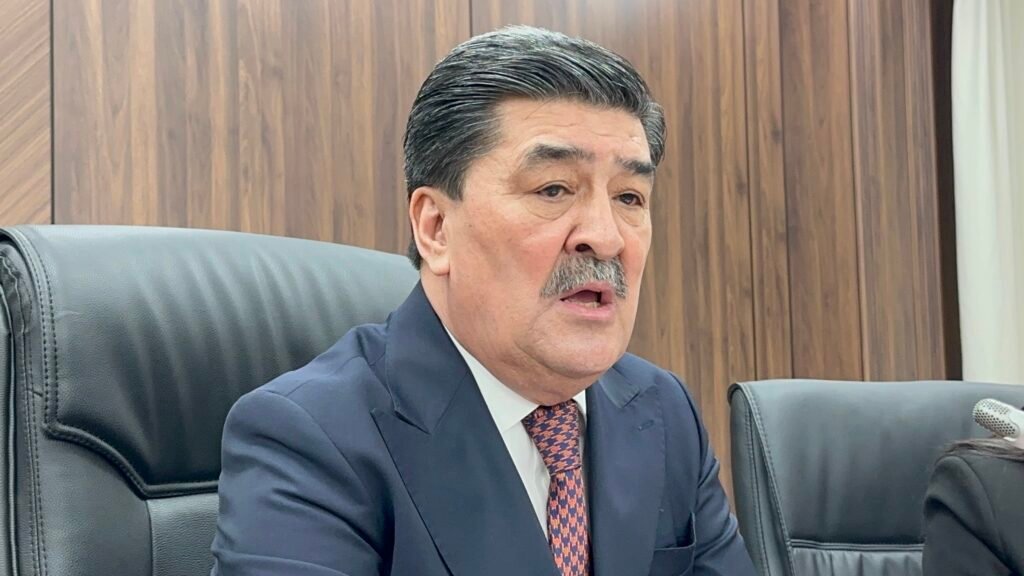
Kazakhstan’s Minister of Ecology and Natural Resources, Yerlan Nyssanbayev, framed the stakes with unusual clarity ahead of the summit:
“Central Asia stands at a decisive ecological crossroads. The scale of environmental challenges demands not fragmented national responses, but coordinated regional action with concrete, measurable outcomes.”
He further emphasized the urgency of implementation over rhetoric, stating:
“Our priority is to transform dialogue into practical cooperation through joint projects, green investment mechanisms, and long-term policy alignment across the region.”
These statements capture the summit’s central ambition: to move beyond declarations toward enforceable cooperation. Yet they also expose its central dilemma.
For all the urgency expressed, policy signals across the region remain inconsistent. Kazakhstan itself embodies this contradiction advancing renewable energy and exploring nuclear power while simultaneously planning new coal-fired plants. Other Central Asian states display similar dualities, endorsing sustainability in principle while delaying the structural reforms required to achieve it.
This tension is not accidental; it reflects the region’s development model. Economic growth, energy security, and political stability remain immediate priorities, often outweighing long-term environmental considerations. As Tokayev himself has argued in previous international forums, climate action must remain “balanced and inclusive,” accommodating national development needs, a formulation that, in practice, tends to favor gradualism.
The Astana summit attempts to resolve this tension by reframing environmental cooperation as an economic opportunity rather than a constraint. Climate finance, ESG frameworks, and green technology investment are being positioned as incentives to drive compliance. The presence of international lenders and development institutions underscores this approach: sustainability is being monetized as a pathway to alignment.
Still, structural obstacles remain formidable.
Regional environmental challenges are inherently transboundary, but political systems remain nationally focused. Water-sharing agreements require trust that is often in short supply. Data transparency remains uneven. Existing mechanisms from water commissions to recurring climate conferences have struggled to enforce commitments or coordinate policy effectively.
The broader geopolitical environment only complicates matters. External shocks, including environmental fallout from conflicts beyond the region, highlight Central Asia’s vulnerability to forces it cannot control. Yet internal coordination remains insufficient to mount a unified response.
This is where Astana’s ambition becomes strategic. By positioning itself as a convening hub for environmental diplomacy, Kazakhstan is seeking to shape not just outcomes, but the architecture of regional cooperation itself. The summit is as much about influence as it is about ecology.
The likely outcome will include a Joint Declaration and a 2026–2030 Programme of Action developed in partnership with the United Nations. These frameworks could provide a foundation for long-term coordination, if they are backed by political will and institutional follow-through.
But that remains the critical uncertainty.
Central Asia has reached a point where environmental stress is no longer a slow-moving crisis; it is an active force reshaping governance and regional dynamics. The question is not whether the threats are understood they are. The question is whether governments are prepared to make the difficult, often costly decisions required to address them.
The Regional Ecological Summit 2026 offers a rare opportunity to bridge that gap between awareness and action. Whether it succeeds will determine if Astana becomes the starting point of a new regional compact or just another stage where urgency is acknowledged but deferred.