



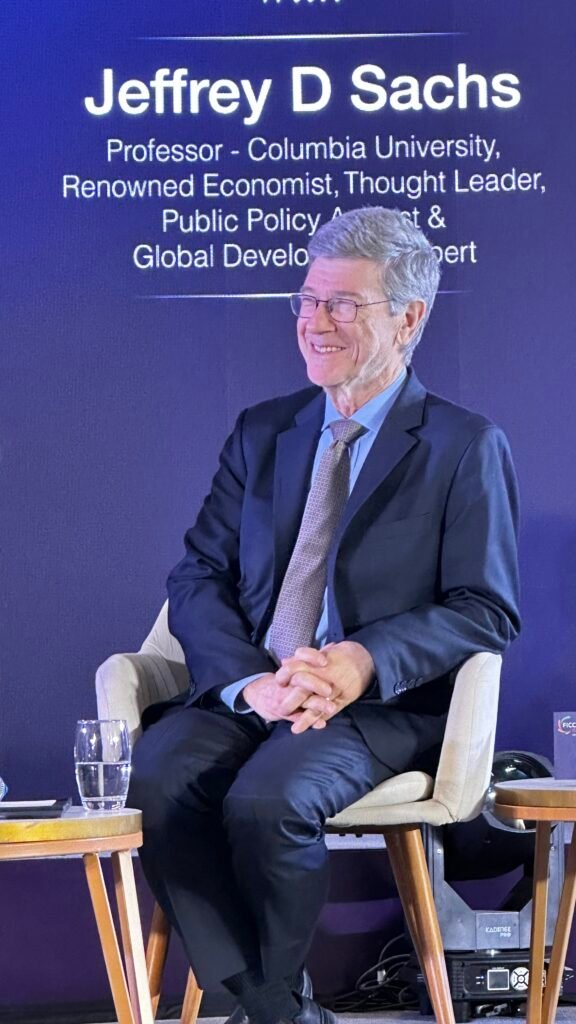
NEW DELHI, India: When Jeffrey Sachs spoke at a recent dialogue hosted by FICCI, he offered something rare in today’s geopolitical discourse: a coherent argument that ties economic destiny to strategic restraint. His central claim is both optimistic and cautionary, India can become a developed nation by 2047, but only if it resists the gravitational pull of great-power alignments.
Sachs’ confidence in India’s growth trajectory is not rhetorical. It rests on structural fundamentals demographics, digitalization, infrastructure expansion, and integration into global value chains. In his framing, the vision of “Viksit Bharat 2047” is achievable if India maintains policy continuity and prioritizes development over geopolitical entanglement. But this is precisely where his argument sharpens: economic rise and strategic alignment do not always move in tandem. In fact, the latter can undermine the former.
At the heart of his critique is India’s participation in the Quadrilateral Security Dialogue. Sachs views the Quad not merely as a cooperative platform, but as part of a broader U.S.-led architecture that risks deepening polarization, particularly vis-à-vis China. His warning is direct, India should not be part of any effort that is overtly anti-China, nor should it align itself with Washington’s strategic agenda.
This position is rooted in a longer historical arc. India, Sachs reminds, was a principal architect of the Non-Aligned Movement, a doctrine designed to preserve autonomy in a bipolar world. Today’s multipolar reality, he argues, makes that doctrine even more relevant. The strategic advantage lies not in choosing sides, but in retaining the ability to engage all sides simultaneously.
Yet Sachs’ analysis extends beyond India’s foreign policy. His remarks on the UAE’s evolving posture within OPECreveal a broader concern about the erosion of coordination in global systems. He described the UAE’s signaling as a potential misstep, not because autonomy is undesirable, but because unilateral recalibration in tightly coupled systems like energy markets can trigger disproportionate instability.
In Sachs’ reading, energy geopolitics has long depended on managed cooperation. When key actors begin to deviate without a stabilizing framework, volatility is no longer cyclical, it becomes structural. The implication is significant: as energy coordination weakens, its ripple effects extend into trade balances, currency stability, and geopolitical leverage. What appears as a national strategy can, in fact, accelerate systemic fragmentation.
This theme of avoidable disruption carries into his assessment of current global conflicts. Sachs was unequivocal in describing today’s war environment as one that “was not supposed to happen.” The phrase is more than rhetorical—it is analytical. He attributes ongoing conflicts not to inevitability, but to accumulated policy failures: missed diplomatic windows, overreliance on deterrence, and the steady erosion of multilateral problem-solving.
His critique of Donald Trump fits into this broader diagnosis. Sachs argues that the normalization of unilateral, transactional foreign policy, exemplified during Trump’s tenure has weakened global institutions and reduced the space for coordinated action. The consequence is a world where unpredictability is no longer an exception but a baseline condition, increasing the likelihood of miscalculation and escalation.
Taken together, these strands form a unified thesis. The global order is not simply evolving, it is fragmenting under the weight of strategic overreach and institutional decay. India, in Sachs’ view, stands out as a potential counterweight to this trend, not by asserting dominance, but by embodying balance.
This is why he frames India as a “pillar of global stability and peace.” It is also why he argues that India’s global role must expand beyond economics into institutional leadership. His call for India’s permanent membership in the UN Security Council potentially supported by China is not incidental. It reflects a belief that global governance structures must adapt to contemporary realities, and that India is central to that recalibration.
But Sachs’ argument is not without tension. India’s security environment, particularly in relation to China, complicates the case for strategic distance. The Quad offers tangible benefits defence cooperation, technological partnerships, and a degree of deterrence. Walking away from such frameworks is neither simple nor necessarily prudent.
What Sachs proposes, however, is not withdrawal but recalibration. Engagement without entanglement. Cooperation without alignment. The distinction is subtle but decisive. It allows India to leverage partnerships while preserving the flexibility to pivot as conditions evolve.
The deeper question, then, is not whether India should be part of the Quad or engage with the United States. It is whether these engagements are shaping India’s trajectory or constraining it. Sachs’ warning is that in a world increasingly defined by blocs, the real power lies in resisting binary choices.
For India, the stakes are unusually high. Its path to becoming a developed nation by 2047 is not just an economic journey; it is a strategic one. Growth requires stability, and stability increasingly depends on navigating a fragmented global landscape without being subsumed by it.
Sachs’ intervention at FICCI ultimately reframes the debate. It shifts the focus from alignment to agency, from participation to purpose. In doing so, it presents a demanding but compelling proposition: India’s rise will not be defined by the alliances it joins, but by the independence it sustains.
-Dr. M Shahid Siddiqui