





TEHRAN, Iran/ NEW DELHI, India: The most consequential development in the BRICS financial debate may not be the creation of a common currency. It may be something quieter, more technical and ultimately more consequential: the construction of alternative financial infrastructure that allows countries to trade, settle payments and move capital without depending entirely on established Western financial channels. For years, discussions around BRICS and the global financial order have focused heavily on the possibility of a BRICS currency challenging the US dollar. But that framing misses a more fundamental reality. Financial power does not rest only on the currency in which transactions are denominated. It rests on the networks through which money moves, the banks that clear transactions, the systems that transmit payment instructions, the liquidity available to settle obligations and the institutions that provide confidence. The real contest may therefore be less about replacing the dollar than about creating enough alternatives to make dependence on any single financial system less necessary.
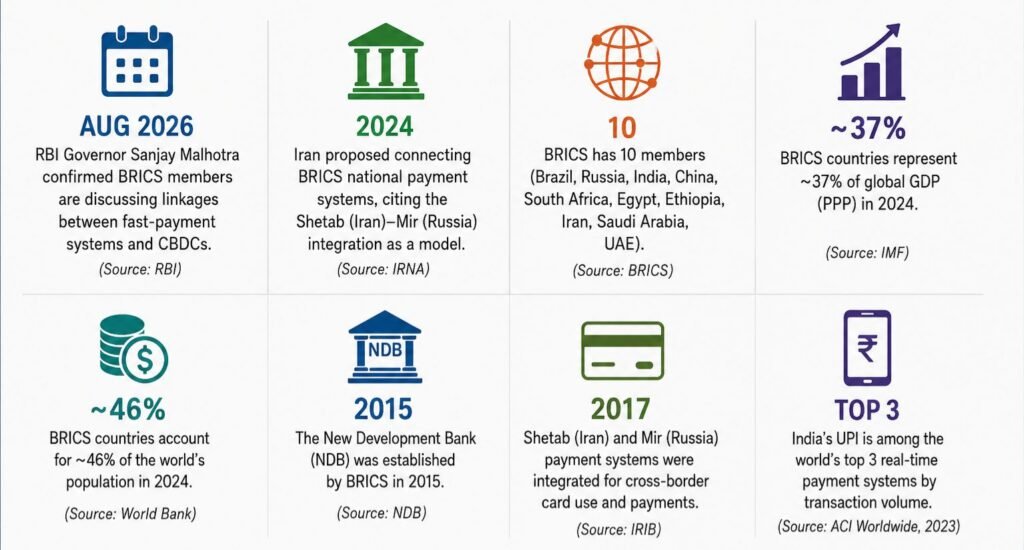
Iran’s proposal to connect the national payment systems of BRICS members has acquired new significance precisely because the wider BRICS discussion is moving from political ambition toward practical infrastructure. In August 2026, Reserve Bank of India Governor Sanjay Malhotra confirmed that BRICS members were discussing linkages between fast-payment systems and central bank digital currencies, with the goal of making cross-border payments faster, more efficient and less costly. He also reiterated India’s interest in expanding the use of local currencies in international trade and payments. The development is important because it moves the debate away from the symbolism of creating an alternative monetary order and toward the much harder question of how such an order could actually function in the real economy. A currency can be announced relatively easily. Building the infrastructure that enables millions of businesses, banks and individuals to use it across borders is an entirely different challenge.
Iran first proposed connecting the national payment systems of BRICS members in 2024, drawing attention to the integration of Russia’s Mir and Iran’s Shetab systems as a possible model. The significance of that experience lies in its practical character. Neither country needed to create a new currency, establish a common central bank or surrender monetary sovereignty. Instead, they sought to make their domestic payment infrastructures interact with each other. Expanding such an arrangement across BRICS would be far more complicated, given the diversity of its members, currencies, regulatory systems and economic structures. Yet the underlying principle is powerful. Countries do not necessarily need to abandon their national currencies to reduce dependence on external financial infrastructure. They can begin by creating direct and interoperable channels through which their existing currencies and payment systems can interact.
This is why the familiar question of whether BRICS intends to “replace the dollar” is increasingly inadequate. The more important question is whether BRICS can create enough financial optionality to reduce dependence on any single currency, banking network or payment architecture. That distinction could define the next stage of global financial competition. The dollar’s international dominance is not sustained simply because countries prefer to hold dollars. It is supported by a vast ecosystem of correspondent banking, payment networks, clearing arrangements, deep capital markets, liquidity, financial messaging systems and institutional trust. The network reinforces itself: widespread use creates liquidity, liquidity encourages more use, and the resulting scale makes the system difficult to replicate. Challenging that dominance therefore requires much more than encouraging trade in national currencies. It requires building alternative channels through which international transactions can actually be executed, cleared and settled.
Iran’s experience makes the strategic importance of this issue particularly clear. For years, Tehran has operated under extensive international financial restrictions, giving it an unusually direct understanding of the vulnerabilities associated with dependence on external financial infrastructure. For Iran, developing alternative payment mechanisms is not simply an ideological campaign against the dollar. It is a practical response to the risk that access to conventional international channels can be restricted by geopolitical decisions. This gives Tehran a different perspective from many other BRICS members. While some countries view financial diversification primarily as a way to increase strategic autonomy, Iran has experienced financial isolation as an operational reality. Its proposal therefore reflects not only geopolitical ambition but also accumulated experience with the consequences of financial dependence.
India’s role could be especially significant because New Delhi approaches the question from a very different position. India remains deeply integrated into Western financial markets and has no obvious interest in dismantling the existing global financial system. Its approach is better understood as diversification rather than confrontation. India’s experience with digital payments, particularly the rapid expansion of its domestic real-time payment ecosystem, gives it considerable practical relevance in discussions about cross-border payment interoperability. The RBI’s confirmation that BRICS members are exploring linkages between fast-payment systems and CBDCs suggests that the conversation is increasingly focused on connecting existing national infrastructures rather than imposing a single system on all members. That could make the project considerably more realistic. Instead of asking countries to abandon systems that already work domestically, the objective becomes making those systems capable of communicating with one another across borders.
Central bank digital currencies could eventually add another layer to this emerging architecture, but technology alone cannot solve the problem. Cross-border CBDC interoperability would require agreements on regulation, identity verification, cybersecurity, data governance, settlement finality, foreign-exchange conversion and legal responsibility. It would also raise difficult questions about monetary sovereignty. Which country’s rules apply when a transaction crosses multiple jurisdictions? Who bears responsibility when a payment fails? Who provides liquidity during periods of financial stress? How are exchange-rate risks managed? These are not simply technological questions. They are questions of trust, sovereignty and political agreement.
Any serious BRICS financial architecture will therefore have to combine technological innovation with institutional arrangements capable of supporting confidence over the long term.
Iran’s reported interest in joining the New Development Bank adds another dimension to this evolving picture. On August 12, Iranian Central Bank Governor Abdolnaser Hemmati said Iran would soon join the New Development Bank, although the bank had not independently confirmed the membership at the time of the Reuters report. Hemmati also advocated greater use of national currencies and stronger monetary cooperation among BRICS members. If completed, Iran’s deeper involvement would place it within a broader financial architecture operating at several levels: payment systems for transactions, national currencies for settlement and institutions such as the New Development Bank for development financing. These functions are distinct, but their interaction could gradually produce something more significant than any single BRICS financial initiative.
Yet BRICS faces a fundamental structural challenge: its members do not share a single economic or geopolitical strategy. India and China are simultaneously competitors, trading partners and major global economic powers. Russia and Iran have particularly strong incentives to develop alternatives because of financial restrictions and geopolitical pressures. Gulf economies have sophisticated financial systems and deep relationships with both Western and Asian markets. Brazil has its own priorities around trade, development and monetary stability. Expecting all of these countries to support an explicitly anti-dollar financial bloc would therefore be unrealistic. A more durable model may be one based not on monetary unity but on functional compatibility. BRICS does not necessarily need a common currency, common central bank or common monetary policy. It may simply need systems that can communicate, settle transactions and provide members with greater choice.
That distinction also explains why the concept of “de-dependence” may be more useful than conventional “de-dollarisation.” De-dollarisation suggests that the central objective is to reduce or eliminate the role of the dollar. De-dependence is more pragmatic. It means ensuring that countries have credible alternatives when circumstances require them. The dollar can continue to be used where it is efficient, liquid and commercially attractive while alternative payment channels develop alongside it. If those alternatives eventually become faster, cheaper and more reliable, businesses and financial institutions will use them because they make economic sense rather than because governments have instructed them to do so. The resulting transformation would be evolutionary rather than revolutionary.
This is also why the future of BRICS financial reform will ultimately be determined by commercial behaviour rather than political declarations. Governments can announce payment corridors, financial agreements and interoperability initiatives, but businesses will decide whether those systems succeed. Exporters and importers care about transaction costs, settlement speed, liquidity, currency convertibility, exchange-rate risk and legal certainty. Banks care about compliance, cybersecurity and operational reliability. If an alternative system is politically attractive but commercially cumbersome, it will struggle to gain scale. If it is efficient, secure and inexpensive, adoption will follow naturally. The true measure of financial multipolarity will therefore not be the number of agreements signed, but the number and value of transactions that eventually move through alternative channels.
The Gulf dimension could make this process even more consequential. The participation of major Gulf economies in the expanding BRICS framework complicates any interpretation of the project as simply an anti-Western initiative. Countries such as Saudi Arabia and the UAE have deep financial and economic relationships with the United States and Europe while simultaneously expanding commercial and strategic ties with China, India and other emerging markets. Their interests are increasingly shaped by diversification and optionality. Having multiple payment channels does not necessarily mean abandoning the dollar. It means having alternatives when those alternatives are more efficient or strategically useful. This could make financial multipolarity less about confrontation and more about flexibility.
The same principle applies to the internationalisation of national currencies. Greater use of the rupee, renminbi, ruble or other local currencies does not automatically create a coherent alternative to the dollar. Currency internationalisation requires deep markets, liquidity, convertibility, trusted institutions and confidence in the underlying economy. These conditions cannot be created simply through political agreements. They emerge over time through trade, investment and financial integration. Payment interoperability can nevertheless accelerate the process by making it easier for businesses to transact directly in local currencies. In that sense, payment infrastructure may become an enabling mechanism for currency diversification rather than a substitute for it.
There is also a larger geopolitical implication. Control over payment infrastructure has increasingly become part of state power. Financial sanctions have demonstrated that access to international payment networks can influence the behaviour of governments, companies and entire economies. The ability to restrict, delay or monitor transactions creates leverage. Conversely, the existence of alternative channels can reduce that leverage. This does not mean that alternative systems automatically become immune to geopolitical pressure. Every network requires governance, and every network can develop its own vulnerabilities. But a more diversified global payment landscape would distribute financial power more widely and potentially reduce the ability of any single system to determine who can participate in international commerce.
The dollar, however, is unlikely to disappear from the centre of global finance anytime soon. Its advantages are structural and deeply embedded. The United States continues to possess enormous financial-market depth, a highly liquid Treasury market, extensive global banking connections and significant institutional influence. No emerging payment network can reproduce these advantages overnight. Nor is there convincing evidence that BRICS is on the verge of creating a unified financial system capable of replacing the dollar. The more plausible scenario is gradual diversification: the dollar remains the principal international currency while its dominance in certain categories of trade and settlement slowly becomes less absolute.
That possibility deserves more attention than predictions of a sudden collapse of the dollar system. Global financial orders rarely change because one currency is formally replaced by another. They change when economic actors acquire new choices. A company that once had only one practical payment route may eventually have two. A central bank that once depended on one settlement channel may have several. A development project that once relied primarily on Western financial institutions may have access to additional sources of financing. None of these developments alone represents a revolution. Collectively, however, they can alter the balance of power.
Iran’s proposal should therefore be understood as part of a much larger structural transition. Its importance lies not in the promise of an immediate replacement for the dollar, but in its focus on the infrastructure required to make greater financial autonomy possible. The emerging BRICS approach appears increasingly to be about building connections between national systems rather than creating a single supranational system. That is a subtle but important difference. It preserves national sovereignty while creating greater interoperability, allowing countries with very different economic and political interests to cooperate without having to agree on everything.
The ultimate question is whether BRICS can turn political convergence into technical interoperability, and technical interoperability into commercially viable settlement. If it can, the global financial system may become more multipolar without becoming post-dollar. The dollar could remain the world’s leading reserve and transaction currency while other payment and settlement networks gradually gain relevance. The result would not necessarily be the collapse of the existing financial order, but its gradual diversification.
The most important challenge to dollar dominance may therefore not come from a rival currency at all. It may come from rival infrastructure. Currencies need networks; networks create liquidity; liquidity creates confidence; and confidence determines whether an alternative financial channel can move from political ambition to commercial relevance. BRICS is still some distance from building such a fully functioning alternative, but the direction of travel is becoming increasingly visible.
The battle for financial autonomy is consequently moving away from the headlines about a single BRICS currency and toward the less glamorous but far more consequential world of payment rails, settlement systems, digital currencies, liquidity mechanisms, financial messaging and development institutions. The future may not belong to one currency replacing another. It may belong to a world in which multiple financial infrastructures coexist and compete.
If that happens, the most consequential change will not be that the dollar suddenly loses its position. It will be that the dollar is no longer the only practical route through which an increasingly multipolar world can conduct its business.
– Eman Asgaripour with WNN Desk in India