
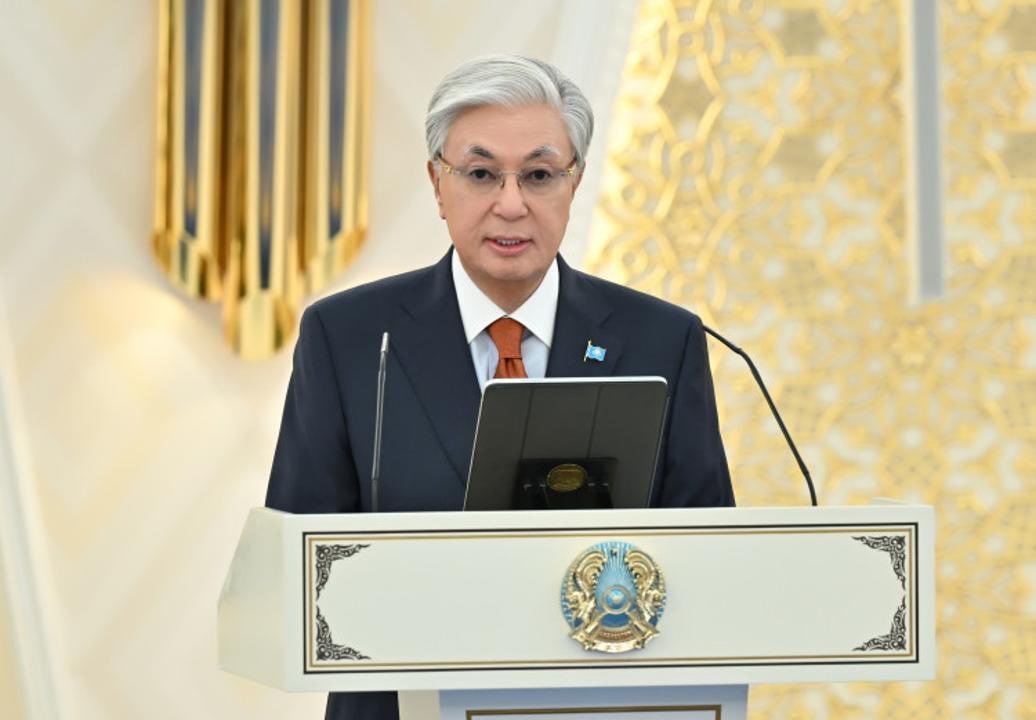
ASTANA: Kazakhstan is approaching a political turning point at a moment when its geopolitical importance is rising sharply. On 23 August 2026, voters will elect the country’s first 145-member Kurultai under the new Constitution. The unicameral legislature, elected for five-year terms through proportional representation, represents the first major test of Kazakhstan’s new constitutional architecture and of President Kassym-Jomart Tokayev’s political modernization agenda.
The election is therefore about more than replacing the former Parliament. It will offer an early indication of whether institutional reform can strengthen political representation and accountability while preserving the stability that has allowed Astana to pursue an increasingly ambitious and independent foreign policy.
The new Constitution was approved in a 15 March referendum, with 87.15% of participating voters supporting it on a turnout of 73.12%. It entered into force on 1 July. Supporters see the reform as a modernization of state institutions designed to make governance more efficient. The more consequential question, however, is how much political authority the new Kurultai will actually exercise and how effectively it will function as an independent legislative institution.
That question matters because Kazakhstan’s domestic evolution is becoming inseparable from its geopolitical strategy.
For decades, Astana has pursued a multi-vector foreign policy, maintaining relationships with Russia, China and the West while expanding ties with Türkiye, the Gulf states and other Asian powers. Today, this approach is no longer simply diplomatic balancing. It is increasingly an economic and strategic necessity.
Kazakhstan’s foreign trade turnover reached $143.9 billion in 2025. China accounted for 19.2% of Kazakhstan’s exports and 29.2% of imports, while Russia accounted for 10.3% of exports and 29.7% of imports. At the same time, trade in goods between Kazakhstan and the European Union reached €41.4 billion in 2025.
These figures explain why Astana has little interest in choosing a single geopolitical camp. Its objective is to build enough economic and strategic relationships to prevent excessive dependence on any one partner.
Russia remains the most complicated element of this equation. Geography, energy infrastructure, transport networks and Eurasian Economic Union integration ensure that Moscow cannot simply be bypassed. Russia accounted for 88.6% of Kazakhstan’s trade with the EAEU in 2025, underscoring the depth of the economic relationship.
Yet Kazakhstan has increasingly recognised that connectivity can become vulnerability. This explains the growing strategic importance of the Trans-Caspian International Transport Route, better known as the Middle Corridor.
Connecting China and Central Asia with the Caspian Sea, the South Caucasus and Europe, the route provides Kazakhstan with an alternative to northern transportation networks. Cargo volumes along Kazakhstan’s section of the route increased by 62% in 2025, while container traffic rose 2.7 times to 56,500 containers. Kazakhstan aims to increase the corridor’s capacity from around six million tonnes annually toward 10 million tonnes by 2030.
The Middle Corridor is therefore more than an infrastructure project. For Kazakhstan, it is geopolitical insurance.
China presents a different challenge. Beijing does not need political alignment from Astana to exercise significant influence. Geography, trade, investment and infrastructure already give China considerable economic weight. But Kazakhstan’s response has been pragmatic rather than confrontational: make China an essential partner without allowing Chinese engagement to become the entire foundation of national development.
Europe offers another strategic option. The EU-Kazakhstan relationship is expanding beyond traditional energy cooperation toward critical raw materials, transport, digitalisation, energy security and emerging technologies. During Tokayev’s June 2026 visit to Brussels, both sides reaffirmed cooperation in critical minerals, connectivity, energy, digitalisation and the Trans-Caspian corridor.
Critical minerals could eventually become even more strategically important than oil. Kazakhstan possesses significant reserves and production capabilities across uranium, copper, ferroalloys and other minerals essential to modern industry and the energy transition. The opportunity lies not simply in extracting these resources but in attracting investment into processing, refining and higher-value manufacturing.
If successful, Kazakhstan could gradually evolve from being primarily a resource exporter into a more important industrial and supply-chain partner for Europe, China and other global markets.
But the credibility of this economic strategy ultimately depends on domestic institutions.
Seven political parties have registered candidates for the Kurultai, with 545 candidates competing for 145 seats. Women, young people and persons with disabilities collectively account for 43.9% of candidates on party lists. These figures indicate efforts to broaden representation, but the real measure of political reform will come after election day.
A stronger legislature could improve accountability, strengthen public legitimacy and increase investor confidence. Yet if constitutional reform concentrates too much authority in the presidency while leaving the legislature institutionally weak, Kazakhstan could face a different outcome: political stability without sufficient institutional independence.
This is the central test facing the Kurultai.
Kazakhstan does not need to replicate the political model of Russia, China or the West. Its strategy has always been more pragmatic. The country seeks to preserve sovereignty by maintaining options.
Russia will remain important. China will remain powerful. Europe will remain economically attractive. Türkiye, the Gulf states and other Asian partners will continue to expand their presence.
Astana’s answer is not to choose one over the others. It is to diversify.
Kazakhstan’s greatest strategic asset may be its ability to remain useful to competing powers without becoming dependent on any single one. But strategic autonomy cannot be sustained by geography alone. It requires political stability, institutional credibility, economic diversification, multiple transport corridors and the ability to convert natural resources into higher-value industries.
That is why the 23 August Kurultai election matters far beyond the composition of Kazakhstan’s new legislature. It is an early test of whether the country can modernise politically while strengthening its position as a middle power at the crossroads of competing Eurasian systems.
In an increasingly fragmented world, Kazakhstan’s most important strategic choice may not be choosing sides, but keeping its options open.
–Gleb Gordeyeva