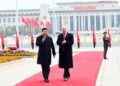





NEW DELHI: For nearly two decades, every India–Japan Annual Summit has reaffirmed a familiar phrase: the two countries are “Special Strategic and Global Partners.” The expression has become a fixture of diplomatic communiqués, often repeated with little scrutiny. The 16th Annual Summit, however, marks a decisive departure from rhetoric. What emerged in New Delhi was not merely another collection of memoranda but a comprehensive attempt to institutionalize an architecture of economic security that reflects the realities of an increasingly fragmented international order.
The significance of the summit lies not in the number of agreements signed sixteen major outcomes, but in the strategic logic connecting them. Together they reveal that India and Japan are responding to a world where geopolitical competition is no longer confined to military power. The contest is now equally about semiconductors, artificial intelligence, critical minerals, resilient supply chains, energy security, digital infrastructure, biotechnology and financial regulation. In this emerging landscape, economic resilience has become a central pillar of national security.
This represents a profound shift in bilateral relations. For decades, Japan’s engagement with India was largely defined by infrastructure financing, Official Development Assistance (ODA), and marquee projects such as the Delhi Metro and the Mumbai–Ahmedabad High-Speed Rail. Those initiatives transformed India’s physical infrastructure. The latest summit seeks to shape its strategic infrastructure.
The centrepiece of the summit, the India–Japan Joint Declaration on Economic Security captures this transition. Rather than pursuing traditional free-trade liberalization, New Delhi and Tokyo are prioritizing trusted partnerships across semiconductors, artificial intelligence, pharmaceuticals, clean energy and critical minerals. This reflects a broader global trend. The disruptions caused by the COVID-19 pandemic, geopolitical tensions in the Indo-Pacific, supply-chain shocks following Russia’s invasion of Ukraine, and increasing technological rivalry between the United States and China have fundamentally altered how governments define security.
Today, the ability to manufacture advanced chips, secure access to lithium and rare earth elements, maintain resilient pharmaceutical supply chains and protect digital infrastructure is increasingly as important as military preparedness.
India and Japan have correctly identified this transformation. Yet the declaration also raises an important question: Can ambition overcome structural constraints?
Japan remains one of the world’s leading technology powers but faces demographic decline, labour shortages and sluggish domestic growth. India possesses scale, a youthful workforce and expanding manufacturing ambitions but continues to struggle with infrastructure bottlenecks, regulatory complexity and uneven industrial competitiveness. The success of this partnership will therefore depend less on political declarations and more on whether both governments can reduce bureaucratic friction, accelerate implementation and create predictable investment ecosystems.
Artificial intelligence illustrates both the promise and the challenge.
The Joint Statement on AI and the institutional partnership between India’s IndiaAI Mission and Japan’s GENIAC initiative represent perhaps the most forward-looking outcomes of the summit. Cooperation across the full AI technology stack—including computing infrastructure, foundation models, research collaboration and policy coordination—signals that both countries intend to participate actively in shaping global AI governance rather than merely adopting technologies developed elsewhere.
This ambition is reinforced by collaborations between IIT Bombay, BharatGen Technology Foundation, Japan’s National Institute of Informatics, SarvamAI and Preferred Networks to develop advanced large language models capable of scientific reasoning.
Yet here again, realism is essential.
The global AI race is increasingly dominated by the United States and China, whose technology companies command computing power, investment capital and talent at unprecedented scales. India and Japan possess complementary strengths but remain significantly behind in foundational AI infrastructure. Without sustained investment in high-performance computing, semiconductor manufacturing, AI talent development and research funding, the partnership risks producing valuable academic cooperation without achieving technological leadership.
The same tension between aspiration and execution appears in the battery, semiconductor and critical mineral initiatives.

The agreements on battery cooperation and geological exploration acknowledge an uncomfortable geopolitical reality. Clean-energy transitions have created new forms of strategic dependence, particularly on countries controlling lithium, cobalt, graphite and rare earth processing. Diversifying these supply chains has become an urgent priority for democracies seeking to reduce vulnerabilities.
However, mineral exploration alone does not guarantee supply-chain resilience. Processing capacity, refining technologies, environmental safeguards, financing mechanisms and long-term commercial viability will determine whether these initiatives produce tangible strategic benefits.
Similarly, strengthening pharmaceutical supply chains through collaboration on Active Pharmaceutical Ingredients and Key Starting Materials is a welcome response to lessons learned during the pandemic. India is already a pharmaceutical manufacturing powerhouse, while Japan contributes advanced medical technologies and research capabilities. The partnership has considerable potential—but only if industry collaboration moves beyond memoranda into sustained investment and technology transfer.
One of the summit’s more understated achievements is the Next Generation Mobility Partnership.
While public attention often focuses on the Mumbai–Ahmedabad bullet train, the new framework expands cooperation into shipbuilding, aviation, logistics, ports, urban mobility and advanced manufacturing. This aligns with India’s ambition to emerge as a global manufacturing hub under the “Make in India for the World” initiative.
The challenge is whether India can leverage Japanese investment quickly enough to compete with Southeast Asian manufacturing centres that continue to attract substantial foreign capital through more streamlined regulatory environments.
Energy resilience represents another important dimension of the partnership.
The agreement on strategic petroleum reserves and maritime energy transport demonstrates that energy security can no longer be viewed solely through the lens of oil imports. Protecting supply chains, diversifying transport routes and strengthening reserve mechanisms have become integral components of national resilience.
Likewise, the India–Japan Cooperative Biogas for Growth Initiative reflects a welcome recognition that sustainability cannot remain confined to elite climate diplomacy. By leveraging India’s extensive dairy cooperative network to establish 1,000 biogas and organic fertilizer plants, the initiative links climate objectives with rural development, agricultural productivity and circular economy principles.
Perhaps the most enduring outcomes of the summit lie outside government altogether.
Research partnerships involving RIKEN, C-CAMP, the National Centre for Biological Sciences, and leading AI institutions recognize that technological leadership increasingly depends on ecosystems rather than isolated breakthroughs. Scientific diplomacy, academic exchanges and collaborative innovation may ultimately prove more durable than individual commercial agreements.
Equally significant is cooperation between the National Internet Exchange of India and the Japan Network Information Center, alongside financial regulatory cooperation between IFSCA and Japan’s Financial Services Agency. These agreements strengthen the often-overlooked institutional foundations upon which digital economies increasingly depend.
Nevertheless, the summit also exposes an important strategic limitation.
Despite the breadth of economic and technological cooperation, defence collaboration remains comparatively cautious. Given the increasingly contested security environment in the Indo-Pacific, deeper cooperation in defence manufacturing, cyber resilience, maritime domain awareness and emerging technologies could have strengthened the partnership further. Political sensitivities, constitutional constraints in Japan and India’s tradition of strategic autonomy continue to shape the pace of security cooperation.
This does not diminish the summit’s significance. Rather, it highlights that the India–Japan partnership remains a work in progress.
The declaration of 2027 as the India–Japan Year of Shared Horizons, marking seventy-five years of diplomatic relations, is therefore more than symbolic. It acknowledges that strategic partnerships are ultimately sustained by trust, societal engagement and institutional continuity—not merely government agreements.
The broader geopolitical message is unmistakable.
As global politics becomes increasingly polarized, India and Japan are advancing an alternative model of strategic cooperation. Instead of military alliances or ideological blocs, they are investing in trusted technologies, resilient supply chains, innovation ecosystems and rules-based economic integration. This reflects the growing importance of middle powers in shaping international order.
Whether this model succeeds will depend on implementation.
History offers reason for caution. India and Japan have announced ambitious initiatives before, only to encounter delays caused by bureaucratic procedures, land acquisition challenges, financing complexities and shifting commercial priorities. The real measure of success will not be the number of memoranda signed but the number of semiconductor facilities established, AI research centres funded, critical mineral projects operationalized, supply chains diversified and startups successfully commercialized over the next decade.
The 16th India–Japan Annual Summit therefore deserves recognition not because it transforms the bilateral relationship overnight, but because it acknowledges a fundamental truth about contemporary geopolitics: the future balance of power will increasingly be determined not only by military capabilities but by who controls technologies, supply chains, innovation ecosystems and trusted economic networks.
India and Japan have now articulated a shared vision for that future. The harder task begins now, turning strategic intent into measurable outcomes. If they succeed, the partnership will not simply adapt to the Indo-Pacific century; it will help define it.
-Dr. M Shahid Siddiqui