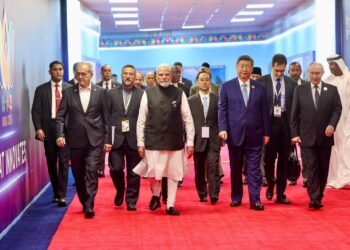




EVIAN, France: Sometimes the most important diplomatic meetings are not the ones that produce dramatic announcements. They are the conversations that reveal where a relationship truly stands. The meeting between U.S. President Donald Trump and Indian Prime Minister Narendra Modi on the sidelines of the G7 Summit in Évian offered exactly such a moment. There was no breakthrough agreement, no grand strategic declaration, and no carefully choreographed geopolitical spectacle. Yet the discussion provided a revealing snapshot of a partnership that has become increasingly important to both countries and increasingly complicated.
Trump emerged from the meeting describing his conversation with Modi as “very good.” He praised the Indian leader as a “tough negotiator” and suggested that a visit to India could be on his agenda “sometime in the future.” Both leaders also signaled progress toward resolving long-running trade disputes that have clouded bilateral ties over the past year.
On the surface, it was a meeting filled with optimism. Beneath the diplomatic smiles, however, lay a far more consequential story.
The India–U.S. relationship is entering a period where strategic necessity is colliding with political reality. Trade disagreements, maritime security concerns, energy vulnerabilities, and shifting geopolitical alignments are testing a partnership that both Washington and New Delhi increasingly view as indispensable.
The backdrop to the meeting was particularly sensitive.
Relations between the two countries have experienced turbulence in recent months. Washington’s tariff measures on Indian goods, disagreements over India’s continued purchases of Russian energy, and perceptions in New Delhi that the United States has been engaging more closely with Pakistan have all generated unease. The situation was further complicated by the deaths of three Indian sailors in a U.S. military operation linked to escalating tensions in the Gulf region.
For many Indians, the tragedy was not merely an unfortunate consequence of a distant conflict. It raised uncomfortable questions about the growing risks faced by Indian citizens working in some of the world’s most volatile regions.
That concern was evident when Modi addressed Trump directly.
“You are aware that hundreds of thousands of Indian seafarers are working across the world, performing their duties along international maritime trade routes including the Strait of Hormuz and their safety is of utmost importance to us,” Modi said in front of reporters.
The statement was measured, but its message was unmistakable.
India’s concern today is not simply about one incident. It is about the broader instability spreading across the Middle East and the consequences that instability could have for India’s economy, energy security, and citizens abroad. Few countries are as exposed to disruptions in global energy flows as India. Nearly ninety percent of the country’s crude oil requirements are imported. Much of that energy passes through the Strait of Hormuz, one of the world’s most strategically important waterways. Any prolonged disruption in the region would immediately affect fuel prices, inflation, industrial production, and economic growth.
Viewed through that lens, Modi’s intervention was about far more than maritime safety. It was a reminder that geopolitical crises unfolding thousands of kilometres away can quickly become domestic economic challenges.
The Indian leader went even further when discussing Trump’s efforts to secure an understanding with Iran.
“You have made tremendous efforts to reach this understanding, and I am confident that the issue of seafarers will receive the highest priority during the implementation of this agreement,” Modi said.
That remark reflected New Delhi’s broader strategic preference for stability. India has little interest in becoming entangled in regional rivalries. Its primary objective is straightforward: keeping trade routes open, energy supplies secure, and international commerce functioning without disruption.
Trump’s response carried a more personal tone.
Asked about the deaths of the Indian sailors, the U.S. president said: “It’s a rough profession, there’s no question about it, and we work together on it … We love all of those people, they’re great people.” The comment may not have addressed every concern in New Delhi, but it underscored an often-overlooked reality. Behind discussions of maritime security and strategic competition are ordinary people whose livelihoods depend on the stability of the global trading system.
The conversation about trust extended beyond maritime issues.
Earlier at the summit, Modi had spoken about what he described as a global “shortage of trust.” It was a phrase that resonated far beyond the G7 gathering. Around the world, countries are increasingly confronting an international environment shaped by conflict, uncertainty, and competing power centres. Institutions that once provided predictability are under strain. Long-standing alliances are being reassessed. Economic interdependence is no longer viewed solely as a source of prosperity but also as a source of vulnerability.
Against that backdrop, trust has become one of the most valuable and scarce commodities in international affairs.
Trade remains another significant test for the India–U.S. relationship. Despite Trump’s optimistic comments, negotiations have been difficult. Tariffs continue to be a recurring source of friction. Proposed restrictions linked to labour and supply-chain concerns have added further uncertainty. While both governments remain committed to finding common ground, neither side has found it easy to reconcile domestic political priorities with economic realities.
Yet there is a reason these disputes have not escalated into a larger strategic rupture.
Both countries understand what is at stake.
For Washington, India occupies a central position in efforts to maintain a balance of power across the Indo-Pacific. No other democracy combines India’s scale, economic potential, geographic location, and growing military capabilities. As competition with China continues to shape American strategic thinking, India’s importance only increases.
For New Delhi, the United States remains a critical source of investment, advanced technology, defence cooperation, innovation, and global influence. Closer ties with Washington strengthen India’s own capacity to navigate an increasingly competitive world.
In other words, the relationship has evolved beyond transactional politics.
It is now rooted in long-term strategic interests that neither side can easily ignore. That reality was reflected in Trump’s remarks regarding India’s security. His suggestion that the United States would assist India in the event of an attack reinforced the growing strategic convergence between the two nations. While such comments do not amount to a formal alliance commitment, they nevertheless signal how central India has become to American geopolitical calculations.
At the same time, India remains determined to preserve its strategic autonomy.
This balancing instinct has long defined Indian foreign policy. New Delhi seeks stronger partnerships with Washington while avoiding dependence on any single power bloc. It continues to engage with multiple actors, maintain independent decision-making, and protect room for manoeuvre in a rapidly changing world.
That approach may occasionally frustrate American policymakers, but it is unlikely to change. The prospect of a future Trump visit to India therefore carries significance beyond symbolism.
A presidential visit could help restore momentum to a relationship that has faced visible strains over the past year. It could accelerate discussions on trade, defence cooperation, critical technologies, supply-chain resilience, maritime security, and energy collaboration. Just as importantly, it would send a signal to investors, allies, and competitors alike that the relationship remains on a positive trajectory.
But diplomatic symbolism can only go so far.
The real measure of success will not be found in photographs, summit communiqués, or carefully crafted statements. It will be found in whether both governments can translate goodwill into policy outcomes. Progress on tariff barriers, market access, maritime security, energy cooperation, technology partnerships, and regional stability will ultimately determine the future direction of the relationship.
What emerged from Évian was not the image of two countries that agree on everything.
Rather, it was the image of two increasingly important partners learning how to manage disagreement without jeopardizing a larger strategic purpose. That may prove to be the most significant takeaway from the Trump–Modi meeting.
In an era marked by geopolitical fragmentation, economic uncertainty, and declining trust, India and the United States are discovering that successful partnerships are not built on perfect alignment. They are built on resilience, pragmatism, and a recognition that some relationships are too important to fail.
The headlines may focus on Trump’s promise to visit India and the possibility of a future trade deal.
The deeper story unfolding in Évian is about whether two major democracies can convert strategic necessity into enduring trust and whether one of the defining partnerships of the twenty-first century can remain strong enough to shape an increasingly uncertain global order.
-Dr. M Shahid Siddiqui