


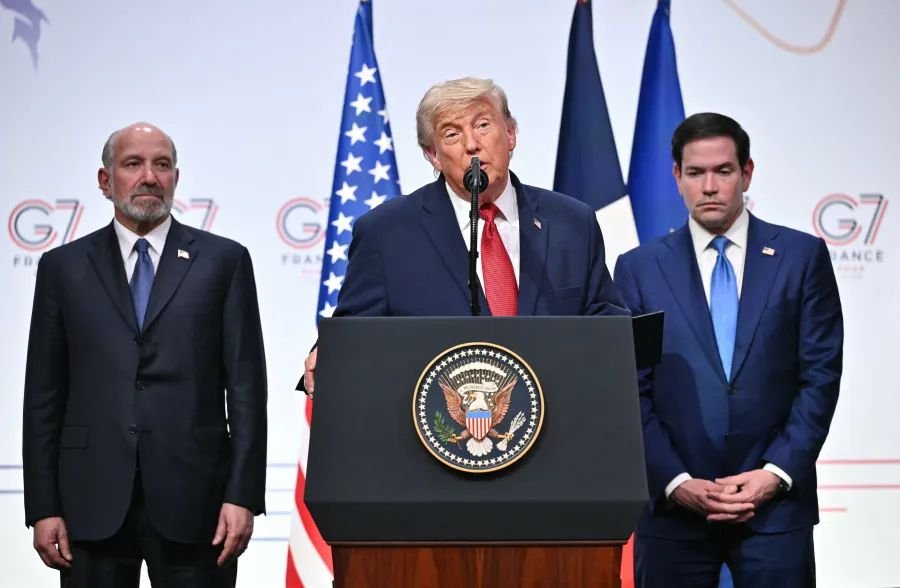
EVIAN-LES-BAINS, France/NABATIEH, Lebanon: – Three days after announcing a surprise interim agreement with Iran, U.S. President Donald Trump arrived at the conclusion of the G7 Summit in Évian with a message that was both reassuring and unsettling.
The agreement, Trump argued, prevented what could have become a global economic catastrophe. Yet in the same breath, he made clear that military action remains very much on the table should Tehran fail to comply with its commitments.
“We’re going to bomb the hell out of them if they violate the agreement,” Trump said bluntly during his closing press conference. “I don’t want them to. I want them to honor the agreement.”
The statement captured the paradox at the heart of the emerging U.S.-Iran understanding. The deal has reduced immediate fears of a wider regional war, reopened hopes for stability in one of the world’s most important energy corridors, and triggered a decline in oil prices. At the same time, the language coming from Washington suggests the ceasefire remains fragile and that the Middle East is still operating under the shadow of renewed conflict.
For global markets, the stakes could hardly be higher.
The war that erupted following U.S. and Israeli strikes on Iran in February quickly evolved into a broader regional confrontation. Energy prices surged, inflationary pressures returned across major economies, and developing nations began warning about the risk of food supply disruptions driven by rising transportation and fuel costs. Trump acknowledged those dangers directly.
“So the one thing I didn’t want to see is, I didn’t want to see economic catastrophe. If you kept this going, that could have happened,” he said.
His comments reveal an important shift in strategic thinking. While the original objective of military pressure was to curb Iran’s nuclear ambitions, the escalating economic consequences increasingly threatened to outweigh any geopolitical gains.
The Strait of Hormuz became the central concern.
Roughly one-fifth of the world’s traded oil passes through the narrow waterway connecting the Persian Gulf to international markets. Any sustained disruption would have sent shockwaves through energy markets, raising costs for consumers and governments alike.
Trump claimed maritime traffic through the strait had increased significantly since the truce was announced and expressed hope that the agreement could become the foundation for a broader Middle Eastern peace process. Financial markets initially responded positively. Oil prices fell to their lowest levels since the beginning of the conflict as traders anticipated a gradual normalization of shipping routes and energy exports.
Yet confidence remains tentative.
Prices recovered after Trump warned that military operations could resume if Washington becomes dissatisfied with Iranian behavior. Earlier in the day, he delivered an even sharper warning.
“If I don’t like it, if they don’t behave, we’ll go right back to dropping bombs right smack in the middle of their head.”
Such rhetoric reflects a familiar Trump negotiating style mixing diplomacy with deterrence. But it also underscores the uncertainty surrounding the agreement itself. The 14-point memorandum extends an existing ceasefire by another sixty days while negotiators attempt to reach a permanent settlement. It includes provisions for restoring maritime traffic, lifting restrictions on Iranian ports, easing sanctions, and launching an ambitious $300 billion economic rehabilitation plan for Iran.
In return, Tehran has once again pledged not to pursue nuclear weapons.
However, the agreement leaves many of the conflict’s underlying issues unresolved. Iran’s leadership remains firmly in power. Its stockpile of enriched uranium remains intact. Its ballistic missile capabilities have not been dismantled. And its relationships with regional allies, including Hezbollah in Lebanon, remain largely unchanged.
In strategic terms, this raises an uncomfortable question.
Has Washington achieved a breakthrough, or simply purchased time?
Supporters of the agreement argue that preventing a wider regional war is itself a major achievement. Critics contend that Iran has emerged from the conflict with many of its core assets preserved while gaining leverage through its ability to withstand sustained military pressure.
That debate was visible at the G7 Summit. Leaders from France, Germany, Britain, Japan, Italy, Canada and the United States welcomed the diplomatic opening while simultaneously stressing the need for negotiations that address broader concerns about Iran’s regional activities and nuclear ambitions.
Their message was clear: the ceasefire is a beginning, not an end.
The Lebanon front illustrates why.
Although the memorandum calls for a cessation of hostilities between Israel and Hezbollah, fighting has not entirely stopped. Israeli air strikes and Hezbollah drone attacks continued to be reported even as diplomats celebrated progress toward a wider agreement.
Trump also appeared to publicly signal frustration with Israeli Prime Minister Benjamin Netanyahu’s military approach.
“Netanyahu happens to be a good man, gets a little excited sometimes,” Trump remarked.
“We have a little dispute over Lebanon. I say you can do a little softer touch, Bibi.”
The comments highlighted a growing challenge for Washington. Even if the United States and Iran move closer to a permanent understanding, regional actors retain the ability to influence events on the ground. Managing those dynamics may prove as difficult as negotiating with Tehran itself.
Beyond the diplomatic maneuvering, the human dimension remains profound.
For ordinary Iranians, months of war have compounded years of economic hardship. Inflation, sanctions, unemployment, and uncertainty continue to shape daily life.
“I think 99% of people are in survival mode and just living day by day,” said Amir, a media entrepreneur from Isfahan. His words may ultimately be the most important reminder of what is at stake. Diplomatic agreements are often measured in strategic gains, military calculations, and economic indicators. But their true value lies in whether they improve lives and reduce the likelihood of future conflict.
The agreement unveiled this week has undoubtedly lowered the immediate risk of a wider war. It has reassured markets, stabilized energy flows, and created a pathway toward further negotiations.
Yet it remains an interim arrangement built on fragile trust.
The coming sixty days will determine whether this moment represents the beginning of a durable peace or merely an intermission between conflicts. For now, the world has stepped back from the brink Whether it stays there remains the defining geopolitical question.
-PeterJones and Aidan