




KATHMANDU/NEW DELHI: The official visit of Nepal’s Minister for Foreign Affairs, H.E. Mr. Shisir Khanal, to New Delhi marks more than a routine diplomatic engagement. As the first foreign ministerial-level visit between India and Nepal since the formation of Nepal’s new government in March 2026, it offered both countries an opportunity to recalibrate and modernize a relationship that has often been defined by geography, history, and cultural affinity but increasingly requires strategic and economic substance.
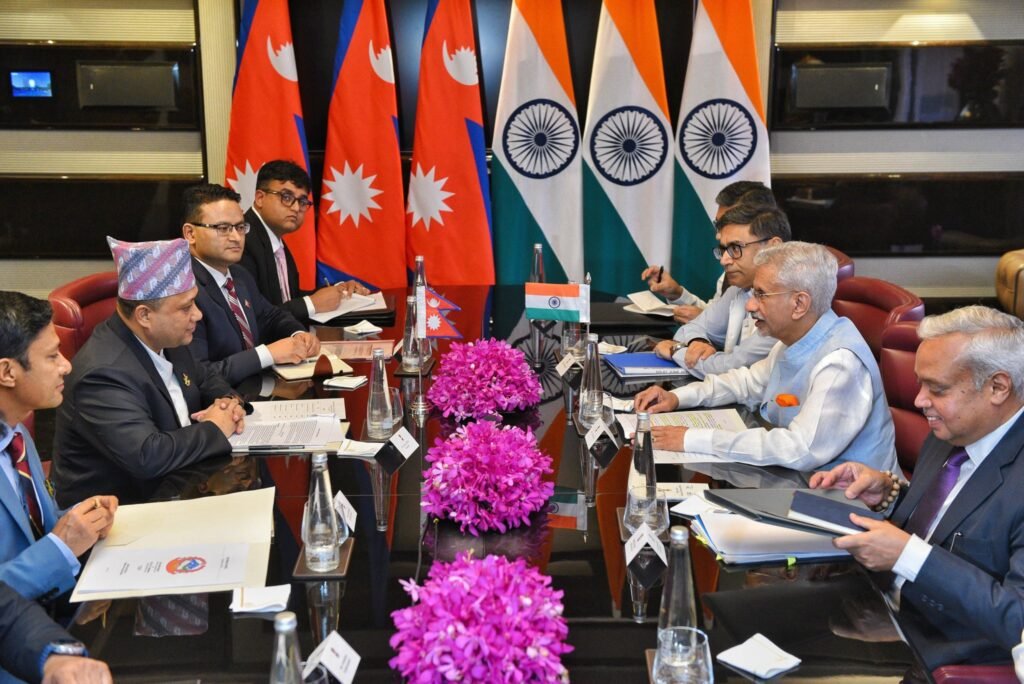
The discussions between External Affairs Minister Dr. S. Jaishankar and Foreign Minister Khanal covered the traditional pillars of the bilateral relationship development cooperation, connectivity, trade, transit, energy, and people-to-people exchanges. Yet the significance of the visit lies less in the breadth of the agenda and more in the nature of the initiatives announced.
For decades, India-Nepal relations have been anchored by an open border, deep civilizational links, and extensive economic interaction. However, the challenges of the twenty-first century demand new frameworks of cooperation centered on technology, financial integration, institutional resilience, and cross-border governance. The outcomes of this visit suggest that both governments recognize this reality.
Among the most consequential developments was the launch of the Peer-to-Peer linkage between India’s Unified Payments Interface (UPI) and Nepal’s National Payments Interface (NPI). While digital payment integration may appear technical in nature, its strategic implications are considerable. Nepal receives substantial remittances from its citizens working abroad, including in India, while cross-border travel, tourism, education, and commerce continue to expand. By enabling faster and more efficient personal remittance flows, the initiative has the potential to deepen economic integration at the grassroots level and reduce transaction costs for ordinary citizens.
Equally significant was the Memorandum of Understanding between Digital India Bhashini and Kathmandu University for the development of a voice-first language translation platform. This initiative reflects an emerging trend in India’s regional diplomacy: the export of digital public infrastructure and technology partnerships as instruments of regional cooperation. Rather than focusing solely on physical infrastructure, New Delhi is increasingly promoting digital connectivity, linguistic inclusion, and technological capacity building as components of its neighborhood engagement strategy.
The visit also reaffirmed India’s long-standing role in Nepal’s reconstruction and development efforts. The handover of 72 health facilities and 12 cultural heritage projects completed under India’s post-2015 earthquake reconstruction assistance demonstrates continuity in bilateral cooperation. More importantly, it highlights how development partnerships remain central to India’s influence and goodwill in Nepal. Such projects generate tangible benefits for local communities while reinforcing the perception of India as a reliable development partner.
Another outcome with long-term implications was the completion of domestic procedures necessary for the entry into force of the India-Nepal Mutual Legal Assistance Agreement in Criminal Matters. As cross-border movement between the two countries remains among the most open in the world, enhanced legal cooperation is becoming increasingly important. The agreement is expected to strengthen collaboration in investigations, prosecutions, and judicial processes related to transnational crime, thereby contributing to regional security and institutional coordination.
From a broader geopolitical perspective, the visit comes at a time when South Asia is undergoing significant strategic transformation. Connectivity corridors, energy cooperation, digital infrastructure, and economic resilience are becoming key determinants of regional influence. For India, maintaining strong and stable relations with Nepal remains an essential element of its Neighbourhood First policy. For Nepal, balancing economic development, strategic autonomy, and regional engagement requires productive partnerships with all major stakeholders, particularly its immediate neighbours.
The importance of this visit therefore lies not in any single agreement but in the collective message conveyed by the outcomes. India and Nepal appear to be moving beyond a relationship defined primarily by historical affinity toward one increasingly characterized by institutional cooperation, technological integration, and economic interdependence.
While challenges will inevitably remain including trade imbalances, implementation delays, and periodic political sensitivities the visit demonstrated a shared commitment to strengthening practical cooperation in areas that directly affect citizens on both sides of the border.
In an era where regional partnerships are increasingly measured by their ability to deliver tangible outcomes, the India-Nepal relationship is showing signs of adaptation and renewal. The agreements announced in New Delhi may not be transformational individually, but together they represent a gradual yet significant evolution of one of South Asia’s most consequential bilateral partnerships.
-India Desk With Input From Clarence Fernandez and Dr. Shahid Siddiqui