




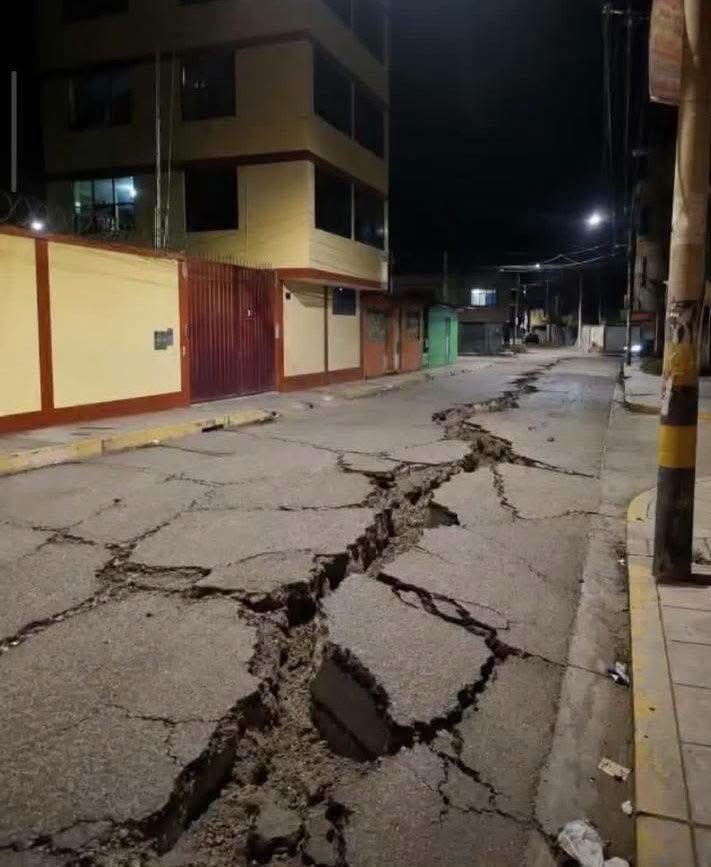
LIMA: As rescue teams continue to search through collapsed homes in Peru’s central highlands, the country is once again confronting a painful reality: for millions living along the Pacific Ring of Fire, earthquakes are not a question of if, but when.

At least five people were killed and 21 others injured after two earthquakes struck Chupaca province in the Junín region, about 300 kilometers (186 miles) east of Lima, late Saturday. According to Peru’s National Seismological Center, the first earthquake measured magnitude 5.1 at a depth of 24 kilometers, followed by a 3.7-magnitudeaftershock at 18 kilometers. The European-Mediterranean Seismological Centre (EMSC) initially estimated the stronger quake at magnitude 5.6, reflecting the common differences in early seismic assessments.
For many residents, the earthquakes lasted only seconds. Their consequences, however, may last for years.
Peru’s National Civil Defense Institute (INDECI) said preliminary assessments indicate that 48 homes were destroyed, 18 others were damaged, and nearly 300 people have been displaced, many now sheltering in emergency tents while authorities assess the full extent of the destruction. Emergency crews, firefighters, and local officials worked through the night to remove debris amid fears that additional victims could still be trapped beneath collapsed buildings. The tragedy also highlights a long-standing challenge facing rural Peru.
Many of the homes in the affected mountain communities are built using adobe bricks, a traditional and affordable construction material that has been used for generations. While well suited to local climates and economic realities, adobe structures are particularly vulnerable during earthquakes because they lack the flexibility needed to withstand seismic shaking. That is why earthquakes of only moderate magnitude can still prove deadly.
Peru sits directly on the Pacific Ring of Fire, a horseshoe-shaped belt stretching around the Pacific Ocean that is responsible for roughly 85% of the world’s recorded seismic activity. The constant movement of the Nazca Plate beneath the South American Plate generates frequent earthquakes across the country, making Peru one of the most seismically active nations in the world.
The country has experienced devastating earthquakes before, including the 1970 Ancash earthquake, which killed an estimated 70,000 people, and the 2007 Pisco earthquake, where more than 500 people lost their lives. Those disasters prompted improvements in emergency management and public awareness, yet many rural communities continue to face significant structural vulnerabilities. This latest earthquake demonstrates that disaster preparedness extends far beyond emergency response.
Scientists cannot prevent earthquakes, but stronger building standards, resilient housing, improved land-use planning, and public preparedness can dramatically reduce casualties. Countries such as Japan and Chile have shown that even powerful earthquakes need not result in large-scale loss of life when resilient infrastructure is in place.
For Peru, however, the challenge remains uneven. Urban centres have generally benefited from stricter construction standards, while many remote Andean communities continue to rely on traditional housing because safer alternatives remain financially inaccessible.
As families mourn loved ones and begin rebuilding their lives, the earthquake serves as another reminder that resilience is measured not only by how quickly rescue teams arrive, but by how well communities are protected before disaster strikes. For the people of Chupaca, recovery has only just begun. For Peru, the broader lesson is clear: living on the Ring of Fire demands continuous investment in safer communities, not only after tragedy, but long before the next earthquake occurs.
– Chizu Janowski