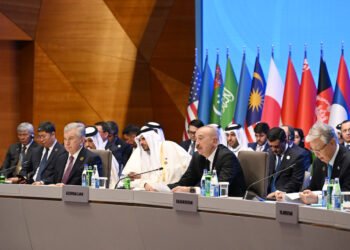


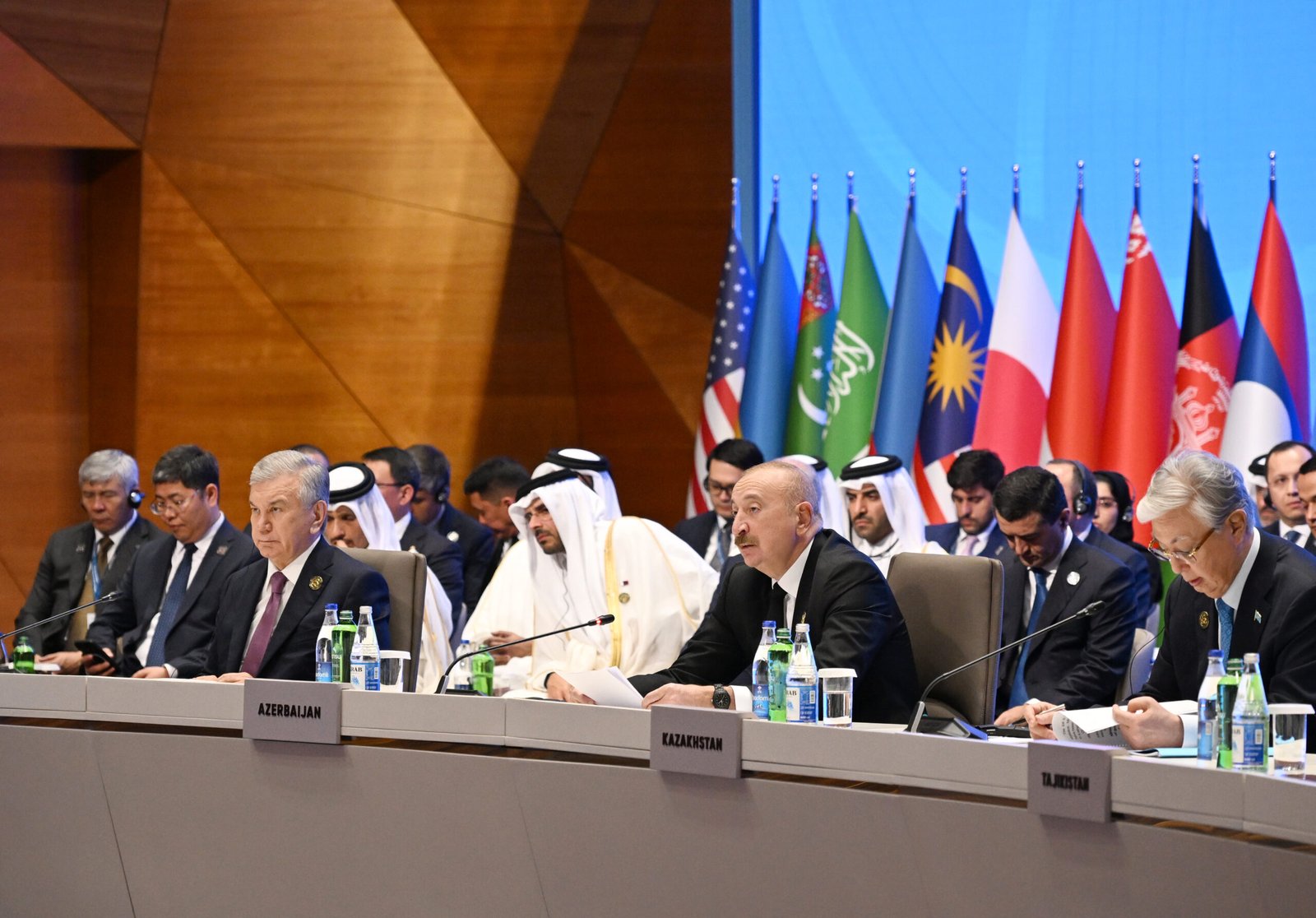
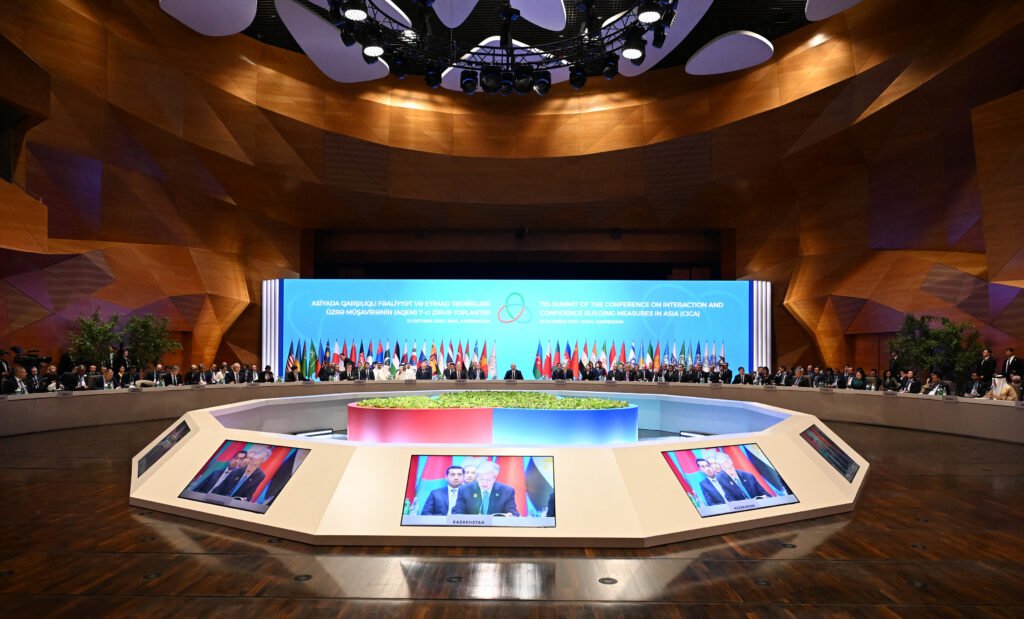
BAKU, Azerbaijan: The seventh summit of the Conference on Interaction and Confidence Building Measures in Asia (CICA), hosted by Azerbaijani President Ilham Aliyev in Baku, was intended to strengthen dialogue among countries divided by competing security interests, regional conflicts and geopolitical rivalries. Instead, the departure of multiple delegations during Israeli President Isaac Herzog’s address exposed the profound political divisions confronting the very institution designed to bridge them.
Representatives from Iran, Palestine, Pakistan, Saudi Arabia, Türkiye, Iraq, Egypt and several other countries were reported to have participated in the walkout. Iranian media identified 13 delegations in total, including Kuwait, Qatar, Jordan, Malaysia, Indonesia and Bangladesh. However, accounts differed over Qatar’s participation, with several reports stating that Emir Sheikh Tamim bin Hamad Al Thani remained in the hall during Herzog’s speech. The reported walkout by Iranian, Turkish, Pakistani, Kuwaiti and Palestinian representatives was independently covered by multiple news organisations.
The incident transformed the summit from a demonstration of diplomatic convergence into a revealing illustration of its limits. Leaders and officials from countries with sharply different political positions had assembled under one roof, but their physical proximity did not translate into a shared willingness to participate in the same diplomatic moment. The distinction matters. CICA’s purpose is to encourage confidence-building, cooperation and peaceful engagement across Asia. A walkout does not automatically invalidate that mission, nor does it establish that every participating country shares the same position. It does, however, demonstrate that multilateral forums cannot manufacture political consensus merely by bringing governments together.
The central question emerging from Baku is whether Asian diplomacy can sustain meaningful engagement when disagreements over war, sovereignty, civilian protection and international law become too politically consequential to contain within conventional diplomatic exchanges. Aliyev placed the credibility of international institutions at the centre of his address to the summit, drawing on Azerbaijan’s decades-long conflict with Armenia. He referred to four United Nations Security Council resolutions adopted in 1993 concerning the Nagorno-Karabakh conflict and the withdrawal of occupying forces from Azerbaijani territories. Their prolonged non-implementation, he argued, exposed a fundamental weakness in an international system capable of adopting decisions but unable to ensure their execution.
Azerbaijan subsequently regained control over Nagorno-Karabakh through military operations in 2020 and September 2023. Baku presents these developments as the restoration of its internationally recognised territorial integrity. Yet the conflict’s broader legacy includes mass displacement, civilian suffering, deep Armenian-Azerbaijani mistrust and continuing challenges to reconciliation. Aliyev’s argument raises a question that extends beyond the South Caucasus: what authority can international institutions retain when governments believe that enforcement depends on political alignment rather than consistent principles?
The answer cannot be selective enforcement in favour of one state or another. Territorial integrity, civilian protection, human rights and the prohibition on the use of force must be assessed consistently. International law cannot become credible merely because one government invokes it against another; its legitimacy depends on whether its principles are applied regardless of the strategic identity of those involved.
That challenge has particular relevance to the Middle East. Herzog’s presence at CICA brought Israel into a multilateral setting alongside representatives of countries that oppose its policies and, in some cases, do not maintain diplomatic relations with it. The subsequent walkout revealed the political cost of treating participation in a common forum as equivalent to acceptance of the political legitimacy of every participant’s position.
For the delegations that departed, the action constituted a visible diplomatic protest. Their departure communicated opposition without requiring the abandonment of the wider summit. Yet the incident also raised questions about whether symbolic confrontation can achieve more than sustained engagement, particularly when the issues at stake require negotiations, humanitarian commitments and changes in state behaviour.
Herzog’s address was delivered against the backdrop of continuing regional tensions and international disagreement over Israel’s conduct towards Palestinians. Türkiye’s Foreign Minister Hakan Fidan used his own intervention to emphasise Palestinian rights and called for an independent Palestinian state based on the 1967 borders, with East Jerusalem as its capital. He also challenged the compatibility of regional confidence-building with what he described as violations of Palestinian fundamental rights.
These competing positions reveal a central difficulty for CICA. Confidence-building cannot require governments to disregard substantive disagreements over international law, security or civilian protection. Nor can diplomatic participation reasonably be interpreted as endorsement of the conduct of other states. The challenge is to create procedures through which disagreements can be expressed, challenged and managed without destroying the possibility of further engagement.
Qatar’s presence added another layer to this diplomatic complexity. Doha has pursued a foreign policy that combines regional partnerships with mediation and communication across political divides. Its participation illustrated the value of maintaining diplomatic channels even where governments disagree sharply over security and regional policy. Reports that the Emir remained in the hall during Herzog’s address, despite the departure of other delegations, also demonstrate why individual countries’ actions should not automatically be treated as evidence of a unified regional position.
Türkiye, represented by Fidan, occupied a particularly significant position because Ankara’s diplomatic approach links regional security with Palestinian rights, economic connectivity and the need for stronger cooperation among regional institutions. Türkiye’s call for greater coordination and a more developed institutional role for CICA points to an ambition to turn the forum into something more consequential than a venue for periodic diplomatic encounters. But stronger institutions cannot substitute for political agreement, particularly when members disagree over the application of international law.
China’s Foreign Minister Wang Yi and Russia’s Foreign Minister Sergey Lavrov brought the perspectives of two major powers seeking to preserve and expand their regional relationships. China’s economic interests are closely tied to reliable energy supplies, international trade and transport corridors, while Russia seeks to sustain its influence through Eurasian partnerships and multilateral engagement.
Both have reasons to support a regional environment in which disputes do not routinely disrupt commerce or close diplomatic channels. Yet a cooperative security framework must do more than accommodate the preferences of major powers. It must also provide smaller states with meaningful agency and credible safeguards against coercion. India’s participation through Minister of State for External Affairs Kirti Vardhan Singh reflected New Delhi’s continued engagement with a diverse range of Asian partners. India’s priorities include counterterrorism, energy security, trade connectivity and regional stability, alongside the preservation of strategic autonomy in an increasingly competitive international environment.
For India, CICA offers a platform for maintaining dialogue without requiring participants to align behind a single geopolitical bloc. Its practical value, however, depends on whether discussions can produce measurable cooperation on shared threats. Diplomatic flexibility is important, but it cannot by itself secure transport routes, resolve regional disputes or ensure compliance with international agreements. Azerbaijan, meanwhile, sought to use the summit to reinforce its position as a connector between Europe and Asia. Its geographic location between the Caspian Sea and the South Caucasus gives it a role in discussions about transport corridors, energy security and the diversification of international trade routes. During its CICA chairmanship, Baku prioritised connectivity, digitalisation, environmental protection, tourism, education and scientific cooperation. The summit also saw support for extending Azerbaijan’s chairmanship and the admission of Laos as a member state.
These developments provide institutional momentum, but the walkout exposed the difference between organisational expansion and political cohesion. A growing membership does not necessarily mean growing agreement. An institution can expand its geographical reach while remaining unable to reconcile the competing interpretations of security and justice held by its members. This is the structural challenge confronting CICA. It is a confidence-building forum rather than a supranational authority capable of compelling governments to implement international decisions. Its influence depends on sustained political commitment, voluntary cooperation and practical mechanisms that make dialogue useful even when agreement is difficult.
The walkout should therefore be understood neither as proof that multilateral diplomacy is futile nor as an inconsequential interruption. It was a visible expression of unresolved political differences within a forum established to manage precisely such divisions. Its significance lies in the question it leaves unanswered: can a multilateral institution remain effective when its members disagree not only about solutions but also about the legitimacy of one another’s actions?
The answer depends on what follows the summit. Crisis communication, transport security, energy cooperation, counterterrorism and environmental protection offer areas in which governments can pursue shared interests despite wider disagreements. Clear commitments, implementation timelines and regular assessments would help establish whether CICA can move beyond declarations towards practical results.
At the same time, confidence-building cannot be reduced to technical cooperation while fundamental questions of international law remain contested. An institution that promotes dialogue must also provide space for serious disagreement over civilian protection, sovereignty and accountability. Otherwise, the appearance of consensus risks becoming a substitute for addressing the sources of mistrust.
The seventh CICA Summit exposed the contradiction at the heart of contemporary Asian diplomacy. Countries increasingly recognise their shared exposure to conflict, disrupted trade, energy insecurity and environmental pressures. Yet they remain divided over the principles and political arrangements needed to address these challenges.Aliyev’s criticism of international enforcement, the walkout during Herzog’s address, Türkiye’s emphasis on Palestinian rights, China’s advocacy of cooperative security, Russia’s Eurasian priorities and India’s strategic autonomy all illuminate different dimensions of this dilemma.
Baku brought competing interests together, but it did not reconcile them. The walkout demonstrated that diplomatic access is not the same as political acceptance, and that institutional participation cannot erase disputes over international law or regional security.
A new Asian order will require more than summits, declarations and expanding membership. It will require consistent principles, credible commitments and mechanisms capable of sustaining cooperation without suppressing disagreement. Most importantly, it will require governments to recognise that international rules cannot retain legitimacy if they are invoked selectively against adversaries while being disregarded when they constrain allies.
The real test for CICA is not whether rival powers can occupy the same room, but whether they can turn disagreement into sustained diplomacy, consistent principles and measurable progress towards regional stability.
-Mariye Bryanski