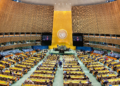


NEW YORK, USA: The second day of the 81st United Nations General Assembly exposed a profound contradiction at the heart of the international system: governments remain deeply dependent on multilateral diplomacy even as confidence in the institutions of multilateralism continues to erode. In New York, the immediate language of war collided with the longer-term demands of development, economic sovereignty and institutional reform. Iranian President Masoud Pezeshkian used the General Assembly to reject U.S. pressure and insist that Iran would not surrender, while leaving open the possibility of diplomacy. Kenya’s William Ruto focused attention on development finance, debt and climate finance. Namibia’s Netumbo Nandi-Ndaitwah argued for a more representative multilateral order and greater African participation in global value chains. Mozambique’s Daniel Chapo placed peace, national dialogue and development at the centre of his country’s international engagement. Taken together, the speeches revealed that the struggle over the future of the international order is no longer confined to military alliances or diplomatic blocs. It is increasingly about who controls capital, resources, technology, supply chains and the institutions that establish the rules governing them.
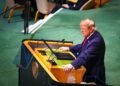
The confrontation between Iran and the United States gave the day’s proceedings their most immediate geopolitical intensity. Pezeshkian spoke one day after U.S. President Donald Trump had warned that Iran could be “annihilated” if a peace agreement was not reached, while also maintaining that a diplomatic settlement remained possible. Pezeshkian’s response was uncompromising in tone. He accused Washington of applying a coercive “bullying mentality”, rejected the idea that military pressure could force Tehran into surrender and presented Iran as a country resisting external attack. Yet beneath the confrontation was an important diplomatic distinction: Tehran was rejecting negotiations conducted under coercion, not necessarily diplomacy itself. Reuters reported that Iran and the United States remained far apart on how to end the conflict but that Iranian officials continued to argue that diplomacy must continue.
That distinction may prove more important than the rhetoric surrounding the speeches. Modern conflicts rarely end at the point at which military pressure reaches its maximum intensity. Eventually, the parties must confront questions that military operations cannot settle permanently: security guarantees, sanctions, territorial arrangements, energy flows, nuclear policy, reconstruction and the political conditions for a sustainable settlement. The current Iran-U.S. confrontation is especially consequential because the Strait of Hormuz has become part of the strategic equation. Tehran has indicated that it could reopen the strategically vital waterway if Washington reduces military pressure and lifts its blockade on Iranian ports. The issue therefore extends far beyond the bilateral relationship. Any prolonged disruption of Hormuz has consequences for energy markets, shipping, inflation and the economic calculations of countries far removed from the battlefield.
The walkout by the U.S. delegation when Pezeshkian began speaking provided a dramatic image of the diplomatic divide, but the more revealing fact is that diplomacy has not disappeared. Washington permitted Pezeshkian and Foreign Minister Abbas Araqchi to attend the General Assembly despite the ongoing conflict, although the Iranian delegation faced significant movement restrictions. The decision reflected U.S. obligations under the UN headquarters agreement while preserving a limited channel for diplomatic contact. The contradiction is characteristic of the current international environment: states increasingly rely on military power to improve their bargaining position while simultaneously needing diplomatic channels to prevent confrontation from becoming uncontrollable.
If Iran represented the immediate security crisis, the African interventions represented a deeper structural challenge to the international economic system. Kenya’s President William Ruto placed the cost of development and climate finance at the centre of his UNGA message. His argument is increasingly shared across African capitals: the continent cannot be expected to accelerate infrastructure development, expand energy access, adapt to climate change, create employment and industrialise while financing remains expensive and fiscal space remains limited. Ruto has specifically linked public debt and the global financial architecture to development outcomes, arguing that debt-servicing costs can crowd out spending on education, healthcare, nutrition and social protection.
The significance of this argument lies in its departure from the traditional language of aid. Africa’s financing debate is increasingly about the architecture of capital rather than simply the volume of assistance. A climate pledge has limited practical value if financing cannot be accessed quickly, affordably and at sufficient scale. A large infrastructure commitment does not automatically generate development if the financing structure creates unsustainable debt or if the project produces insufficient local economic value. Ruto’s agenda therefore reflects a broader effort to reposition African economies from recipients of development assistance toward destinations for long-term investment, technology and industrial capital. Kenya’s emphasis on clean cooking, infrastructure, artificial intelligence and investment mobilisation during UNGA week illustrates this broader approach.
Namibia’s President Netumbo Nandi-Ndaitwah pushed that argument into the institutional sphere. Her message around the implementation of the Pact for the Future emphasised stronger African representation in global decision-making, reform of the international financial architecture, technology transfer, international tax cooperation and economic transformation. She argued that Africa must move beyond its traditional role as an exporter of raw materials and strengthen its participation in global value chains. This is becoming one of the most important themes in African economic diplomacy because the strategic value of African resources is increasing at precisely the moment when global competition for critical minerals, energy and new technologies is intensifying.
The distinction between possessing resources and capturing value from them is fundamental. Africa possesses enormous reserves of minerals, energy resources and agricultural potential, but ownership or extraction alone does not guarantee industrial development. The larger economic prize lies in processing, manufacturing, logistics, technology, skills and intellectual property. As the global energy transition increases demand for critical minerals, African countries have an opportunity to negotiate investment on terms that support domestic value addition rather than simply expanding exports of unprocessed commodities. Namibia’s emphasis on beneficiation, industrialisation and employment reflects this changing calculation. The competition among the United States, China, Europe, India and Gulf economies for stronger economic relationships across Africa could create additional choices for African governments, but competition becomes meaningful only when countries possess the institutional capacity to negotiate partnerships that produce lasting domestic economic benefits.
Mozambique’s President Daniel Chapo added another dimension to the African message by connecting peace and development. His UNGA programme has focused on the country’s Inclusive National Dialogue, sustainable development and cooperation with international institutions. His engagement in New York has also included discussions with international financial institutions on economic reforms and investment. The significance is larger than Mozambique’s immediate domestic agenda. Political stability is itself an economic asset. Long-term infrastructure, energy and industrial projects require predictability, while investors require confidence that political disputes will not repeatedly become security crises. For countries attempting to attract large-scale external capital, national dialogue and institutional stability can therefore become part of the economic strategy rather than issues separate from it.
The African message at UNGA 81 is particularly notable because the presidents of South Africa, Egypt and Nigeria, the continent’s three largest economies by nominal GDP are not personally attending the high-level gathering. South Africa is represented by Foreign Minister Ronald Lamola, Egypt by Prime Minister Mostafa Madbouly and Nigeria by Vice President Kashim Shettima. All three countries remain represented at senior levels, and their governments continue to participate in the diplomatic programme. The circumstances are different in each case, and the absence of a president should not be interpreted as the absence of the country from UNGA diplomacy.
Nevertheless, the symbolism is significant. High-Level Week is not merely about delivering national statements. It is also a concentrated period of bilateral meetings, investment discussions, strategic consultations and informal diplomacy.
Personal attendance gives heads of government an opportunity to move rapidly across issues that span security, trade, energy, finance and regional politics. That makes the absence of the leaders of Africa’s three largest economies notable at a moment when African governments are simultaneously demanding a stronger voice in global institutions.
There is an important contradiction here. Africa is calling for greater representation in the UN Security Council, reform of international financial institutions and greater influence over global rules, yet the continent’s diplomatic influence remains divided among national priorities and regional strategies. Kenya’s priorities are not identical to Egypt’s. Namibia’s economic strategy differs from Nigeria’s. South Africa approaches global diplomacy through its own strategic relationships and multilateral commitments. The African Union provides a continental framework, but individual states remain the principal actors in international negotiations. The challenge is therefore not simply gaining a seat at the table. It is converting Africa’s collective economic weight, population and strategic resources into sustained negotiating power.
This is where the speeches of Day Two converge. Iran’s argument is ultimately about sovereignty and the conditions under which diplomacy can take place. Kenya’s argument is about the financial conditions under which development can occur. Namibia’s argument is about who captures value and who makes the rules. Mozambique’s argument is about the relationship between political stability and economic transformation. Beneath all four is the same question: how much agency do states possess in an international system where military power, financial leverage, technology and market access are increasingly interconnected?
The traditional separation between geopolitics and economics is rapidly disappearing. Energy routes are strategic assets. Critical minerals are geopolitical resources. Financial sanctions can become instruments of foreign policy. Technology standards can influence industrial competitiveness. Climate finance can shape development choices. Infrastructure corridors can determine trade patterns. In such an environment, economic policy is increasingly an extension of national security, while diplomacy is increasingly inseparable from investment and supply chains.
That transformation explains why the broader debate at UNGA 81 is not simply about whether multilateralism is working or failing. The more consequential question is whether the multilateral system can adapt to a world whose distribution of power has changed dramatically since the institutions of the post-1945 order were established. The President of the General Assembly, Khalilur Rahman, has himself framed the central challenge around whether the United Nations can remain effective and trusted in a rapidly changing world.
Day Two offered no definitive answer. Instead, it demonstrated the competing pressures that the United Nations must absorb. Iran wants diplomacy without surrender. African states want development without structural dependency. Resource-rich countries want investment without remaining trapped at the lowest-value end of supply chains. Developing economies want climate finance without unsustainable debt. And emerging powers want greater influence over institutions that continue to reflect an earlier distribution of global power.
The real test of UNGA 81 will therefore not be measured by the intensity of speeches delivered in the General Assembly Hall. It will be measured by whether diplomacy can prevent military confrontation from becoming permanent, whether financial reform can expand genuine development space, whether African economies can capture more value from their strategic resources and whether international institutions can accommodate a broader distribution of power.
The second day of UNGA 81 made one reality increasingly difficult to ignore: the struggle over the future international order is no longer being fought only over territory, military alliances or ideology. It is also being fought over capital, technology, resources, supply chains and the rules that determine who benefits from them. Iran’s confrontation with Washington represents the security dimension of that struggle. Africa’s demands represent its economic and institutional dimension. Together, they point toward a world in which sovereignty increasingly means not merely defending borders, but securing the economic and political capacity to determine a country’s future.
That may ultimately be the defining challenge of UNGA 81. The question is no longer whether the world is changing. It is whether the institutions built to manage the previous order can change quickly enough to remain relevant to the one now emerging.
-Dr, Shahid Siddiqui From UNGA, New York
READ THE FULL E-MAGAZINE | WorldAffairs: For Decision-Makers Who Need More Than Headlines