


WASHINGTON, USA: Chinese President Xi Jinping’s arrival in Washington on Wednesday begins a three-day state visit designed to project diplomatic importance at a moment when the United States and China remain deeply intertwined economically while facing significant disagreements over trade, technology, security, Iran and Taiwan. President Donald Trump is scheduled to personally greet Xi and his wife, Peng Liyuan, at Joint Base Andrews before the formal programme moves to the White House. The visit marks Xi’s first return to the White House in more than a decade and follows Trump’s visit to China earlier this year. The White House has described the September 23–25 programme as an official state visit, with a State Arrival Ceremony, military honours, a state dinner and additional cultural engagements.
The decision for Trump to receive Xi at Joint Base Andrews gives the opening of the visit an unusually prominent ceremonial character. Rather than treating the airport arrival as a routine logistical moment, Washington is using it as an early diplomatic signal. Such protocol does not by itself determine the substance of negotiations, but it establishes the atmosphere in which those negotiations will take place. The symbolism matters because the bilateral relationship is operating simultaneously through cooperation, competition and strategic mistrust. Trade remains central, while rare-earth supply chains, artificial intelligence, advanced technology, Taiwan and broader security questions are expected to feature in discussions. The two governments are therefore attempting to manage a relationship in which economic interdependence has not eliminated geopolitical rivalry.
The contrast between ceremony and substance is likely to define the Washington summit. The White House programme includes a formal arrival ceremony and military review before Thursday’s state dinner, followed by a private tea and a visit to the National Archives on Friday. The ceremonial schedule is intended to underline the importance Washington attaches to the relationship and to reciprocate the elaborate hospitality extended to Trump during his visit to China earlier this year. Yet the visible pageantry should not obscure the harder negotiations taking place behind closed doors. The central question is not whether Washington and Beijing can stage a successful state visit, but whether they can establish mechanisms that prevent disagreements in trade, technology and security from producing wider instability.
Trade and economic security are particularly significant. The United States and China remain major economic partners even as Washington has imposed restrictions and tariffs affecting strategic sectors and Beijing retains considerable influence over supply chains, including materials and industrial inputs important to advanced manufacturing. Rare earths have become an especially sensitive issue because their importance extends beyond commercial exchange into technology, defence and industrial resilience. U.S. officials have identified the flow of rare earths, trade and artificial intelligence among the subjects expected to be discussed during the visit. That agenda illustrates how the traditional distinction between economic policy and national security has weakened in the contemporary U.S.–China relationship.
Artificial intelligence represents an even broader frontier. Both countries increasingly view advanced computing, semiconductors and AI capabilities as strategic assets with implications for economic competitiveness, military systems and technological influence. The summit therefore takes place not simply within a conventional trade dispute but amid a wider contest over technological standards, access to critical computing resources and the future structure of the digital economy. For Washington and Beijing, managing competition in this field requires balancing restrictions intended to protect national-security interests with the economic realities of globally integrated technology markets.
Taiwan remains another major structural issue. Differences over Taiwan cannot be reduced to a single negotiating point because they involve questions of sovereignty, military planning, regional alliances and the wider security architecture of the Indo-Pacific. The issue therefore sits alongside trade and technology rather than outside them. Any deterioration in one area can affect the others, making crisis-management mechanisms particularly important even when the two governments disagree on fundamental questions.
The international context adds another layer of complexity. Trump’s war with Iran and the wider conflict in the Middle East have introduced additional strategic calculations into the U.S.–China relationship. China’s relationship with Iran and its position within the broader Eurasian geopolitical system have become subjects of concern in Washington. Senator Roger Wicker, chairman of the Senate Armed Services Committee, used a Senate floor speech on September 22 to argue that Trump should raise Chinese military activity, Beijing’s relationship with Iran and human-rights concerns during the summit. These are Wicker’s stated positions, not a description of an agreed U.S. negotiating position.
The disagreement within Washington illustrates that the Xi visit is being watched through different policy lenses. For the White House, high-level engagement provides an avenue for managing competition and negotiating issues of immediate economic and strategic importance. Other U.S. policymakers emphasize military competition, Taiwan, human rights and China’s relationship with countries challenging U.S. interests. The coexistence of these approaches is a feature of contemporary U.S. policy toward Beijing, where engagement and strategic competition increasingly operate at the same time.
The presence of major technology and business leaders at the state dinner further reflects the economic dimension of the relationship. Executives from leading U.S. technology and financial companies are expected to attend, highlighting the extent to which American corporations remain connected to Chinese markets, manufacturing networks and regulatory structures even as Washington and Beijing impose greater strategic controls on sensitive technologies. The dinner consequently represents more than diplomatic ceremony: it also brings together political and commercial constituencies whose interests are affected by the future direction of U.S.–China relations.
Yet expectations surrounding the substantive outcome remain restrained. A state visit can create political space for dialogue, but ceremonial warmth cannot resolve structural disagreements that have accumulated over years. Trade balances, tariffs, technology restrictions, rare-earth dependencies, Taiwan, military competition and differing approaches to international security are not issues that can be settled simply through personal rapport between two leaders. At most, high-level diplomacy can establish temporary understandings, reduce immediate friction or create channels through which future disputes can be managed.
That distinction is increasingly important in a world where the U.S.–China relationship affects far more than Washington and Beijing. Decisions on semiconductor controls influence technology markets across Asia and Europe. Rare-earth policies affect manufacturing supply chains. U.S.–China competition shapes investment decisions, industrial strategies and defence planning across the Indo-Pacific. Their positions on Iran, Russia, the Middle East and other geopolitical questions also influence the calculations of countries seeking to avoid alignment with either power.
Xi’s Washington visit therefore carries two parallel messages. The first is ceremonial: the United States is demonstrating that it remains prepared to engage China’s leadership at the highest diplomatic level. The second is strategic: despite profound disagreements, neither side can easily disengage from the other. The challenge is to prevent competition from becoming an uncontrolled cycle in which economic restrictions deepen strategic mistrust and strategic mistrust produces further economic separation.
For Washington, the summit offers an opportunity to test whether direct leader-level engagement can preserve channels of communication across a relationship increasingly defined by strategic competition. For Beijing, the visit provides an opportunity to engage directly with the U.S. administration while reinforcing China’s position as an indispensable participant in discussions on global trade, technology and security. The outcome will depend less on the pageantry surrounding Xi’s arrival than on whether the two sides can translate dialogue into practical arrangements for managing disputes.
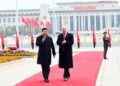
The red carpet at Joint Base Andrews, the White House ceremony, the state dinner and the National Archives visit will provide the visual language of diplomacy. The more consequential story will unfold behind closed doors, where trade, technology, rare earths, Taiwan, Iran and strategic stability meet. In that sense, Xi’s Washington visit is not simply a state occasion. It is a test of whether the world’s two largest powers can sustain communication while their strategic competition continues to reshape the international order.
-Michelle Jalonick