


NEW YORK, USA: The 81st United Nations General Assembly has opened against a backdrop in which diplomacy and military confrontation are operating almost simultaneously. On the first day of the High-Level General Debate, the world witnessed an extraordinary contradiction: from the General Assembly podium came warnings about the dangers of force, appeals for international law and calls for renewed multilateralism, while outside the chamber the United States and Iran were engaged in a new diplomatic contact over a war that has already transformed the security and economic landscape of the Middle East. The development is particularly significant because it came after U.S. President Donald Trump used his UN address to warn of further escalation if an agreement with Iran could not be reached, while U.S. envoys Steve Witkoff and Jared Kushner subsequently participated in mediated discussions with Iranian representatives in New York. Witkoff said mediators shuttled between the two sides and described the discussions as constructive and promising; Trump characterized the meeting as very good but acknowledged that the Iranian representatives were not the highest level.
The juxtaposition captures the central paradox of UNGA 81. The United Nations remains the world’s principal forum for diplomacy precisely when the mechanisms of diplomacy are under extraordinary strain. The General Debate is taking place from September 22 through September 26 and resumes on September 28, bringing national leaders and senior representatives together at a moment when Gaza, Iran, Ukraine, energy security, maritime navigation, artificial intelligence, economic fragmentation and the future of multilateral institutions have become increasingly interconnected. The formal theme, “Restoring trust, managing transformation: a United Nations that delivers for all” is therefore more than diplomatic language. It describes the structural problem confronting the international system: states need cooperation to manage global risks, but the political trust required for that cooperation has weakened.
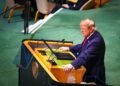
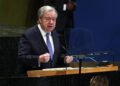
UN Secretary-General António Guterres used his final General Debate address as Secretary-General to frame the crisis in systemic rather than isolated terms. He warned that the world’s “faultlines” are widening, pointing to war, inequality, climate change and artificial intelligence as interconnected tests of how power is exercised. He called for de-escalation and dialogue in the Middle East, restoration of navigational freedoms under international law and continued international engagement on Gaza and Ukraine. He also renewed the case for reforming global institutions, including stronger African representation on the Security Council.
His argument was essentially that military power cannot by itself provide durable international security. The challenge is to build rules, institutions and diplomatic mechanisms capable of constraining the use of force before individual conflicts expand into systemic crises.
That argument was immediately tested by the extraordinary developments surrounding Washington and Tehran. The U.S.–Iran contact in New York did not constitute a publicly announced breakthrough, and the two sides remain separated by major disagreements over the war, Iran’s nuclear programme, sanctions, military pressure and the future of the Strait of Hormuz. Yet the fact that senior U.S. envoys and Iranian representatives engaged through intermediaries after months of stalled communication is diplomatically significant. The discussions followed earlier indirect contacts involving mediators in Doha and came amid Iranian indications that reopening Hormuz could be linked to changes in U.S. military and economic pressure. The immediate outcome remains uncertain, but the channel itself demonstrates that even amid severe confrontation, diplomacy has not completely disappeared.
The timing is perhaps the most revealing element. Trump’s public language and the subsequent diplomatic contact appear contradictory on the surface, but international negotiations frequently operate through precisely such combinations of pressure, signalling and communication. Public statements establish political positions; intermediaries test whether those positions leave room for negotiation; and private discussions explore conditions that governments may not yet be prepared to announce publicly. The danger, however, is that the space between coercive rhetoric and diplomacy can become extremely narrow. Miscalculation, domestic political pressure or a new military incident can quickly close the channel that negotiators are attempting to reopen.
The Strait of Hormuz has become the clearest physical expression of this dilemma. Qatar’s Amir Sheikh Tamim bin Hamad Al Thani told the General Assembly that the Gulf crisis had demonstrated the absence of a regional collective-security system and warned that an international waterway through which nearly a quarter of the world’s energy trade passes had become vulnerable to closure. He argued that disputes should be addressed through dialogue, negotiations, international law and respect for sovereignty.
The importance of the statement extends beyond the Gulf. Hormuz connects regional military calculations directly to global energy security. When navigation through the waterway is disrupted, the consequences are transmitted through oil markets, shipping, insurance, industrial costs and inflation. A conflict that begins as a regional security confrontation can therefore become a global economic shock.
Qatar’s position also highlights the emergence of regional diplomacy as a parallel track to great-power diplomacy. Doha has maintained a mediator role between competing parties and has continued discussions aimed at de-escalation. On the sidelines of UNGA 81, Sheikh Tamim met Turkish President Recep Tayyip Erdoğan, with the two leaders discussing regional developments, diplomatic efforts to reduce tensions and freedom of navigation through the Strait of Hormuz.
Qatar’s wider diplomatic activity illustrates why middle and regional powers have become increasingly important to conflict management. They may not possess the military weight of major powers, but they can sometimes maintain communication channels that adversaries find politically difficult to sustain directly.
The Gulf states are consequently not passive observers of the Iran crisis. Their geography makes them directly exposed to missile threats, maritime disruption, attacks on energy infrastructure and economic consequences. Trump also met leaders and senior representatives from Gulf Cooperation Council countries and Jordan in New York to discuss the war and the regional situation.
For the Gulf states, the issue is not simply whether Iran and the United States reach an agreement. It is whether any future settlement can create a sufficiently durable security environment to protect national infrastructure, energy exports, commercial navigation and economic transformation.
This is why Qatar’s call for a regional collective-security framework deserves attention. The proposal reflects a recurring problem in Middle Eastern diplomacy: there are numerous bilateral security relationships but no comprehensive regional security architecture accepted by all principal states. The absence of such an architecture leaves governments heavily dependent on external military guarantees while simultaneously creating incentives for regional states to develop their own partnerships and security arrangements. The result can be a cycle in which one state’s attempt to increase security is perceived by another as a threat, producing further military preparations rather than greater stability.
UNGA 81 has therefore become a meeting point for two competing approaches to international security. One approach emphasizes military strength, deterrence and the ability to impose costs. The other emphasizes negotiations, international institutions, regional arrangements and rules intended to constrain the use of force. In practice, states frequently employ elements of both. The real question is whether military pressure can eventually be translated into a diplomatic settlement or whether it instead creates conditions for prolonged confrontation.
The Middle East is not the only theatre where this question is being tested. Ukraine remains central to the European security agenda, and its war is increasingly connected to energy and global markets. Russian and Ukrainian attacks on energy infrastructure have added another layer of risk to an already strained international energy system. French President Emmanuel Macron’s discussions with Trump in New York included Ukraine, energy-market pressures and the possibility of a moratorium on attacks against energy and civilian infrastructure. Macron subsequently met Ukrainian President Volodymyr Zelenskyy, while France continued to discuss the protection of Ukrainian energy infrastructure and wider security arrangements.
The connection between Ukraine and the Middle East is therefore not merely diplomatic. It is economic. Energy infrastructure has become a target and a strategic instrument in both theatres. The war in Ukraine affects European energy security, while the Iran conflict affects Gulf energy exports and maritime routes. A simultaneous deterioration in both theatres could create consequences extending far beyond their immediate regions. This is why energy security has become one of the most important connecting themes of UNGA 81.
The same applies to maritime security. The Black Sea, Red Sea and Strait of Hormuz demonstrate how commercial waterways have become strategic theatres. Freedom of navigation is no longer simply a technical question concerning shipping law. It has become part of the wider contest over security, economic resilience and geopolitical leverage. When a maritime corridor is disrupted, the effects can reach consumers, manufacturers, farmers and governments thousands of kilometres away.
This convergence is changing the nature of geopolitical risk. The world is no longer dealing with isolated wars whose consequences remain largely regional. Military conflicts increasingly intersect with energy markets, food security, supply chains, technology and financial stability. The international economy has become so interconnected that a missile strike near an energy facility or a blockade of a maritime corridor can influence decisions in central banks, corporate boardrooms and government ministries across continents.
The opening day of UNGA 81 also demonstrated that the crisis of multilateralism extends well beyond traditional warfare. Artificial intelligence, organized crime, climate change, inequality and technological competition increasingly occupy the same strategic space as conventional security questions. Guterres argued that AI represents one of the defining tests of power in the contemporary world and called for international safeguards. (
The significance is clear: the international system is being transformed not only by armies and alliances but by technologies capable of reshaping economies, information environments and military capabilities.
Brazilian President Luiz Inácio Lula da Silva’s opening intervention before the U.S. president also placed multilateralism and international institutions at the centre of the political debate. The sequence was symbolically important. Brazil’s emphasis on diplomacy and global governance was followed by Trump’s defence of U.S. military action and his warning that further action remained possible if negotiations failed. The contrast illustrated the wider disagreement over how international order should function: through stronger collective institutions and negotiated rules, or through national power backed by the willingness to use force when governments determine that their security interests require it.
Qatar’s intervention added another layer to this debate. Sheikh Tamim argued that the Gulf crisis should not be understood only through the immediate confrontation between Washington and Tehran. His broader argument was that the region lacks an inclusive security system capable of preventing individual conflicts from pulling neighbouring states into wider confrontation.
This perspective shifts the debate from the immediate question of whether the current war can be stopped to the longer-term question of how the region might prevent the next crisis from producing the same chain reaction.
That question is increasingly relevant because the Middle East’s strategic geography makes complete isolation of conflicts almost impossible. The Gulf, Red Sea, eastern Mediterranean and wider Indian Ocean form interconnected commercial and security corridors. Energy infrastructure, ports, shipping routes and military facilities are distributed across this geography. A crisis in one location can therefore produce pressure elsewhere almost immediately.
The diplomatic activity around UNGA 81 reflects an understanding of this interconnectedness. Governments are not only negotiating with their direct adversaries. They are also speaking to neighbouring states, energy partners, European governments, regional organizations and international institutions. The objective is partly to prevent secondary consequences even when the primary conflict cannot yet be resolved.
This is where the United Nations remains indispensable, despite the criticism directed at it. The institution cannot force governments to abandon their strategic interests. It cannot independently stop wars when powerful states choose confrontation. But it provides something that no individual government can replicate: a universal diplomatic arena in which virtually every country can place its position on record and maintain communication with others.
The challenge is credibility.
The opening address by General Assembly President Khalilur Rahman put the problem bluntly: people outside the UN are asking not whether the organization exists, but whether it works. He linked that question to Security Council effectiveness, reform, development finance, AI governance and the representation of Africa.
The issue is therefore not simply institutional survival. It is whether the UN can demonstrate sufficient effectiveness to justify the expectations placed upon it. That challenge becomes particularly acute when international law is invoked inconsistently. Guterres argued that international humanitarian law, civilian protection and humanitarian access cannot be applied selectively. The credibility of a rules-based system depends not only on the existence of rules but on whether governments believe those rules apply across geopolitical boundaries.
UNGA 81 is consequently exposing an international order caught between two realities. The first is that power remains decisive: military capabilities, economic strength, technological capacity and strategic geography continue to shape international outcomes. The second is that power alone cannot manage an interconnected world indefinitely. Even the strongest states depend on secure shipping, functioning markets, stable energy supplies, diplomatic communication and international institutions.
The emerging diplomatic landscape is therefore unlikely to be defined by a simple choice between power and multilateralism. States will continue to use power to defend interests while simultaneously relying on diplomacy to prevent the costs of confrontation from becoming unmanageable. The New York meetings demonstrate this coexistence.
The U.S.–Iran mediated contact is perhaps the clearest example. The public confrontation remains severe, yet negotiators are still testing whether a pathway toward an agreement exists. Qatar continues to advocate dialogue and regional security arrangements. Gulf states are seeking protection for their infrastructure and navigation. France is connecting European security with energy and maritime concerns. Ukraine remains engaged in efforts to protect its energy system and secure international support. And the United Nations continues to provide the institutional setting in which these competing agendas intersect.
The significance of UNGA 81, therefore, lies not in the expectation that one week in New York will resolve the world’s conflicts. It will not. Its importance lies in the fact that diplomacy is still functioning alongside confrontation.
That distinction matters.
The most dangerous international environments are not necessarily those in which governments disagree. Disagreement is permanent in international politics. The greater danger emerges when communication disappears, when crisis-management mechanisms fail and when military escalation becomes easier than political negotiation.
New York is currently testing whether those channels can remain open. The U.S.–Iran discussions may or may not develop into a broader negotiation. The outcome remains uncertain. But their occurrence after months of stalled communication demonstrates that even intense confrontation leaves room for diplomacy. Qatar’s intervention demonstrates the demand for a regional security mechanism. France’s engagement demonstrates how energy and maritime security now connect European and Middle Eastern calculations. Guterres’s address demonstrates the continuing effort to place military power within a wider framework of international law and multilateral cooperation.
The world that has arrived at UNGA 81 is therefore not simply a world at war. It is a world negotiating the meaning of power itself.
Who can use force? Who can restrain it? Who guarantees maritime security? Who controls critical energy routes? Who defines the rules governing artificial intelligence? Who gets representation in global institutions? And, ultimately, who has the authority to shape the rules of an international system that is becoming increasingly multipolar?
These questions will not be answered by one speech or one meeting. But they are being negotiated, sometimes publicly, sometimes privately and sometimes through intermediaries in New York this week.
The General Assembly Hall has become the visible stage. The real test of UNGA 81 is taking place beyond it: whether adversaries can continue talking, whether regional powers can build mechanisms for collective security, whether major powers can translate pressure into negotiation, and whether the international system can restore enough trust to prevent today’s interconnected crises from becoming tomorrow’s permanent instability.
For a world facing simultaneous wars, energy shocks, technological disruption and institutional uncertainty, diplomacy is no longer merely an instrument for ending conflicts. It is becoming an instrument for keeping the international system from breaking apart.
– Dr. M Shahid Siddiqui, From UN Headquarters, New York
READ THE FULL E-MAGAZINE | WorldAffairs: For Decision-Makers Who Need More Than Headlines