

ASUNCIÓN: Paraguay is confronting one of the most serious political and financial crises of its recent history after the collapse of Ueno Bank triggered criminal investigations, public protests and an impeachment process against President Santiago Peña. What began as a banking-sector emergency has rapidly evolved into a test of political accountability, regulatory independence and the credibility of the country’s financial institutions.
The crisis has placed Peña’s presidency in unprecedented danger. On 5 November, the president announced his resignation, citing the need to protect national stability, social peace and democratic institutions. Yet his departure did not proceed as expected. The resignation was not formally accepted after a congressional session lost its quorum, while the Chamber of Deputies approved an impeachment accusation against him by 78 votes. The matter subsequently moved to the Senate, which began proceedings on 5 November. Peña is scheduled to exercise his right to defence on 6 November.

The distinction between resignation and impeachment is politically and legally significant. Opposition lawmakers argue that accepting Peña’s resignation could allow him to retain eligibility for a lifetime Senate seat, potentially providing constitutional protections that could complicate future prosecution. They therefore want the impeachment process to continue, with removal from office carrying different legal consequences. The Senate must now determine whether the allegations justify his removal. Under the constitutional procedure, a two-thirds majority of the 45-member chamber 30 votes is required for a finding of guilt and dismissal.
The crisis has also exposed fractures within the ruling Colorado Party, which has dominated Paraguayan politics for decades. The party’s support for impeachment in the lower chamber represents a remarkable reversal for a president who had previously enjoyed considerable backing from the country’s political establishment. The episode raises a broader question about whether political loyalty can survive when a financial crisis threatens the savings, pensions and livelihoods of a large section of the electorate.
At the centre of the controversy is Ueno Bank, a digital lender that expanded at extraordinary speed from a relatively obscure financial operation into one of Paraguay’s most widely used banking institutions. It reportedly served approximately three million customers, representing more than 60 per cent of the country’s adult population. Its rapid expansion made it a major player in the domestic financial system, but its growing importance also increased the consequences of any failure in governance, lending controls or regulatory supervision.
The Central Bank of Paraguay initiated the bank’s resolution process on 2 November after adjustments to its financial statements revealed that its solvency ratio had fallen below 50 per cent of the legally required minimum. The regulator cited problems identified during the institution’s regularisation process and said the intervention was intended to protect depositors and preserve financial stability. The resolution process involves assessing the bank’s assets and liabilities, protecting eligible deposits and determining how recoverable assets can be transferred or managed.
The underlying allegations are particularly serious. Reports indicate that bank inspectors identified substantial lending to companies connected to the institution’s controlling interests, with concerns involving inadequate documentation, insufficient collateral and possible breaches of lending limits. Regulators also identified expenses that had been incorrectly recorded as assets. Once the accounts were adjusted, the bank’s capital position deteriorated sharply.
These findings raise questions that extend beyond the conduct of individual bank executives. They concern the effectiveness of internal risk management, the independence of financial supervision and the capacity of regulators to intervene before a rapidly expanding institution becomes a systemic source of instability.
The political dimension is complicated by Peña’s previous connection to a company linked to Ueno. The president held a stake in a company associated with the bank’s business group until 2025, according to reports. He has denied having a direct investment in Ueno Bank and has said he would cooperate with investigators. Nevertheless, his past business connection has intensified scrutiny of possible conflicts of interest, particularly because public institutions placed substantial funds with the lender.
According to reporting by Reuters and the Associated Press, Ueno held approximately US$800 million to US$850 million in public funds. These deposits reportedly included money associated with the state pension and health system and public entities connected to Paraguay’s major hydroelectric operations. The concentration of public resources in a privately controlled institution has therefore become one of the most politically sensitive aspects of the affair.
The question is not simply why public funds were deposited with Ueno. It is whether the institutions responsible for safeguarding those resources conducted adequate risk assessments, whether the applicable exposure limits were respected and whether warnings were acted upon in time. These issues are central to the criminal investigations now being pursued by Paraguay’s Public Prosecutor’s Office.
On 5 November, Attorney General Emiliano Rolón Fernández ordered the opening of three criminal investigations concerning the supervision and resolution of Ueno Bank, the placement of public funds in the institution and the conduct of current and former government officials. The investigations include allegations involving Peña and other officials, as well as questions surrounding the actions of the Central Bank and public institutions that deposited money with the lender. The prosecutor’s office has appointed a specialised team to examine the allegations.
It is important to distinguish an investigation from a criminal conviction or even a formal finding of guilt. Peña’s inclusion in the matters under investigation does not establish that he committed an offence. The authorities must establish whether any individual violated the law, whether regulatory failures involved negligence or misconduct and whether public resources were placed at risk through improper decisions.
https://x.com/Reuters/status/2118457017459499319?a=Dur-8HvmYC6QawHtlJg&s=20
The bank’s executives are also facing serious legal proceedings. Prosecutors have brought charges against 27 bank officials and associates in connection with alleged financial misconduct, including breach of trust and attempted fraud. A judge ordered the detention of several senior figures, including founder Miguel Vázquez and bank president Juan Manuel Gustale, while other individuals were placed under house arrest. The defence has disputed aspects of the allegations, with lawyers arguing that responsibility for individual lending decisions did not necessarily rest with the bank’s senior leadership.
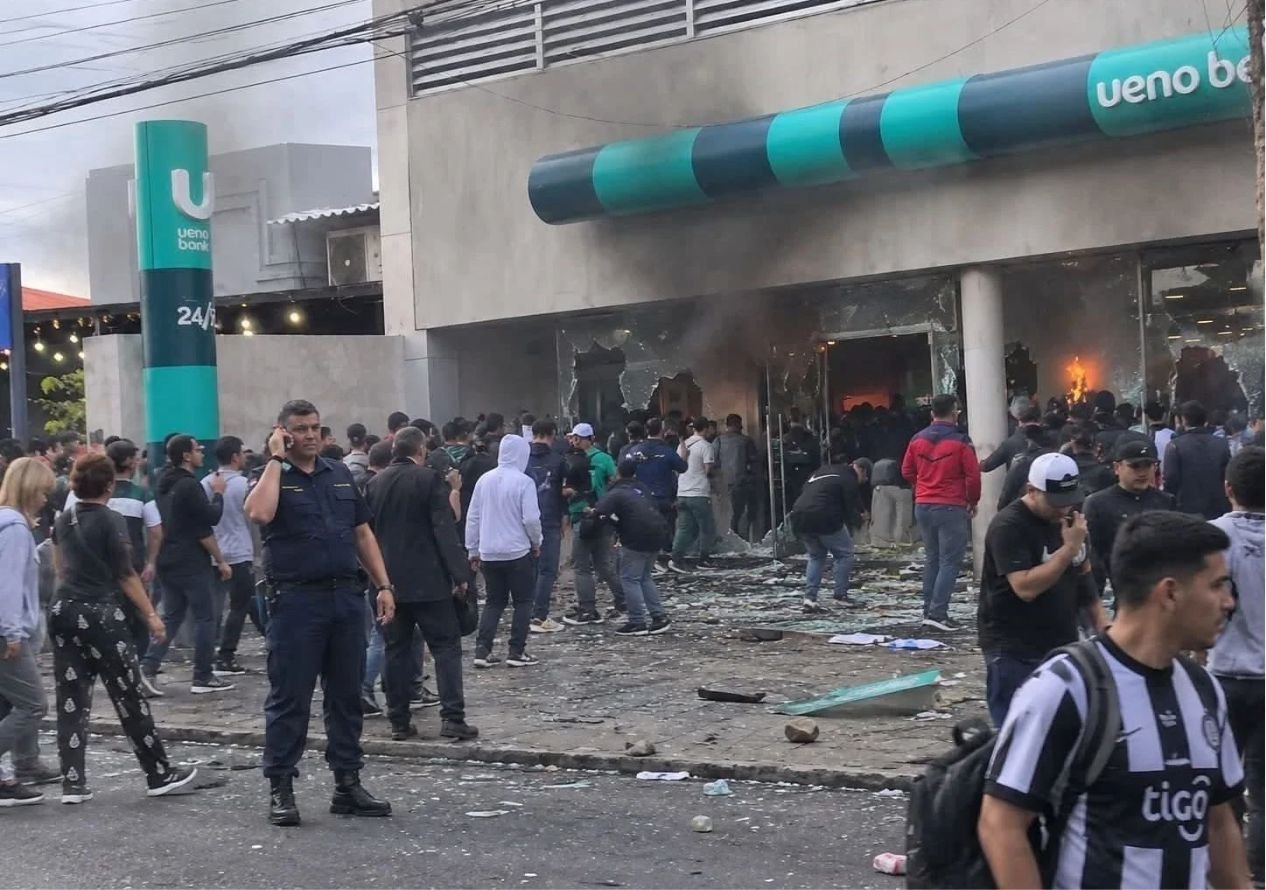
The collapse has had immediate consequences for ordinary Paraguayans. Ueno’s digital services, cards and transfers were disrupted, leaving customers unable to access their savings. Long queues formed outside branches, while concerns spread to other financial institutions as customers attempted to move their money elsewhere. The resulting pressure on banking applications and payment systems demonstrated how quickly confidence can deteriorate when a widely used financial institution becomes inaccessible.
The employment impact has been equally serious. Paraguay’s Labour Ministry has estimated that approximately 7,000 direct and indirect jobs have been affected across the bank and associated businesses. Employees have protested over unpaid wages and severance, while depositors have demanded the return of their savings. The crisis has therefore become a social and economic issue rather than remaining confined to financial regulators and political institutions.
Authorities have moved to limit the damage through the country’s Deposit Guarantee Fund. The Central Bank has begun the first stage of payments to eligible Ueno depositors, initially covering accounts with balances of up to 10 million guaraníes, provided customers meet specified conditions, including having no outstanding debts to the bank and an account at another financial institution. A legislative measure has also established an advance mechanism of up to 40 minimum monthly wages per depositor, subject to applicable deductions and conditions, with the payment process required to begin within 24 hours and be completed within five business days.
The broader statutory deposit guarantee covers up to 75 minimum monthly wages per depositor, equivalent to 228.3 million guaraníes under the current calculation. The Central Bank has stated that the resolution concerns a specific institution and does not, in itself, indicate a generalised weakness across Paraguay’s banking system. Nevertheless, the distinction between the legal guarantee, the initial payment and the recovery of deposits exceeding the protected limit is important. Customers whose balances are above the applicable coverage may face a more complicated recovery process.
The government’s immediate priority is to prevent a crisis of confidence from spreading through the wider financial system. Yet the longer-term challenge is institutional. Deposit guarantees can protect eligible customers, but they cannot substitute for effective supervision, transparent lending practices and credible mechanisms to identify excessive exposure before a bank becomes insolvent.
Paraguay’s economic record makes the crisis especially consequential. The country has benefited from relatively stable macroeconomic management, agricultural exports, hydropower generation and improved sovereign credit standing. Its investment-grade ratings have helped strengthen its international financial profile and improve its attractiveness to investors. A banking scandal involving public deposits and senior political figures threatens to undermine confidence in the institutions that supported this progress.
The country’s reputation as a comparatively stable investment destination now faces a test. International investors will be watching whether the authorities can resolve Ueno’s failure transparently, protect depositors, recover public resources where possible and establish accountability without political interference. The credibility of the Central Bank and the independence of the prosecutor’s office will be particularly important.
There is also a wider governance question. Paraguay’s experience illustrates the risks created when political, business and regulatory networks become too closely interconnected. A financial institution can grow rapidly, attract public deposits and become central to everyday economic activity, but its size and political relationships must never place it beyond independent scrutiny. Effective regulation requires not only technical capacity but also institutional distance from the interests being supervised.
For the United States and other international partners, the crisis presents a more complicated picture of a country that has recently been viewed as a strategically important partner in South America. Peña had been received in Washington as a close partner of the Trump administration. However, diplomatic relationships cannot insulate governments from domestic accountability. The political future of Paraguay’s leadership will depend primarily on its constitutional institutions, the evidence presented in the investigations and the confidence of its citizens.
The immediate political outcome remains uncertain. Peña has offered to resign, but the resignation has not been formally accepted. The Senate’s impeachment proceedings are continuing, and the president has the opportunity to defend himself before lawmakers. If he is removed, Vice President Pedro Alliana would assume the presidency under the constitutional succession arrangements. The criminal investigations, however, would remain a separate legal process.
Ultimately, the Ueno Bank crisis is a warning about the relationship between financial stability and democratic accountability. A bank serving millions of citizens cannot be treated as an ordinary private enterprise when public funds, pension resources and the savings of ordinary households are involved. Equally, political responsibility must be established through evidence and due process, not merely through public anger or partisan calculations.
Paraguay now faces two interconnected tests: whether it can restore confidence in its financial system and whether its institutions can investigate allegations involving the highest levels of government without fear or favour. The resolution of Ueno’s deposits will determine whether citizens recover their money; the outcome of the Senate trial and criminal investigations will determine whether the country’s political and regulatory institutions can restore public trust.
Ueno Bank’s collapse has become more than a banking failure; it is a defining test of Paraguay’s institutional credibility, financial governance and democratic accountability.
-DeBre Sáenz