


NEW DELHI, India: South Korea’s latest diplomatic push toward India is no longer just about expanding trade, it is about correcting a strategic imbalance that both sides can no longer afford to ignore.
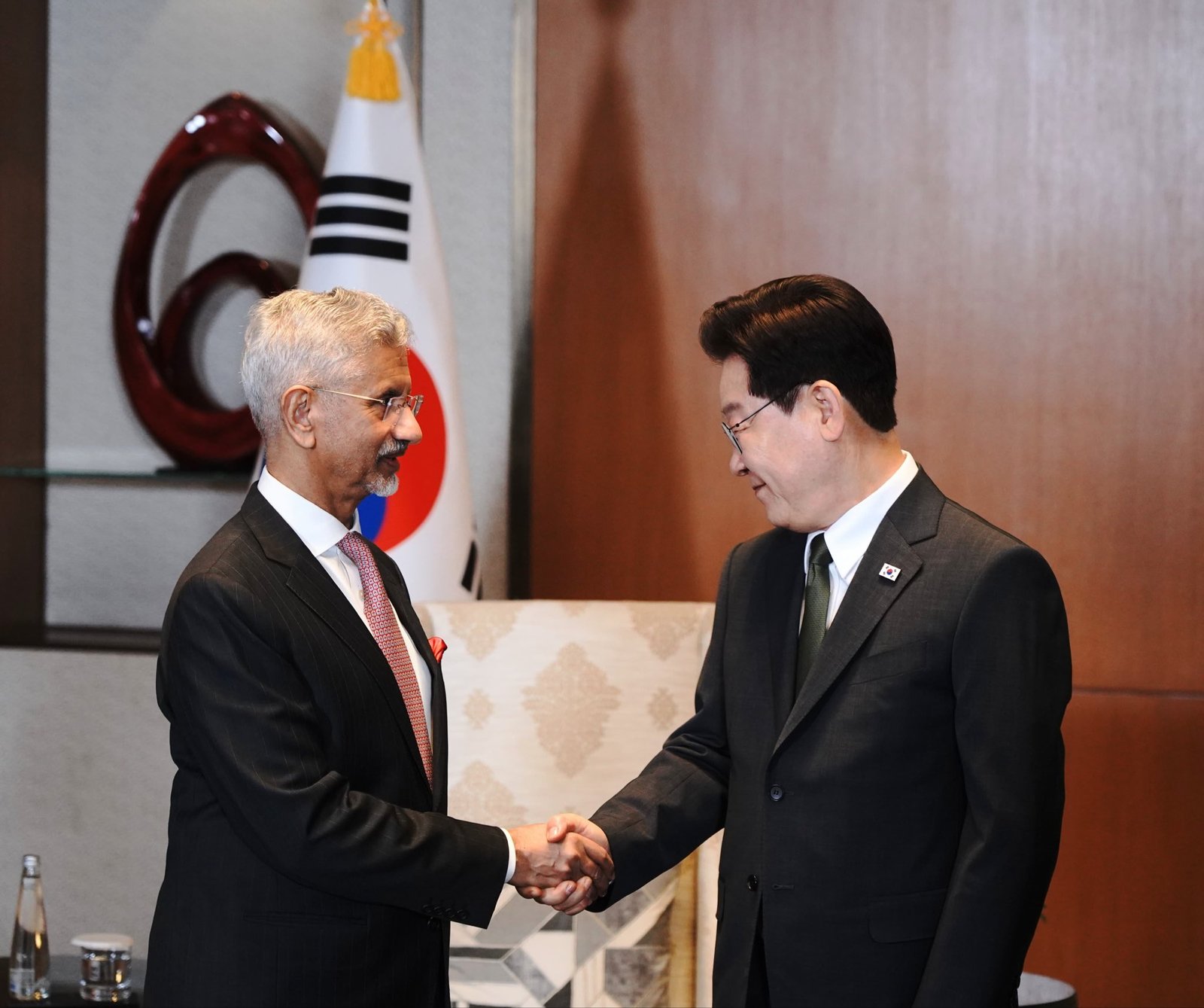
As Lee Jae Myung begins his three-day visit to India, his unusually blunt assessment, that economic cooperation between the two countries remains “very low”, sets the tone for what is at stake. When he meets Narendra Modi in New Delhi, the conversation will not merely revolve around agreements, but around redefining the architecture of India–South Korea ties for a far more uncertain world.
This is the first South Korean presidential visit to India in eight years, a gap that now appears strategically costly. In that period, global supply chains have fractured, geopolitical tensions have intensified, and India has quietly transitioned from being seen as a consumption-driven market to a serious production and technology hub. Seoul’s recalibration reflects that shift.
The headline ambition to double bilateral trade to $50 billion by 2030 from roughly $25.7 billion is significant, but the real story lies beneath the numbers. The current trade structure is heavily skewed in favor of South Korea, which enjoys a $12.8 billion surplus. For India, this imbalance has long been a source of friction; for Seoul, it is increasingly a strategic vulnerability. An unbalanced partnership is rarely a stable one, particularly when both sides are seeking deeper integration.
What has changed in the latest developments is the scope and urgency of cooperation. The agenda now extends well beyond traditional sectors into artificial intelligence, finance, defense, and advanced manufacturing. These are not peripheral areas, they define the future of economic power. South Korea’s technological strengths and India’s scale and talent base create a natural, if still underutilized, synergy.
Equally telling is the scale of business engagement surrounding the visit. Lee’s participation in high-level corporate events and the presence of major South Korean conglomerates signals that this is not diplomacy in isolation. It is a coordinated push where state policy and private capital are moving in tandem. Without this alignment, previous efforts such as the Comprehensive Economic Partnership Agreement (CEPA) struggled to deliver on their promise. This time, there is a clearer recognition that trade agreements alone are insufficient without investment flows and industrial collaboration.
Energy security and supply chain resilience are quietly shaping the urgency of these talks. South Korea’s recent request for expanded naphtha supplies from India underscores a deeper concern: overdependence on volatile regions amid ongoing geopolitical tensions. India, while also energy-dependent, is emerging as a more stable and scalable partner in this equation. This convergence of vulnerabilities is pushing both countries closer, not out of convenience, but necessity.
At the same time, structural irritants remain. India’s long-standing concerns over market access and trade deficits will not disappear overnight. Upgrading CEPA will require difficult negotiations, particularly if New Delhi seeks more equitable terms in sectors where South Korea has traditionally dominated, such as automobiles, electronics, and heavy industry.
Yet, the broader strategic context may override these frictions. As global economic fragmentation accelerates, middle powers like India and South Korea are increasingly compelled to build resilient, diversified partnerships. Neither can rely solely on existing alliances or legacy supply chains. In that sense, this summit is less about bilateral optics and more about hedging against an unpredictable global order.
Lee’s remark that the relationship must become “completely different” is not rhetorical flourish, it is an acknowledgment that incremental change is no longer enough. The question is whether both sides are prepared to match ambition with structural reform and sustained execution.
If they succeed, this could mark a turning point where India–South Korea ties evolve from underperformance to strategic relevance. If they fall short, it will reinforce a familiar pattern: high expectations, modest outcomes.