



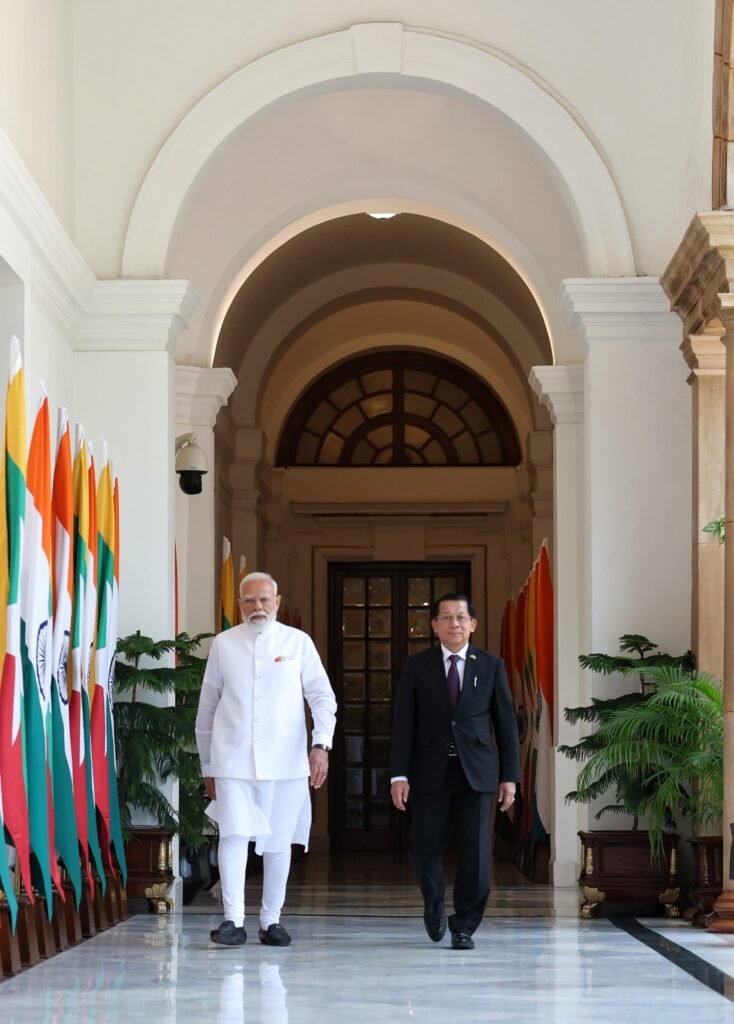
NEW DELHI, India: Myanmar’s President Min Aung Hlaing’s official visit to India marks a defining moment in the recalibration of regional diplomacy, where economic pragmatism and geopolitical strategy are increasingly intertwined. Hosted by Prime Minister Narendra Modi from May 30 to June 3, the visit signals Myanmar’s attempt to reinsert itself into regional engagement while offering India a strategic opening to deepen influence in a critical frontier state.
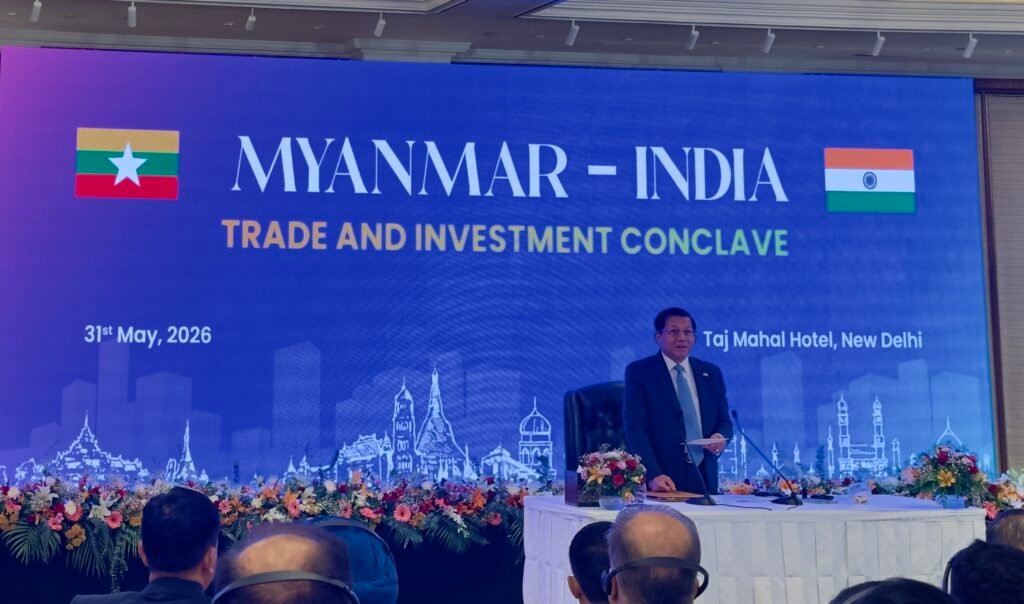
At the heart of the visit lies a deliberate shift from political optics to economic substance, most visibly captured in the India–Myanmar Business Conclave held in New Delhi. Far from a ceremonial engagement, the conclave functioned as the economic centerpiece of the visit, bringing together business leaders from sectors ranging from energy and agriculture to banking, IT, logistics, and pharmaceuticals. It highlighted a clear message: Myanmar is open for business, and India is prepared to engage.
Min Aung Hlaing’s keynote address at the conclave underscored Myanmar’s intent to attract investment, expand trade, and position itself within regional supply chains. For a country navigating post-coup isolation and internal conflict, economic diplomacy has become a critical tool for survival. The presence of a large and diverse business delegation reinforced this approach, signaling that Naypyidaw is prioritizing economic normalization as a pathway to broader international engagement.
For India, the conclave represents more than commercial opportunity, it is a strategic instrument. Myanmar’s resource base, particularly its rare earth deposits and energy potential, aligns closely with India’s long-term economic and technological ambitions. As global supply chains undergo restructuring, access to alternative sources of critical minerals has become a priority for New Delhi. Engagement through business platforms allows India to secure these interests while embedding itself more deeply in Myanmar’s economic landscape.
The broader diplomatic engagement reflected this convergence of interests. Discussions between the two sides spanned trade, connectivity, security, and cultural cooperation, reinforcing Myanmar’s position within India’s Neighbourhood First, Act East, and MAHASAGAR frameworks. Connectivity projects such as the Kaladan Multi-Modal Transit Transport corridor and the India-Myanmar-Thailand trilateral highway were reaffirmed as central pillars of the relationship, underscoring their importance in linking South Asia with Southeast Asia.
Economic mechanisms introduced during the visit further highlight a shift toward functional cooperation. The expansion of the rupee-kyat settlement system reflects an effort to facilitate trade while bypassing external financial constraints. Increased collaboration in sectors such as mining, petroleum, and agro-processing signals a move toward deeper economic integration, with both sides seeking to capitalize on complementary strengths.
The visit also demonstrated how economic diplomacy is being used to offset geopolitical pressures. China’s entrenched influence in Myanmar remains a defining factor in regional dynamics. By strengthening economic ties through platforms like the Business Conclave, India is positioning itself as an alternative partner, one capable of offering investment, technology, and market access without the same level of dependency.
At the same time, security concerns remain central to the relationship. Both countries reiterated their commitment to ensuring that their territories are not used for activities that threaten each other’s stability. This is particularly relevant along India’s northeastern frontier, where insurgency and cross-border tensions persist. Economic engagement, in this context, is not separate from security, it is part of a broader strategy to stabilize border regions through development and cooperation.
Symbolism, however, was not absent. Min Aung Hlaing’s visit to Bodh Gaya served as a reminder of the deep cultural and spiritual ties between the two countries, reinforcing a softer dimension of diplomacy that complements strategic engagement. Similarly, India’s expansion of Mekong-Ganga scholarships reflects a long-term investment in building influence through education and cultural exchange.
Yet, the underlying contradictions remain. India’s engagement with Myanmar’s leadership, despite ongoing international scrutiny, reflects a pragmatic recognition that isolation has limits. In a region defined by strategic competition, engagement is increasingly seen as the more effective tool. For Myanmar, this creates space to pursue what can be described as selective normalization rebuilding external ties without fundamentally altering its internal political trajectory.
The Business Conclave, in this context, becomes more than an economic forum; it is a signal of intent. It demonstrates that both countries are willing to prioritize opportunity over hesitation, and strategy over symbolism. It also reflects a broader shift in regional geopolitics, where economic engagement is emerging as the primary currency of influence.
Min Aung Hlaing’s visit does not resolve Myanmar’s internal challenges, nor does it fully restore its international standing. What it does achieve is the creation of a new pathway, one defined by trade, connectivity, and strategic alignment. For India, the challenge will be to translate this engagement into sustained influence without becoming entangled in Myanmar’s internal complexities.
In the end, the reset is not about reconciliation, it is about realignment. And in that realignment, New Delhi’s business corridors may prove just as significant as its diplomatic ones.
⁃ Dr. M Shahid Siddiqui