

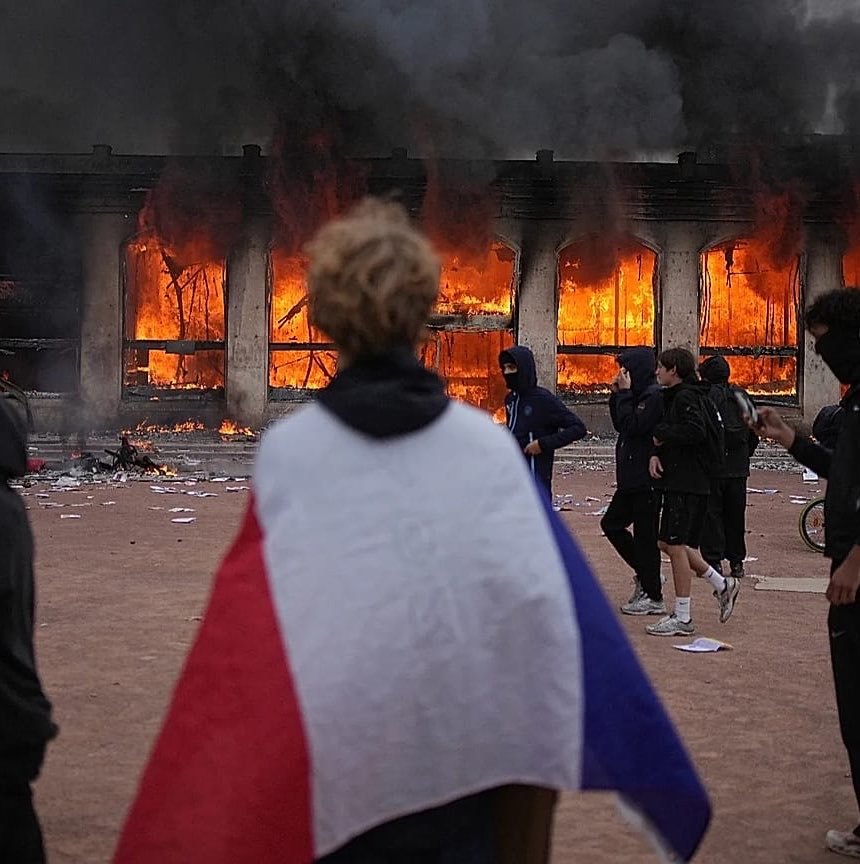
PARIS: From France to Albania, economic insecurity, deteriorating public services and political distrust are turning Europe’s streets into arenas of confrontation.
Europe is confronting a crisis that extends far beyond demonstrations, burning buildings and clashes with police. From France and Italy to Spain, Portugal and Albania, mounting public anger is exposing a widening gap between political promises and the everyday realities of ordinary citizens. Rising fuel costs, inflation, underfunded schools, deteriorating public services and an increasingly unaffordable housing market have created the conditions for an autumn of unrest. For weeks, crowds have occupied major European cities. Peaceful marches have, in some instances, deteriorated into looting, arrests, injuries and violent confrontations. Tent encampments have appeared in Spain and Portugal, where housing costs have become increasingly unattainable for younger generations. The geography differs, but the underlying grievance is remarkably consistent: millions of people are questioning whether the economic and political systems governing their lives can deliver security, dignity and opportunity.
María Silvestre, a sociology professor at Spain’s University of Deusto, describes young Europeans as experiencing a profound sense of uncertainty and a lack of control. When multiple frustrations converge, she argues, a specific incident can ignite accumulated resentment and propel people into the streets. That observation captures the deeper significance of Europe’s present turmoil. These demonstrations are not simply isolated reactions to individual policies. They reflect a broader crisis of confidence in the social contract between governments and citizens.
France: When Schools Become a Flashpoint
France, with its centuries-old tradition of popular protest, offers the clearest illustration of how a sector-specific grievance can evolve into a nationwide political confrontation. For more than three weeks, high school students have organised blockades and demonstrations demanding greater resources for schools they describe as understaffed and dilapidated, particularly in lower-income neighbourhoods. The movement expanded when the CGT labour union and other activists joined the protests while students paused for their autumn break. Demands subsequently widened to encompass rising living costs and declining public services.
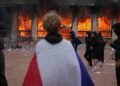
Although hundreds of thousands participated in peaceful marches, the weekend’s unrest produced approximately 2,400 arrests and serious disturbances in Paris, Marseille, Lyon and Bordeaux. In Limoges, flames engulfed the nineteenth-century City Hall, nearly destroying the historic building. Some schools were also set on fire.As students and other rioters threw firebombs, law enforcement responded with tear gas, leaving hundreds injured.
President Emmanuel Macron condemned the violence, accusing far-left activists of attempting to foment chaos through attacks on public buildings and police. In a rare televised address, he warned that those responsible for looting would pay for the damage and those seeking to undermine the Republic would be held accountable.
The violence, however, has also become an instrument of political competition. US President Donald Trump portrayed immigrants as responsible for France’s destruction, writing on Truth Social on Monday: “The migrants have taken over France. They must CLOSE THE BORDERS, FAST!” Yet French authorities and police have not blamed immigrants for the unrest. While masked, black-clad agitators have contributed to violence, many demonstrators have been mobilised by economic hardship and concerns about public services. Trump’s intervention illustrates how domestic unrest can be reframed through the polarising politics of immigration, potentially diverting attention from the grievances that initially brought people onto the streets.
Spain: The Housing Crisis Is Devouring Opportunity
In Spain, the struggle for affordable housing has become one of the most visible expressions of generational frustration. For weeks, tarpaulin tents have covered Madrid’s central Puerta del Sol as protesters demand relief from soaring housing costs. The demonstrations were sparked by the eviction of Maricarmen, an 87-year-old woman who subsequently died while hospitalised. Smaller encampments emerged in other Spanish cities, while Barcelona became another focal point because of its housing pressures and overtourism.
The economic arithmetic is stark. Spain’s monthly minimum wage stands at €1,221, while the average monthly rent for an 80-square-metre apartment is approximately €1,130, according to an analysis by business newspaper Expansión. Rent alone can therefore consume nearly an entire minimum-wage payment before food, transport, utilities and other essentials are considered.
Diana Manzanares, a 20-year-old waitress at Madrid’s encampment, described how most of her salary goes towards rent, leaving her roommate struggling to make ends meet. She characterised this as the reality confronting many people living in the city. The pressure forced the ruling Socialist government to approve affordable-housing measures, but insufficient parliamentary support prevented their passage. Prime Minister Pedro Sánchez subsequently announced a snap election for November. A general strike was also called for November, the first in 14 years. The political implications are substantial. When working people cannot secure housing despite employment, economic participation no longer guarantees independence. For younger Europeans, the prospect of building a stable life increasingly appears disconnected from hard work. Portugal faces similar demonstrations in Lisbon and Porto, where housing costs have also become a central source of public anger.
Italy: Inflation Meets Public Discontent
Italy’s “Italia in Piazza”, or Italy in the Streets, has mobilised thousands demanding better employment opportunities, healthcare, education, housing access and higher wages. The demonstrations coincide with an inflation rate of 4.2% in September, exceeding the eurozone rate of 3.8%, according to government data. Persistent increases in everyday expenses have intensified pressure on households already struggling to maintain their living standards.
Peaceful marches were followed by violent riots in Turin, Bologna and Milan, Italy’s financial and fashion capital. Masked rioters clashed with police, looted shops and set property on fire. Milan police reported 271 arrests over two days, most involving minors, while 14 security officers were injured. The emergence of the newly formed “Oct. 17 Movement” signals that the mobilisation may continue. The group has announced what it calls a permanent campaign, with demonstrations scheduled every Saturday at 3 p.m. in cities across Italy. The challenge for Italy’s leadership is to distinguish legitimate economic grievances from criminal violence without allowing either to obscure the other.
Albania: Anti-Corruption Anger Takes Centre Stage
In Albania’s capital, Tirana, anti-government demonstrations have continued for more than a week. Tensions escalated after high school and university students joined the broad-based “Flamingo” movement, which is demanding the resignation of Socialist Prime Minister Edi Rama. Rama has characterised protesters as “ideologized and radicalized” by antifa, a term commonly applied to loosely organised far-left militants in the United States. Trump has designated that movement a terrorist organisation. The central demand of Albania’s movement, however, is an end to corruption. Its name refers to flamingos’ natural habitat in an area where Rama’s government agreed to permit a major luxury tourism development linked to Jared Kushner, Trump’s son-in-law. Protesters are also demanding safeguards for healthcare, education and public pensions, according to the movement’s website. These demands raise a fundamental question about political legitimacy: can governments maintain public confidence when citizens suspect that political connections and commercial interests receive greater consideration than essential public needs?
Serbia: A Political Reckoning Approaches
Serbia demonstrates how public discontent can develop into a prolonged challenge to established political power. University students have led mass anti-corruption protests for nearly two years. They are now challenging an attempted political comeback by former populist leader Aleksandar Vučić, who seeks to become prime minister following the October 25 parliamentary vote. The youth-backed Students’ List party is believed to be running close to Vučić’s party, making the election outcome uncertain and intensifying fears of possible violence. The contest is significant beyond electoral arithmetic. It reflects a struggle over accountability, political renewal and the ability of younger citizens to influence the direction of their country.
Europe’s Political Warning
Europe’s unrest is unfolding as major economies, including France, Italy and Spain, approach pivotal elections. Far-right parties have made electoral gains in Germany and could advance elsewhere by exploiting public frustration. The geopolitical environment adds another layer of uncertainty. Europe is at a critical juncture in its support for Ukraine, even as Trump makes overtures to Russian President Vladimir Putin and Moscow faces accusations of increasingly frequent hybrid attacks in NATO countries. These external pressures reinforce the urgency of domestic stability. Governments confronting public distrust at home may find it harder to sustain political consensus on defence, foreign policy and economic priorities abroad.
Yet the answer cannot be reduced to tougher policing or political denunciations. Violence, arson and looting demand accountability, but treating every protester as an extremist risks deepening the alienation that makes unrest possible. Europe’s leaders must confront the structural causes: unaffordable housing, wages that fail to provide security, schools starved of resources, strained healthcare and public services, and persistent doubts about political accountability. The continent’s streets are delivering a warning that election campaigns and official assurances cannot indefinitely silence. When young people lose faith in their ability to shape their future, anger becomes a political force rather than a passing disturbance. The question confronting Europe is no longer simply how to restore order. It is whether its governments can restore public confidence before economic frustration becomes a lasting crisis of democratic legitimacy.
-Christopher Freed