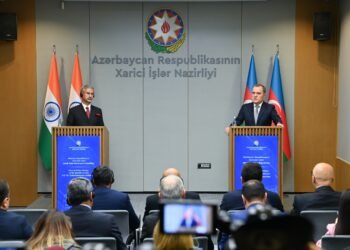


BAKU, Azerbaijan: India’s diplomatic engagement with Azerbaijan has entered a new phase, but the central question remains unresolved: can economic interests and geopolitical pragmatism repair a relationship damaged by conflicting regional loyalties? External Affairs Minister S. Jaishankar’s October 23 visit to Baku, where he met President Ilham Aliyev and held talks with Foreign Minister Jeyhun Bayramov, signals that New Delhi and Baku are prepared to move beyond their recent tensions. Yet neither side has suggested that their strategic differences have disappeared. The emerging relationship is therefore less a restoration of friendship than an attempt to establish workable cooperation between countries that do not always agree on the region’s most consequential security questions.
The visit matters because the deterioration in India–Azerbaijan relations was not merely a diplomatic misunderstanding. It exposed a deeper conflict between India’s security priorities and Azerbaijan’s established partnerships with Pakistan and Türkiye. It also demonstrated the limits of economic engagement when political trust weakens.
The timing is significant. In September 2026, Prime Minister Narendra Modi met Aliyev on the sidelines of the Shanghai Cooperation Organisation summit in Bishkek. Jaishankar’s subsequent visit was the first standalone bilateral visit to Azerbaijan by an Indian foreign minister in eight years. Both developments indicate a deliberate effort to reopen high-level political engagement rather than allow disagreements to define the entire relationship. The diplomatic language emerging from Baku deserves particular attention. Bayramov acknowledged that disagreements between the two countries had affected bilateral relations and opportunities for cooperation within international organisations. He described the discussions as open and constructive and expressed confidence that they could lay the foundation for taking relations to a higher level.
That acknowledgement is important because a meaningful diplomatic reset begins with recognising the problem. It also reveals the cost of prolonged estrangement: differences that begin as bilateral disputes can gradually restrict cooperation in trade, investment, multilateral diplomacy and regional connectivity. Operation Sindoor was a decisive point in this deterioration. Following the April 22, 2025, terrorist attack in Pahalgam, India launched military strikes against what it described as terrorist infrastructure in Pakistan and Pakistan-administered territory in May 2025. Azerbaijan criticised India’s action, placing Baku at odds with New Delhi at a moment when counterterrorism and national security were central to Indian public and diplomatic debate.
For India, the concern extended beyond Azerbaijan’s public statements. Baku’s close political and defence relationships with Pakistan and Türkiye raised a broader question about whether India could rely on a partner that appeared to interpret a major Indian security operation through the preferences of its own regional allies.
Yet the strategic picture is more complicated than a simple division between friends and adversaries. Azerbaijan has cultivated close relations with Pakistan, while Türkiye remains a central security and political partner. These relationships reflect years of defence cooperation, diplomatic coordination and shared regional interests. New Delhi cannot reasonably expect Baku to abandon those partnerships simply because India has objected to their implications.
Equally, Azerbaijan cannot assume that its own strategic alignments will remain inconsequential to India’s assessment of bilateral relations. When a country’s political positions directly affect another state’s core security concerns, the consequences inevitably extend beyond rhetoric. The challenge for both governments is to establish boundaries between disagreement and obstruction. India need not endorse Azerbaijan’s regional policies to maintain commercial and diplomatic relations. Azerbaijan, similarly, need not agree with every Indian position to recognise the benefits of cooperation with one of the world’s major economies. But sustainable engagement requires each side to understand that its actions can carry costs for the relationship.
Jaishankar’s message in Baku reflected this calculation. He described India and Azerbaijan as independent-minded countries that make their own decisions on important international questions. He also emphasised their common interest in peace, progress and prosperity, identifying terrorism, conflict and instability as shared threats. This formulation is diplomatically useful, but its significance will depend on implementation. Strategic autonomy cannot mean indifference to the choices of partners. Nor can it become a convenient phrase for avoiding difficult conversations. If India and Azerbaijan genuinely want a more contemporary partnership, their independent foreign policies must coexist with a credible mechanism for addressing disagreements.
For New Delhi, there is a compelling economic and geopolitical reason to keep that channel open. Azerbaijan occupies an important position in the South Caucasus, linking the Caspian region with transport and commercial networks connecting Europe and Asia. Its location gives it relevance to India’s wider Eurasian ambitions, including the development of alternative trade routes and access to regional markets.
The International North-South Transport Corridor, or INSTC, is a central part of this calculation. The multimodal network is intended to connect India with Iran, the Caspian region, Russia and destinations beyond. Its promise lies in diversifying transport options, facilitating trade and reducing dependence on conventional routes that can be longer, more expensive or vulnerable to disruption.
However, the corridor should not be mistaken for a fully integrated commercial solution. Its practical value depends on infrastructure, shipping arrangements, customs procedures, border coordination, commercial demand and political conditions across participating countries. Azerbaijan can contribute to India’s regional connectivity ambitions, but Baku alone cannot guarantee the corridor’s success.
Jaishankar said the two countries had agreed to coordinate more closely on the INSTC. He also identified air connectivity as an important area for further development, noting that direct flights were already operating between India and Azerbaijan.
These are sensible areas in which to test the diplomatic reset. Rather than measuring progress by declarations of friendship, both governments can assess whether cooperation produces more efficient transport links, stronger business connections, expanded investment and greater movement of people.
Energy provides another established foundation. India’s ONGC Videsh has invested in Azerbaijan’s oil and gas sector, including interests associated with the Azeri-Chirag-Gunashli fields and the Baku-Tbilisi-Ceyhan pipeline. These investments demonstrate that commercial engagement between the two countries has substance beyond diplomatic symbolism.
Jaishankar said the two sides wanted to deepen their existing energy cooperation while exploring additional sectors. He also highlighted opportunities to expand trade and investment, reflecting the view that complementary economic interests could support a broader relationship.
But economic interdependence should not be confused with political trust. Investment can create incentives for stability, yet it does not automatically resolve differences over terrorism, defence partnerships or regional conflicts. A relationship concentrated in a limited number of sectors may remain vulnerable when political tensions intensify. India and Azerbaijan therefore have a stronger long-term interest in diversifying cooperation into pharmaceuticals, technology, tourism, education and business services. The most sensitive strategic issue, however, remains Armenia.
India has developed defence cooperation with Armenia, which has acquired Indian-made military equipment as part of its efforts to strengthen its security capabilities. Azerbaijan, meanwhile, fought wars with Armenia over Nagorno-Karabakh, internationally recognised as Azerbaijani territory but historically home to a predominantly ethnic Armenian population before the mass displacement of Armenians in 2023.
The Washington process of August 2025 marked an important diplomatic step. Armenia and Azerbaijan initialled the text of a peace agreement and signed a joint declaration under US auspices. The distinction matters: initialling the agreement’s text and signing the joint declaration should not be casually described as identical to the formal entry into force of a fully ratified peace treaty. The process nevertheless created an opportunity to move away from decades of conflict.
India’s support for Armenia’s defence modernisation and Azerbaijan’s close partnerships with Pakistan and Türkiye represent different strategic calculations. Neither relationship can be understood entirely through the lens of India–Azerbaijan relations. New Delhi has its own reasons for cooperating with Yerevan, just as Baku has its own reasons for maintaining relations with Ankara and Islamabad.
The question is whether these relationships must continue to function as obstacles to engagement elsewhere. India’s approach suggests that it does not believe they should. Jaishankar welcomed the Azerbaijan–Armenia peace process and reiterated India’s position that disputes should be resolved through dialogue and diplomacy. This provides a basis for maintaining relations with both countries without requiring New Delhi to abandon its existing commitments.
For Azerbaijan, a more constructive relationship with India could widen its economic and diplomatic options. For India, sustained engagement with Baku would preserve access to an important Eurasian partner without compromising its independent regional relationships. The objective should not be to force either side into a geopolitical choice, but to prevent their different alignments from undermining areas where cooperation is mutually beneficial. There is also a practical dimension that deserves greater attention: the role of people-to-people relations. Tourism, direct air links, educational exchanges and commercial delegations can help make bilateral ties less dependent on the political mood of the moment. Jaishankar thanked Azerbaijan for assisting in the evacuation of Indian nationals, particularly students from Iran, during the regional conflict earlier in 2026. That cooperation demonstrated how bilateral channels can produce tangible benefits even amid wider instability.
Such episodes do not erase political disagreements, but they illustrate why countries should preserve working relationships during difficult periods. Diplomacy is most valuable not when interests perfectly align, but when communication remains possible despite disagreement.
The next phase must therefore move beyond carefully worded statements. India and Azerbaijan need regular political consultations, practical progress on connectivity, stronger commercial engagement and a candid dialogue on security concerns. Both sides should also avoid allowing differences in multilateral forums to become instruments of bilateral pressure.
The test will be whether this renewed engagement survives the next disagreement. Will Baku take India’s counterterrorism concerns seriously even while maintaining its relationships with Pakistan and Türkiye? Will New Delhi continue pursuing constructive ties with Azerbaijan while sustaining its defence cooperation with Armenia? Can both governments distinguish legitimate strategic differences from issues that needlessly obstruct economic and diplomatic progress?
These questions cannot be answered by a single ministerial visit. They will be answered by conduct over time. India’s outreach to Azerbaijan is neither a retreat from its security concerns nor evidence that previous disagreements have been resolved. It is an exercise in strategic pragmatism: preserving national interests, keeping diplomatic options open and avoiding the unnecessary surrender of economic opportunities to geopolitical friction.
For Baku, the opportunity is equally clear. A relationship with India that extends beyond episodic diplomacy and energy investment could provide wider economic and political benefits. But those benefits will depend on whether both governments can build confidence through consistency rather than rely on ceremonial expressions of goodwill. The reset is real, but its limits are equally real. India and Azerbaijan have demonstrated that they are willing to talk, acknowledge differences and explore practical cooperation. What remains unproven is whether they can turn that opening into durable strategic trust.
In today’s multipolar world, countries do not need identical alliances to cooperate. They do, however, need a shared understanding that national interests can diverge without making the entire relationship expendable.
That is the real test facing New Delhi and Baku: not whether they can forget Operation Sindoor, but whether they can prevent its legacy and the wider contest among their regional partners from determining the future of their bilateral relationship.
–Mariye Bryanski