

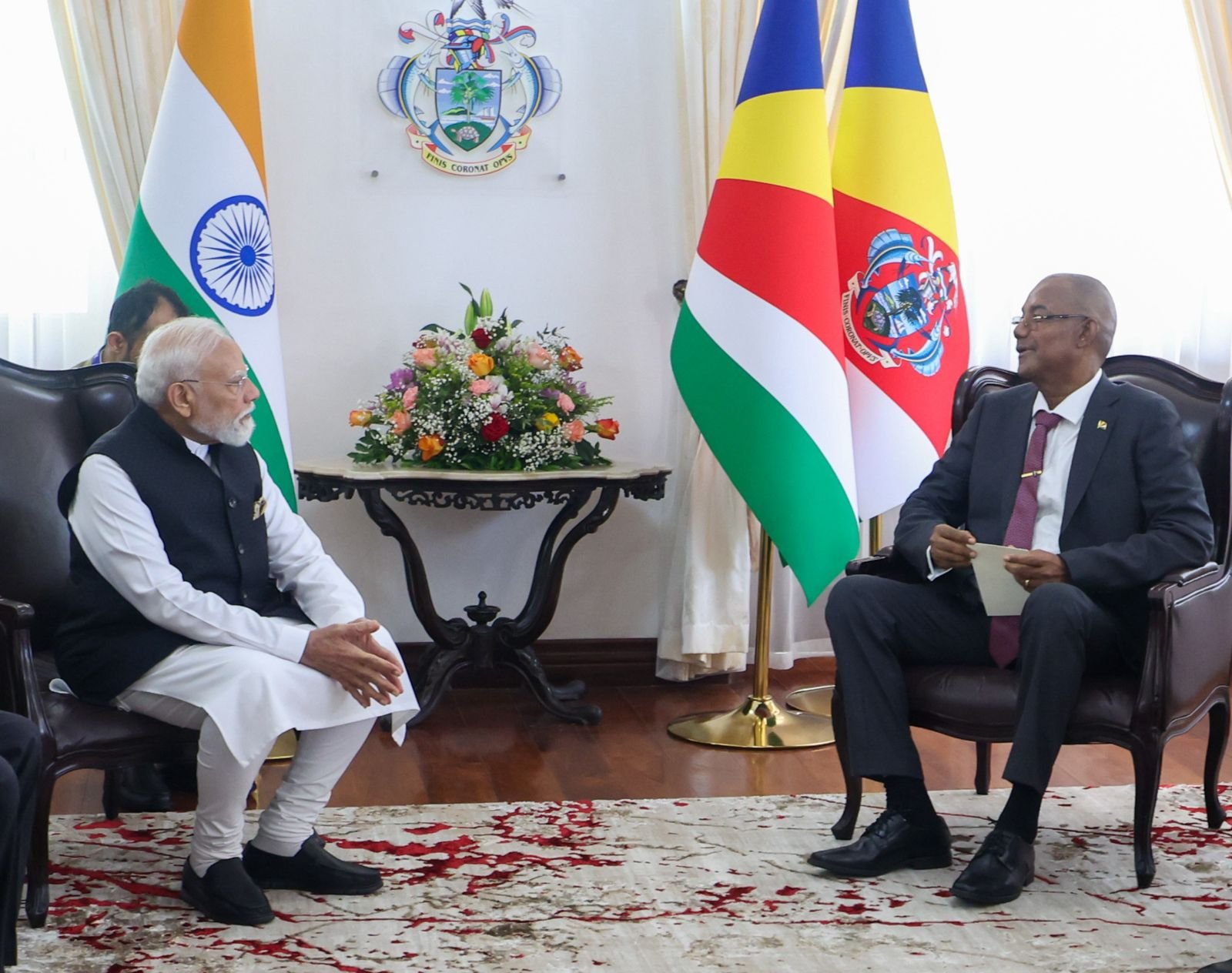
SEYCHELLES/ NEW DELHI: Prime Minister Narendra Modi’s declaration that the Indian Ocean must become an “ocean of opportunity” reflects a deeper geopolitical transformation underway. The recent India–Seychelles agreement, covering maritime security, connectivity, digital infrastructure, health, agriculture, space cooperation and the Blue Economy, is not simply a bilateral milestone. It represents a broader shift in the global balance of power from a world defined by territorial control to one increasingly shaped by maritime governance.
For centuries, strategic influence was measured through land. Empires expanded by acquiring territory, controlling borders and dominating resources. The industrial age reinforced this model, where economic strength and military power were tied to geography on the map. But the twenty-first century is challenging this traditional understanding. In an interconnected world dependent on global supply chains, energy routes, digital networks and climate stability, the oceans have become the new foundation of power.
The Indian Ocean is at the centre of this transition.
Stretching across critical trade routes connecting Asia, Africa and the Middle East, the Indian Ocean is not merely a passage for commercial vessels. It is a strategic ecosystem where energy security, economic connectivity, technological infrastructure and geopolitical competition converge. A disruption in this region can affect global markets, digital communications and international security.
This is why Seychelles, a small island nation of around 115 islands has gained significance far beyond its size.
With an Exclusive Economic Zone of nearly 1.3 million square kilometres, Seychelles controls a maritime space far larger than its land territory. Its location near key routes linking the Persian Gulf, East Africa, the Red Sea and the Indo-Pacific gives it strategic relevance in the emerging ocean-centred world.
The rise of Seychelles reflects a fundamental change in the meaning of power. In the maritime century, influence is no longer determined only by population, military strength or territorial size. Connectivity, location and the ability to govern ocean spaces have become equally important sources of strategic value.
The India–Seychelles partnership captures this transformation.
The signing of nine agreements marks a shift from traditional diplomatic engagement towards a comprehensive maritime partnership. The Rs 1,250 crore Line of Credit agreement through India’s Export-Import Bank, along with cooperation in digital payments, agriculture, healthcare, space, maritime affairs and capacity building, demonstrates that modern security is inseparable from development.
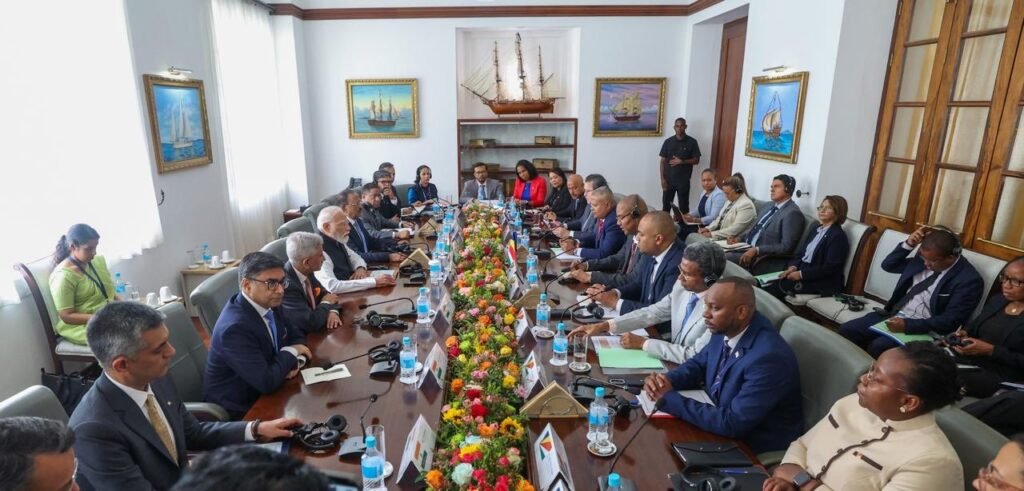
The extradition treaty carries particular significance because maritime security has evolved beyond naval competition. The Indian Ocean faces complex challenges including piracy, illegal fishing, narcotics trafficking, organised crime and transnational threats. These challenges cannot be solved by warships alone. They require legal cooperation, intelligence-sharing, institutional capacity and regional trust.
This forms the foundation of India’s MAHASAGAR (Mutual and Holistic Advancement for Security and Growth Across Regions) vision.
MAHASAGAR represents a different approach to maritime strategy. Historically, oceans were viewed as arenas of rivalry where powerful navies competed for dominance. The emerging reality demands a broader perspective — one where security includes economic resilience, environmental protection, sustainable development and regional cooperation.
The Blue Economy has become central to this new thinking.
For island nations, oceans are not empty spaces between continents. They are sources of food, energy, innovation and economic opportunity. Sustainable fisheries, marine biotechnology, offshore renewable energy and ocean research can transform maritime spaces into engines of growth.
Seychelles demonstrates this possibility. By recognising that its greatest national asset lies beneath and beyond its coastline, the country has linked environmental conservation with economic planning. This approach challenges the old assumption that development requires exploitation.
However, the Blue Economy also creates a new strategic competition. As seabed resources, maritime infrastructure and critical shipping routes become more valuable, the ocean is becoming the next arena of geopolitical rivalry. Major powers are increasingly seeking influence across the Indian Ocean through ports, partnerships and strategic access.
For smaller island states, the challenge is maintaining sovereignty while benefiting from global partnerships. They must avoid becoming locations where external powers compete for influence. Their future strength will depend on building maritime expertise, scientific capacity and the ability to shape international rules.
The digital dimension of ocean politics adds another layer of complexity.
Modern civilisation depends on submarine cables that carry most international internet traffic, financial transactions and government communications. These invisible networks beneath the ocean floor have become strategic assets. Protecting maritime spaces now means protecting both physical and digital infrastructure.
Climate change further transforms maritime security.
For island nations, rising sea levels, coastal erosion and extreme weather events are not distant environmental issues. They threaten national sovereignty, economic stability and human security. Climate resilience is becoming a core element of strategic planning.
The recognition of Prime Minister Modi through Seychelles’ “Guardian of the Blue Horizon” honour reflects this changing understanding — where environmental leadership is increasingly connected with geopolitical credibility.
Yet the future of the Indian Ocean will depend on whether nations choose competition or cooperation.
A stable maritime order cannot be created through military power alone. It requires investment in scientific research, climate adaptation, resilient infrastructure, maritime institutions and fair resource management.
The India–Seychelles partnership offers a glimpse of this emerging order. It suggests that the future of global influence will belong not only to the largest nations but to those capable of protecting shared spaces and creating sustainable partnerships.
The Indian Ocean is becoming the defining arena of the new global order.
The question of the coming decades is not simply who controls the seas. It is who has the vision and responsibility to govern them.
-With Input from Seychelles, Dr. Shahid Siddiqui
READ THE FULL E-MAGAZINE | WorldAffairs: Understand the World Before It Shapes You
–