


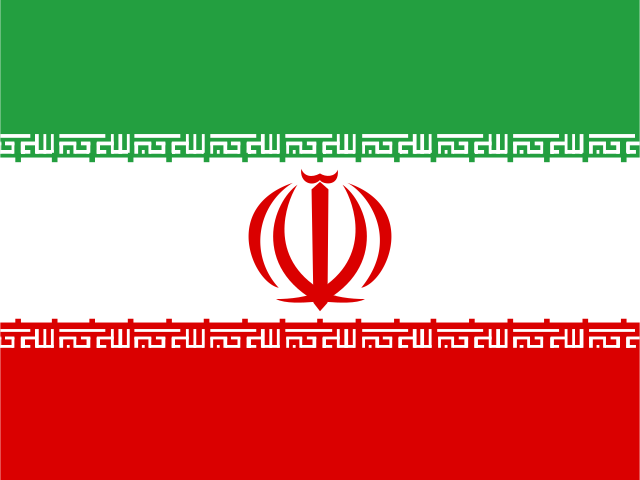

EVIAN-LES-BAINS, France: The emerging U.S.-Iran framework agreement represents far more than an attempt to end a costly regional conflict. It is the first serious effort in years to redefine the strategic balance of the Middle East through diplomacy rather than military escalation. If implemented, the agreement could reshape energy markets, alter regional alliances, and test the political limits of both Washington and Tehran. Yet the optimism surrounding the announcement should be tempered by the reality that the most difficult negotiations have not yet begun.
President Donald Trump’s characterization of the framework as a barrier preventing Iran from acquiring a nuclear weapon reflects the central American objective throughout the conflict. For Washington, the challenge has never been merely ending hostilities but creating a mechanism that prevents Iran from converting its nuclear capabilities into strategic leverage. The interim arrangement appears designed to achieve precisely that by linking economic relief to verifiable restrictions on Iran’s nuclear activities and its conduct in critical waterways such as the Strait of Hormuz.
What makes the agreement particularly significant is that it appears to acknowledge a geopolitical reality often overlooked during periods of confrontation: Iran remains too large, too strategically positioned, and too economically important to remain permanently isolated. Despite decades of sanctions and diplomatic pressure, the country retains vast energy reserves, a substantial industrial base, and a population exceeding 90 million people. The prospect of reintroducing Iran into regional and global economic networks offers incentives that military pressure alone could never create.
At the same time, the agreement reflects a notable shift in Washington’s priorities. Rather than pursuing maximalist demands, the administration appears focused on preventing nuclear weaponization while restoring stability to global energy markets. The immediate reopening of oil exports and maritime trade routes suggests that economic normalization has become an essential component of American strategy. With inflationary pressures, energy security concerns, and growing competition with China, the United States has strong incentives to reduce instability in one of the world’s most important energy-producing regions.
The rapid decline in oil prices following reports of the agreement underscores how deeply global markets had priced in the risk of prolonged conflict. Yet the reaction also highlights the enormous expectations surrounding the deal. Markets are effectively betting that diplomatic progress will continue and that the Strait of Hormuz will gradually return to normal operations. Such expectations may prove premature. Restoring confidence among insurers, shipping companies, energy traders, and investors requires more than signatures on a memorandum. It requires sustained political stability and confidence that military confrontation will not quickly return.
The economic dimension may ultimately become the strongest force sustaining negotiations. Reports of a massive investment and reconstruction mechanism indicate that both sides recognize the scale of post-war recovery required. For Iran, access to international capital and technology could revitalize sectors that have suffered from decades of sanctions and underinvestment. For Gulf states, reconstruction presents an opportunity to stabilize a neighboring power while reducing the risk of future regional conflict. For Western investors, Iran represents one of the largest untapped markets in the broader Middle East.
Yet economic incentives alone cannot resolve the deeper strategic contradictions that continue to divide the region. The question of Lebanon illustrates this challenge clearly. Iranian officials insist that a genuine end to the conflict requires Israeli military withdrawal from southern Lebanon. Israeli leaders reject that position outright, arguing that their security requirements necessitate continued military flexibility. This disagreement is not a peripheral issue; it reflects competing visions of regional order. Iran views resistance movements and allied militias as part of its deterrence architecture, while Israel sees them as an existential security threat.
This divergence exposes the central weakness of the current framework. The agreement may be sufficient to halt direct confrontation between Washington and Tehran, but it does not necessarily resolve the network of conflicts that connect Iran, Israel, Hezbollah, and other regional actors. History suggests that ceasefires often fail not because negotiators misunderstand the primary dispute but because secondary conflicts continue to generate instability. The Middle East remains vulnerable to precisely that scenario.
There is also a significant domestic political dimension. Trump will face scrutiny from critics who argue that economic concessions provide Tehran with resources that could eventually strengthen its regional influence. Conversely, Iranian leaders must convince a skeptical public that diplomacy can deliver meaningful economic relief after years of hardship and a devastating war. Any perception that the agreement benefits one side disproportionately could weaken political support and complicate implementation.
Perhaps the most revealing aspect of the framework is what it says about the changing international environment. The conflict demonstrated how rapidly regional wars can disrupt global supply chains, energy markets, and diplomatic priorities. The resulting pressure from major powers, energy-importing economies, and regional governments created conditions that made compromise more attractive than continued confrontation. In that sense, the agreement is not merely a bilateral understanding between Washington and Tehran; it is a reflection of broader international demands for stability.
The coming weeks will determine whether the framework evolves into a comprehensive settlement or joins the long list of temporary arrangements that postponed rather than resolved deeper disputes. The agreement has created an opening for diplomacy, but openings are not outcomes. Lasting peace will require compromises that neither side has yet fully embraced and solutions to regional disputes that remain fundamentally unresolved.
For now, the deal should be viewed neither as a diplomatic triumph nor as a guaranteed pathway to peace. It is a calculated gamble by two adversaries that the costs of continued conflict have become greater than the risks of negotiation. Whether that gamble succeeds will shape not only the future of U.S.-Iran relations but also the strategic landscape of the Middle East for years to come.
-Stephen Hudson and Dr. M Shahid Siddiqui