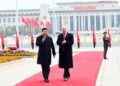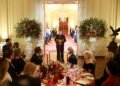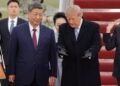



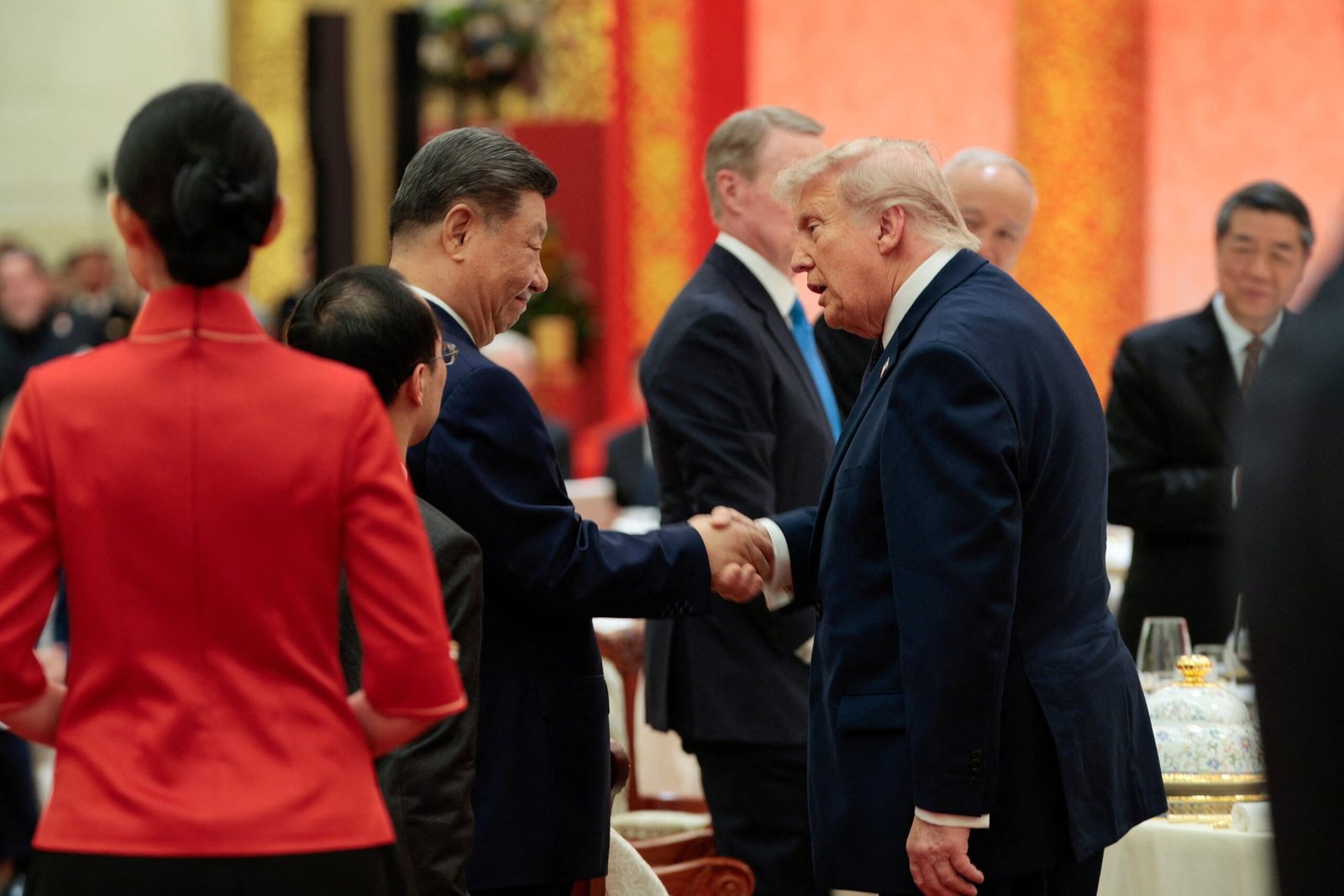
BEIJING: The summit between Chinese President Xi Jinping and U.S. President Donald Trump in Beijing was officially presented as an effort to stabilize relations between the world’s two largest economies. But behind the carefully staged ceremony, diplomatic language, and grand state banquet, the meeting revealed something far more serious: the growing possibility that Taiwan could become the most dangerous flashpoint in global politics. Xi’s warning to Trump that mishandling Taiwan could push China-U.S. relations into an “extremely dangerous place” was not ordinary diplomatic messaging. It was a strategic signal from Beijing that Taiwan remains China’s ultimate red line and that tensions surrounding the island are now central to the broader struggle for global power in the twenty-first century.
The warning came at a moment when the international system is already under extraordinary strain. The war involving Iran has disrupted global energy flows, the Strait of Hormuz has become unstable, global trade fragmentation is accelerating, and geopolitical competition between major powers is intensifying. In this environment, Taiwan is no longer simply a regional territorial dispute. It has become one of the defining questions shaping the future international order.
For China, Taiwan is tied directly to sovereignty, nationalism, territorial integrity, and the legitimacy of the Chinese Communist Party itself. Beijing considers the island an inseparable part of China and has repeatedly refused to rule out the use of military force for reunification. Chinese leaders increasingly view any foreign military or political support for Taipei as interference in China’s internal affairs. For the United States, however, Taiwan represents something much larger than a small democratic island of 23 million people. Taiwan sits at the center of America’s Indo-Pacific strategy, global semiconductor supply chains, and the broader effort to contain Chinese strategic dominance in Asia. The United States is legally committed under the Taiwan Relations Act to help Taiwan maintain its self-defense capabilities, even while officially recognizing Beijing under the “One China” policy.
This deliberate strategic ambiguity has preserved peace for decades. But today, that balance is becoming increasingly fragile. The Beijing summit highlighted how Taiwan now intersects with almost every major geopolitical issue confronting Washington and Beijing. Trade disputes, artificial intelligence, semiconductor controls, military alliances, supply chains, energy security, cyber competition, and maritime strategy are all becoming connected to the Taiwan question.
Xi’s warning therefore reflected more than concern about arms sales or diplomatic gestures. It reflected Beijing’s fear that the United States is gradually moving from strategic ambiguity toward deeper military and political alignment with Taipei.
China is particularly alarmed by growing U.S. arms support for Taiwan, expanding military cooperation in the Indo-Pacific, and closer American coordination with allies such as Japan and the Philippines. Beijing increasingly interprets these moves as part of a long-term containment strategy designed to limit China’s rise as a global power. At the same time, Washington views China’s growing military pressure around Taiwan as evidence that Beijing may eventually seek forced reunification. Chinese military exercises near the Taiwan Strait, air incursions, naval deployments, and missile capabilities have dramatically increased in recent years. These developments are forcing the United States and its regional allies to prepare for the possibility of future confrontation. The deeper problem is that neither side can afford to appear weak on Taiwan.
For Xi Jinping, Taiwan has become closely linked to his vision of “national rejuvenation.” Chinese nationalism has intensified under his leadership, and any perception of compromise on Taiwan could carry serious domestic political consequences. Beijing therefore continues to increase military, diplomatic, and economic pressure on Taipei while warning foreign governments against supporting Taiwanese independence. For Donald Trump, the situation is equally complicated, though for different reasons. Trump entered the Beijing summit facing growing domestic political pressure. The continuing Iran conflict, rising inflation risks, trade uncertainty, and legal battles over tariffs have weakened his political position at home. Economic victories abroad therefore carry greater importance for his administration.
This partly explains why trade and energy dominated the public messaging from the summit. Washington hopes China will increase purchases of American oil, energy products, agricultural goods, and Boeing aircraft. The United States also wants Beijing to play a larger role in stabilizing the Iran crisis and reopening maritime trade routes affected by the war. China, meanwhile, wants relief from American restrictions on advanced semiconductors, chip-making technology, and artificial intelligence hardware. Beijing understands that technological competition with the United States may ultimately define the future balance of global power far more than traditional military rivalry.
This technological struggle gives Taiwan even greater importance.
Taiwan produces the overwhelming majority of the world’s advanced semiconductors, which are essential for artificial intelligence, defense systems, smartphones, electric vehicles, and modern industrial economies. Any conflict involving Taiwan would therefore trigger a global economic shock far beyond East Asia. That reality helps explain why Taiwan has become both a security issue and an economic issue simultaneously. Control over semiconductor supply chains now carries enormous geopolitical value. In many ways, Taiwan sits at the intersection of military power, technological supremacy, and economic survival. Yet despite rising tensions, neither Washington nor Beijing appears eager for direct military conflict. The economic relationship between the two countries remains deeply interconnected even amid strategic rivalry. China still depends heavily on global trade and export markets, while the United States remains economically tied to Chinese manufacturing and supply networks.
This mutual dependence creates a paradox. The two powers increasingly view each other as strategic rivals, yet neither can fully separate from the other without severe global economic consequences. That is why the symbolism of the Beijing summit mattered. The lavish ceremony, warm public language, and invitation for Xi to visit Washington later this year were all intended to project stability. But beneath the diplomatic theater, the underlying tensions remain unresolved.Taiwan continues to represent the single issue most capable of transforming strategic rivalry into open confrontation. The danger today is not necessarily that either side actively seeks war. The greater risk lies in miscalculation, escalation, nationalism, or political signaling spiraling beyond control. History shows that major conflicts often emerge not from deliberate planning but from crises that leaders fail to contain in time.
Xi’s message to Trump was ultimately designed to reinforce one central point: China views Taiwan not as a negotiable geopolitical issue but as a core national interest for which it is prepared to take enormous risks. The Beijing summit therefore was not simply another diplomatic meeting between two competing powers. It was a reminder that the future of global stability may increasingly depend on how Washington and Beijing manage the Taiwan question in an era of deepening geopolitical rivalry. As the international order becomes more fragmented, competitive, and militarized, Taiwan is rapidly emerging not only as Asia’s most sensitive flashpoint, but as one of the defining fault lines of the new world order.
-John Fletcher and Laurie Chu