


ÉVIAN-LES-BAINS, France: As leaders gather in the French lakeside town of Évian-les-Bains for the G7 Summit, trade negotiations between the United States and India are emerging as one of the most closely watched bilateral issues on the diplomatic agenda. While both sides appear eager to deepen economic ties, officials indicate that a comprehensive trade agreement remains a work in progress rather than an imminent breakthrough.
A senior U.S. administration official confirmed that U.S. Trade Representative Jamieson Greer will travel to India shortly after the summit to continue discussions aimed at narrowing differences and exploring the contours of a potential bilateral trade deal. The official acknowledged that progress has been made but cautioned that any final agreement is unlikely to be announced during the G7 gathering itself.
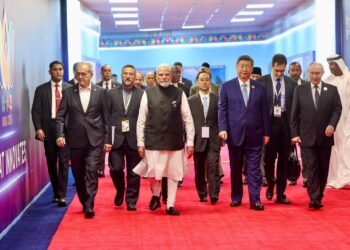
The anticipated meeting between U.S. President Donald Trump and Indian Prime Minister Narendra Modi is expected to focus heavily on trade, investment, and the broader strategic partnership between the two countries. Washington views India as an increasingly important economic and geopolitical partner, particularly as global supply chains continue to diversify and competition with China intensifies.
Yet the relationship has faced significant strains. U.S. tariffs on Indian exports and disagreements over market access have complicated negotiations. Additional friction emerged after President Trump repeatedly claimed that he played a role in ending last year’s brief India-Pakistan conflict, an assertion New Delhi has consistently rejected.
Despite these tensions, recent signals from both governments suggest a renewed effort to move negotiations forward. Indian Commerce Minister Piyush Goyal recently indicated that the first phase of a bilateral trade agreement could be finalized by mid-July. India continues to seek preferential tariff treatment under any interim arrangement, viewing such concessions as essential for expanding exports and improving market access.
The challenge for negotiators is that the trade relationship now extends far beyond tariffs. Strategic concerns, energy security, technology cooperation, and supply-chain resilience increasingly shape economic discussions between Washington and New Delhi. As a result, technical negotiations are likely to continue even if political leaders signal broad support for closer cooperation.
The summit also comes against the backdrop of rising tensions in global shipping lanes. Indian officials are expected to raise concerns over recent U.S. military actions targeting vessels linked to Iranian trade networks. Three attacks on Indian-crewed tankers this week, including one that resulted in the deaths of three Indian sailors, have intensified calls in New Delhi for greater protection of commercial shipping and clearer rules governing maritime security operations.
The issue underscores the growing intersection between trade and geopolitics. For India, uninterrupted maritime commerce remains essential to energy imports and economic growth. For the United States, enforcement measures in strategic waterways are increasingly tied to broader efforts to pressure Iran and safeguard regional security.
These concerns were reflected in discussions between U.S. Secretary of State Marco Rubio and Indian External Affairs Minister Subrahmanyam Jaishankar, who reviewed developments in the Strait of Hormuz ahead of the summit.
Beyond India, trade diplomacy is expected to dominate many conversations in Évian. Canada has also sought renewed engagement with Washington, particularly after easing proposed trade measures that would have affected American streaming companies. However, officials suggest that major breakthroughs on North American trade issues are also unlikely during the summit.
Taken together, the discussions highlight a broader reality confronting world leaders: trade negotiations can no longer be separated from strategic competition, energy security, or geopolitical risk. The G7 may not deliver a landmark U.S.-India trade agreement, but it could provide the political momentum necessary to advance one of the world’s most consequential economic partnerships.
In an era of fragmented supply chains, rising protectionism, and growing geopolitical uncertainty, the future of U.S.-India relations will be measured not only by diplomatic symbolism but by the ability of both countries to translate strategic alignment into tangible economic cooperation.
-Dr. M Shahid Siddiqui
READ THE FULL E-MAGAZINE | WorldAffairs: For Decision-Makers Who Need More Than Headlines