


MANILA: For much of the past decade, U.S.-China relations have been defined by tariffs, technology restrictions, military posturing and an increasingly bitter contest for global influence. Today, that rivalry remains intact. What appears to be changing is not the competition itself, but the willingness of both powers to prevent it from escalating into something far more dangerous.
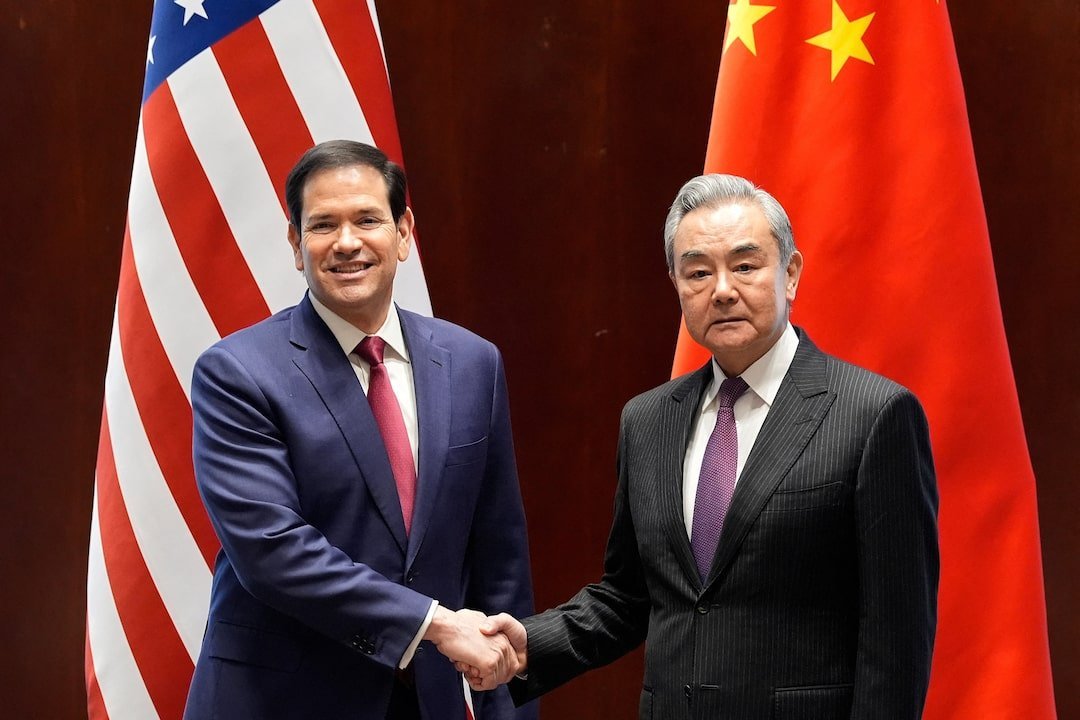
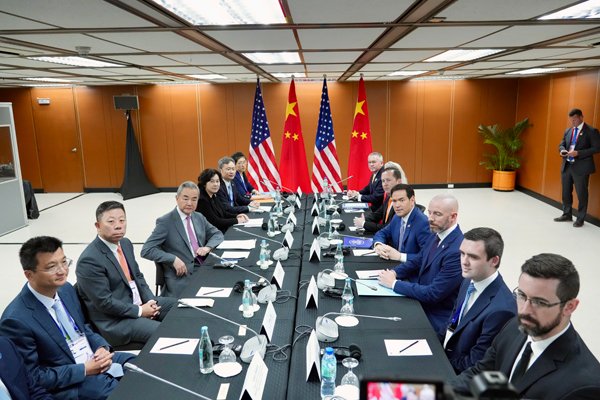
That was the significance of the meeting between U.S. Secretary of State Marco Rubio and Chinese Foreign Minister Wang Yi on the sidelines of the ASEAN Foreign Ministers’ Meeting in Manila. Their 90-minute conversation was not designed to resolve the structural disputes dividing Washington and Beijing. Instead, it sought to prepare the diplomatic groundwork for President Xi Jinping’s expected visit to Washington in September, a summit both governments hope can inject greater predictability into one of the world’s most consequential relationships. Rubio made no attempt to disguise the magnitude of the challenges ahead. The United States and China continue to disagree on trade, technology, artificial intelligence, Taiwan, maritime security and competing visions for the Indo-Pacific. Yet he argued that dialogue remains indispensable, describing it as “reckless and irresponsible” for the world’s two largest economies not to maintain an active relationship.
That statement reflects a broader strategic shift.
The era of expecting a comprehensive “reset” in U.S.-China relations is effectively over. Policymakers on both sides increasingly accept that strategic competition is permanent. The objective has therefore evolved from eliminating rivalry to managing it responsibly. In diplomatic language, this is known as building guardrails mechanisms that reduce the risk of misunderstanding, military accidents and economic shocks even when political disagreements persist.
This emerging framework explains why Xi Jinping’s expected visit carries importance far beyond ceremonial diplomacy. The summit is unlikely to produce sweeping agreements or transform bilateral relations overnight. Its success will instead be measured by whether it restores regular communication between leaders, strengthens military-to-military channels and expands cooperation in carefully selected areas where national interests overlap.
Trade remains one such area.
Despite years of tariffs, export controls and supply-chain diversification, the United States and China remain deeply interconnected. American companies continue to depend on Chinese manufacturing, while China’s economic recovery remains linked to access to global markets and investment. Neither economy can realistically disengage without imposing significant costs on itself and the international financial system.
Technology presents a far more difficult challenge.
Artificial intelligence, semiconductor production, quantum computing and advanced manufacturing have become the new frontlines of strategic competition. Washington increasingly views technological leadership as a matter of national security, while Beijing considers technological self-reliance essential to its long-term development. Cooperation in these sectors will therefore remain limited, even if dialogue improves elsewhere.
Taiwan continues to overshadow every diplomatic engagement between the two governments.
Rubio reiterated Washington’s concerns over China’s expanding military activities around the island, arguing that such actions undermine regional stability. Beijing, however, remains equally firm that Taiwan is an internal matter and has intensified both military exercises and coast guard operations to reinforce its sovereignty claims. Neither side is likely to alter these positions. Consequently, the greatest value of diplomacy lies not in resolving the Taiwan question, but in ensuring that future incidents do not spiral into unintended military confrontation. The Manila discussions also underscored Southeast Asia’s growing importance in the global balance of power.
Addressing ASEAN leaders, Rubio reaffirmed that the United States is “with ASEAN 100 percent,” while announcing $2.5 billion in strategic investments across Southeast Asia and $1.5 billion through the U.S. Development Finance Corporation for infrastructure, energy security and resilient supply chains. These commitments illustrate Washington’s determination to remain economically relevant in a region where China has steadily expanded its influence through trade, investment and connectivity projects.
The message was carefully calibrated. The United States is not asking Southeast Asia to choose between Washington and Beijing. Instead, it is attempting to demonstrate that it remains an indispensable strategic and economic partner as regional governments pursue increasingly diversified foreign policies.
Rubio also broadened the conversation beyond Asia by defending Washington’s approach toward Iran and the Strait of Hormuz. His remarks linked maritime security in the Middle East with the broader principle of freedom of navigation, a principle that also underpins American strategy in the South China Sea. From the Persian Gulf to the Indo-Pacific, Washington is increasingly presenting these theatres as interconnected components of a single global maritime order.
Viewed together, Rubio’s engagements in Manila reveal an administration pursuing a dual-track strategy: competing with China where strategic interests diverge while preserving diplomatic engagement where cooperation remains necessary. It is a recognition that the world’s two largest economies cannot afford either complete confrontation or complete disengagement.
The upcoming Xi-Trump summit, if it proceeds as expected, should therefore be understood less as a peace summit than as an exercise in strategic risk management. The structural rivalry between the United States and China will continue to define international politics for years to come. Trade disputes will persist. Competition over artificial intelligence, critical minerals and advanced technologies will intensify. Military tensions in the Taiwan Strait and the South China Sea are unlikely to disappear.
Yet history suggests that great-power competition becomes most dangerous when communication breaks down. In an increasingly fragmented international order shaped by conflicts in Europe, instability in the Middle East and growing competition across the Indo-Pacific, the willingness of Washington and Beijing to keep talking may prove just as important as any agreement they eventually sign. The future of U.S.-China relations will not be determined by whether competition ends. It will depend on whether both powers can ensure that competition remains bounded by diplomacy rather than driven by confrontation. That may be the most consequential challenge facing the international order today.
⁃ Martin Stanway