

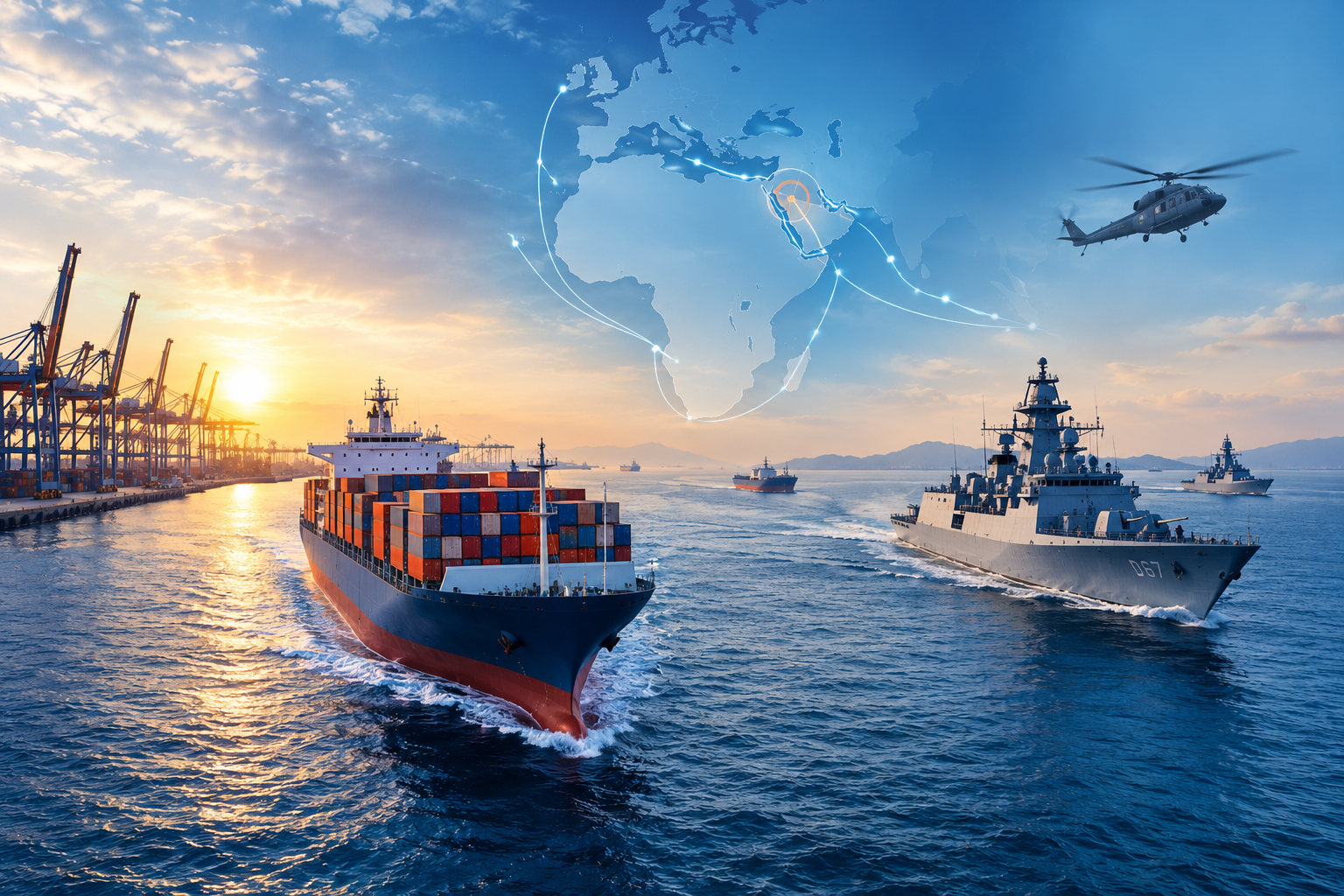
NEW DELHI, India: The Strait of Hormuz crisis has exposed the fault lines connecting energy security, global shipping, industrial dependence and geopolitical power. India’s shipbuilding ambitions offer a response to some of these vulnerabilities, but becoming a maritime power requires far more than constructing additional vessels.
The Strait of Hormuz has become a test of how effectively the global economy can absorb a geopolitical shock. It is also exposing a strategic contradiction confronting India: a country seeking to become a major manufacturing and economic power remains dependent on international energy supplies and commercial shipping routes whose disruption can undermine domestic economic stability. The crisis demonstrates that globalisation has not eliminated geographical vulnerability. It has made the consequences of that vulnerability more widely distributed. A conflict affecting a narrow maritime passage can influence energy prices, freight costs, insurance premiums, industrial production and household purchasing power across countries that have no direct involvement in the fighting.
For India, this is not an abstract geopolitical concern. It raises fundamental questions about the resilience of the country’s energy supply, the competitiveness of its maritime industry and the extent to which its economic ambitions are supported by domestic industrial capacity.
The forthcoming NAMEXPO 2026 conclave, scheduled for 1–2 December in New Delhi, offers an opportunity to examine these questions through the relationship between naval shipbuilding, commercial shipping, marine manufacturing and national security. But the central issue must be defined correctly. India does not need shipbuilding merely because Hormuz is dangerous. It needs a competitive maritime industrial ecosystem because its long-term economic security depends on the ability to build, operate, maintain and finance the vessels and technologies that sustain international trade.
The scale of the Hormuz disruption
The International Energy Agency’s February 2026 factsheet identifies the Strait as one of the world’s most important oil-transit chokepoints. In 2025, approximately 20 million barrels of crude oil and petroleum products passed through it daily, representing around one-quarter of global seaborne oil trade. Approximately 80% of these oil flows were destined for Asian markets.
The same passage carried more than 110 billion cubic metres of liquefied natural gas in 2025, representing almost one-fifth of global LNG trade. Qatar and the United Arab Emirates depend heavily on the Strait for their LNG exports. Alternative pipeline capacity is insufficient to replace the full volume of oil normally transported through the waterway. The crisis has moved beyond a theoretical threat. In its 2026 assessment, the IEA described the conflict as causing the largest supply disruption in the history of the global oil market. It reported that tanker movements through Hormuz had fallen close to a standstill and that Gulf oil production had been cut by at least 10 million barrels per day amid the disruption.
This distinction between normal traffic volumes and disrupted flows is critical. The pre-crisis figure of approximately 20 million barrels per day describes the scale of the route’s importance; it is not a measurement of the volume continuing to move during the crisis. The consequences are compounded by the limited availability of alternatives. Saudi Arabia and the UAE possess pipelines capable of diverting some oil exports away from Hormuz, but the IEA estimates available alternative capacity at approximately 3.5 million to 5.5 million barrels per day. LNG presents an even more difficult challenge because there are no alternative export routes capable of replacing the Gulf’s existing LNG loading infrastructure at scale. The result is a structural imbalance: the global economy depends on a volume of maritime energy trade that cannot quickly be transferred to alternative routes.
A crisis of security, economics and international law
The shipping emergency is also becoming a humanitarian crisis. The International Maritime Organization’s official incident register listed 120 confirmed incidents and 24 seafarer fatalities as of 22 October 2026. Its records include vessels damaged, ships sunk, missing crew members, injuries and cases involving reported pollution.
Reuters, reporting on 23 October, cited the Washington Institute for Near East Policy’s separate count of 113 confirmed and reported attacks since the conflict began on 28 February. The two figures should not be conflated: the IMO’s register covers confirmed incidents, while the Washington Institute’s tally includes confirmed and reported attacks under its own methodology.
The IMO Secretary-General, Arsenio Dominguez, warned on 16 September: “Do not use these conflicts to attack innocent seafarers.”
The IMO also stressed that attacks on international shipping across different conflict zones cannot be attributed to a single actor. Its position is important because the protection of merchant vessels and civilian crews must remain distinct from the competing military objectives of the parties involved.
The strategic implications extend beyond the immediate conflict. If shipping companies cannot reliably assess whether a route is safe, the commercial system must price in greater uncertainty. Insurance costs may rise, vessels may be diverted or held back, and cargo owners may face higher transport costs and longer delivery times. This is how a regional security crisis becomes a global economic shock.
India’s exposure: supplier diversity is not route security
India’s vulnerability arises from its dependence on imported energy and the importance of energy to its domestic economy.
The Reserve Bank of India reported in a 2025 bulletin that India’s crude-oil import dependence had risen from 77.6% in 2013–14 to 88.2% in 2024–25. This makes international supply conditions an important consideration for India’s external balance, inflation outlook and industrial costs.
The problem is not simply the volume of imports. It is the interaction between import dependence, international prices and transport risk. An economy can purchase oil from multiple suppliers and still face a common disruption if several sources rely on the same maritime corridor. Supplier diversification reduces exposure to individual producers; route diversification reduces exposure to geographical chokepoints. They are complementary, not interchangeable, strategies. The distinction is equally important for LNG. India’s access to alternative cargoes depends on global availability, contractual arrangements, liquefaction capacity, shipping and the prices other buyers are willing to pay. In a supply shock, competing importers may seek the same limited volumes.
India therefore needs a layered energy-security strategy: strategic reserves, diversified sources and routes, resilient import infrastructure, domestic energy development and the gradual expansion of alternatives to petroleum. Shipbuilding can strengthen one part of this system. It cannot replace the other components.
Why shipbuilding matters beyond defence
The significance of NAMEXPO 2026 lies in its proposed convergence of naval and commercial shipbuilding.
Organised in partnership by the Confederation of Indian Industry, the Society for Aerospace, Maritime and Defence Studies, and the Research and Information System for Developing Countries, the conclave is scheduled for 1–2 December at the Manekshaw Centre, New Delhi. Its stated ambition is to support India’s emergence as a top-five global shipbuilding nation and contribute to a $300 billion shipbuilding industry by 2047. These objectives should be assessed against the scale of India’s existing industry.
According to the Ministry of Ports, Shipping and Waterways, Indian shipbuilding output increased from 40,923 gross tonnes in 2024 to 57,637 gross tonnes in 2025, a rise of 41%. This is meaningful growth, but it also demonstrates how much expansion is required to establish a globally competitive industrial base.
The government has approved a ₹69,725 crore shipbuilding package comprising ₹24,736 crore in shipbuilding financial assistance, a ₹25,000 crore Maritime Development Fund and ₹19,989 crore for the Shipbuilding Development Scheme. The stated capacity objective is to expand Indian shipbuilding output to 4.5 million gross tonnes annually through new clusters and the expansion of existing shipyards.
The government has also reported a fleet acquisition plan covering more than 400 vessels, intended to improve long-term order visibility for Indian shipyards. These are substantial policy commitments. Their ultimate significance, however, depends on whether they produce sustained industrial competitiveness rather than simply higher expenditure. A shipyard needs orders, skilled workers, reliable suppliers, affordable finance, modern equipment and the ability to deliver vessels on schedule. Without these elements, capacity expansion can create facilities that remain expensive or underutilised. The policy challenge is therefore to convert financial support into productivity, technology and repeat commercial orders.
The real industrial challenge: building the entire ecosystem
Shipbuilding is not an isolated manufacturing activity. It depends on an extensive network of industries producing marine engines, propulsion systems, navigation equipment, electronics, specialised steel, pumps, valves, cables and other critical components. If a vessel is assembled domestically but relies heavily on imported systems, some of the strategic and economic benefits of domestic production remain limited.
This does not mean every component must be manufactured in India. Complete self-sufficiency may be economically inefficient or technically unrealistic in certain areas. The more practical objective is to identify critical dependencies, develop competitive domestic capabilities where feasible and establish reliable international partnerships for technologies that cannot immediately be sourced locally.
Financing is another structural constraint. Shipbuilding requires substantial capital before a vessel begins generating revenue. Commercial shipowners must assess acquisition costs, interest rates, insurance, fuel efficiency, operating expenses and the expected lifetime of a vessel. Higher financing costs can undermine competitiveness even when a shipyard has the technical ability to build the ship.
Demand is equally important. Domestic shipyards require predictable orders to invest in equipment, develop supplier relationships and train their workforce. Government procurement and fleet acquisition plans can provide greater visibility, but public support should encourage efficient production, not shelter uncompetitive operations indefinitely.
Maintenance and repair must also become part of the strategy. A strong maritime economy requires dry-docking, vessel inspections, engine servicing, component replacement and technical upgrades throughout a ship’s operating life. These activities create recurring business and improve fleet availability.
For NAMEXPO, the practical question is whether shipyards, equipment manufacturers, investors, technology providers and government agencies can establish partnerships that address these specific constraints.
Naval-commercial integration: opportunity without false equivalence
Naval and commercial shipbuilding share important industrial foundations, but their products and objectives are different. Naval vessels are designed for military missions, survivability and specialised systems. Commercial vessels prioritise safety, cargo capacity, fuel efficiency, reliability and operating costs.
Their requirements cannot simply be merged. Yet common capabilities in engineering, advanced manufacturing, digital technologies, materials science and propulsion can create opportunities for collaboration.
A larger commercial industrial base may support the development of skilled labour and specialist suppliers. Defence-related research can also create technological opportunities where security, cost and regulatory requirements permit wider application.
The objective should be to develop complementary capabilities, not assume that a stronger naval industry automatically creates a competitive commercial fleet—or that commercial shipbuilding can independently deliver national security.
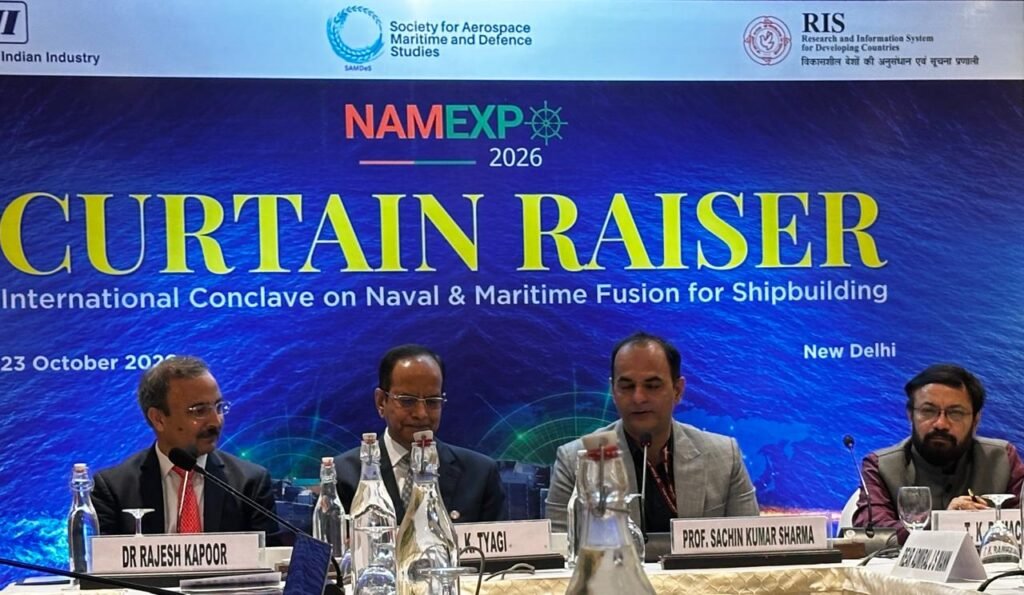
The remarks at the NAMEXPO curtain-raiser identify this institutional challenge.
T. K. Ramachandran, Co-Chair of the CII Task Force on Maritime Ecosystem, Professor of Practice at RIS and former Secretary of the Ministry of Ports, Shipping and Waterways, said: “The way forward lies in breaking silos, accelerating indigenisation and bringing together and synergising government, Industry, academia and the defence sector to build a strong, self-reliant maritime ecosystem.”
Dr R. K. Tyagi, Founding Member of SAMDeS and former CMD of Hindustan Aeronautics Limited and Pawan Hans Limited, emphasised international cooperation: “The oceans connect nations, economies, and societies. Their future cannot be secured by isolating national efforts.”
Prof. Sachin Kumar Sharma, Director General of RIS, stated: “Naval and commercial shipbuilding and shipping require another critical fusion: government and industry.”
These statements establish a clear direction, but the test is implementation. NAMEXPO should be measured by the investment commitments, vessel orders, technology partnerships, supplier agreements and training programmes that follow not by the number of declarations made at the event.
Why more ships cannot solve Hormuz
A critical distinction must be maintained between maritime industrial strength and the security of an international chokepoint. India could increase its production of tankers, cargo vessels and specialised ships without making the Strait of Hormuz safer. Domestic shipyards cannot independently guarantee freedom of navigation through waters affected by a major military conflict.
Nor would a larger merchant fleet necessarily guarantee access to oil or LNG. Ships still require cargoes, functioning ports, insurance, crews, fuel and safe routes. A fleet operating in an unsafe corridor remains exposed to the same physical risks as other commercial vessels. What domestic shipbuilding can provide is greater flexibility over time: more opportunities to procure vessels from Indian yards, stronger repair and maintenance capacity, a broader supplier base and greater control over parts of the maritime industrial system. This distinction matters for public policy. Shipbuilding should be treated as one pillar of resilience, alongside energy diversification, strategic reserves, international diplomacy, maritime surveillance and commercial risk management.
A credible strategy must also address the human costs of disruption. The IMO reported that approximately 20,000 seafarers, port workers and offshore crews were affected by the situation in the region as of 22 October. Their safety is not a secondary concern; it is fundamental to the functioning of international shipping. India should support practical international cooperation to protect merchant vessels, improve emergency communication, assist affected crews and uphold applicable international maritime law.
From ambition to measurable outcomes
The government’s ₹69,725 crore package provides an opportunity to address longstanding industrial constraints. But expenditure and announced capacity targets are inputs, not proof of competitiveness. India should assess progress through measurable indicators: the growth of commercial and export orders, delivery times, shipyard productivity, financing costs, the share of competitively manufactured domestic components, repair capacity, skilled employment and the ability of Indian-built vessels to compete in international markets.
It should also establish clear links between shipbuilding and the needs of domestic shipping operators. A strong shipbuilding sector cannot endure without a commercially viable customer base, while a strong merchant fleet cannot be sustained without competitive acquisition, maintenance and financing arrangements. International partnerships will remain important. Cooperation with established shipbuilding economies can help India gain technology, develop skills and integrate domestic manufacturers into global supply chains. Strategic autonomy should mean having greater choices and stronger capabilities, not withdrawing from international cooperation.
NAMEXPO 2026 can contribute to this agenda by bringing together government, industry, investors, academia and international partners around practical, commercially credible projects. The broader opportunity is to connect shipbuilding with India’s ambitions in manufacturing, logistics, energy security and international trade. That is a much more demanding task than increasing vessel output, but it is also the task that gives the industry its strategic significance.
The verdict will be measured in capability
The Hormuz crisis has exposed the costs of concentrated energy routes, the vulnerability of international shipping and the difficulty of protecting economic activity from geopolitical confrontation. It has also demonstrated that maritime security and industrial capability are related without being interchangeable. A country needs secure sea lanes, but it also needs the ability to build and maintain vessels, finance commercial operations, develop critical technologies and absorb disruptions when normal trade is interrupted.
India’s shipbuilding ambition is therefore strategically relevant, but its success must not be overstated. A domestic shipbuilding industry cannot resolve the underlying conflict, eliminate oil-import dependence or guarantee safe transit through an international chokepoint. What it can do is strengthen India’s industrial base, widen its commercial options and reduce selected dependencies over time. The $300 billion shipbuilding vision for 2047 will become meaningful only if supported by competitive products, sustainable demand, reliable delivery, skilled labour and deep domestic supplier networks.
NAMEXPO 2026 arrives at a moment when the need for those capabilities is unusually clear. The challenge is to convert that urgency into long-term industrial progress rather than a temporary policy response to a crisis.
The decisive question for India is not how many ships it can announce, finance or plan to build. It is whether it can develop a maritime ecosystem that remains commercially competitive in normal times and more resilient when geopolitical shocks disrupt global trade. That is the standard by which NAMEXPO should be judged and the more demanding measure of India’s ambition to become a leading maritime power by 2047.
-Dr. M Shahid Siddiqui