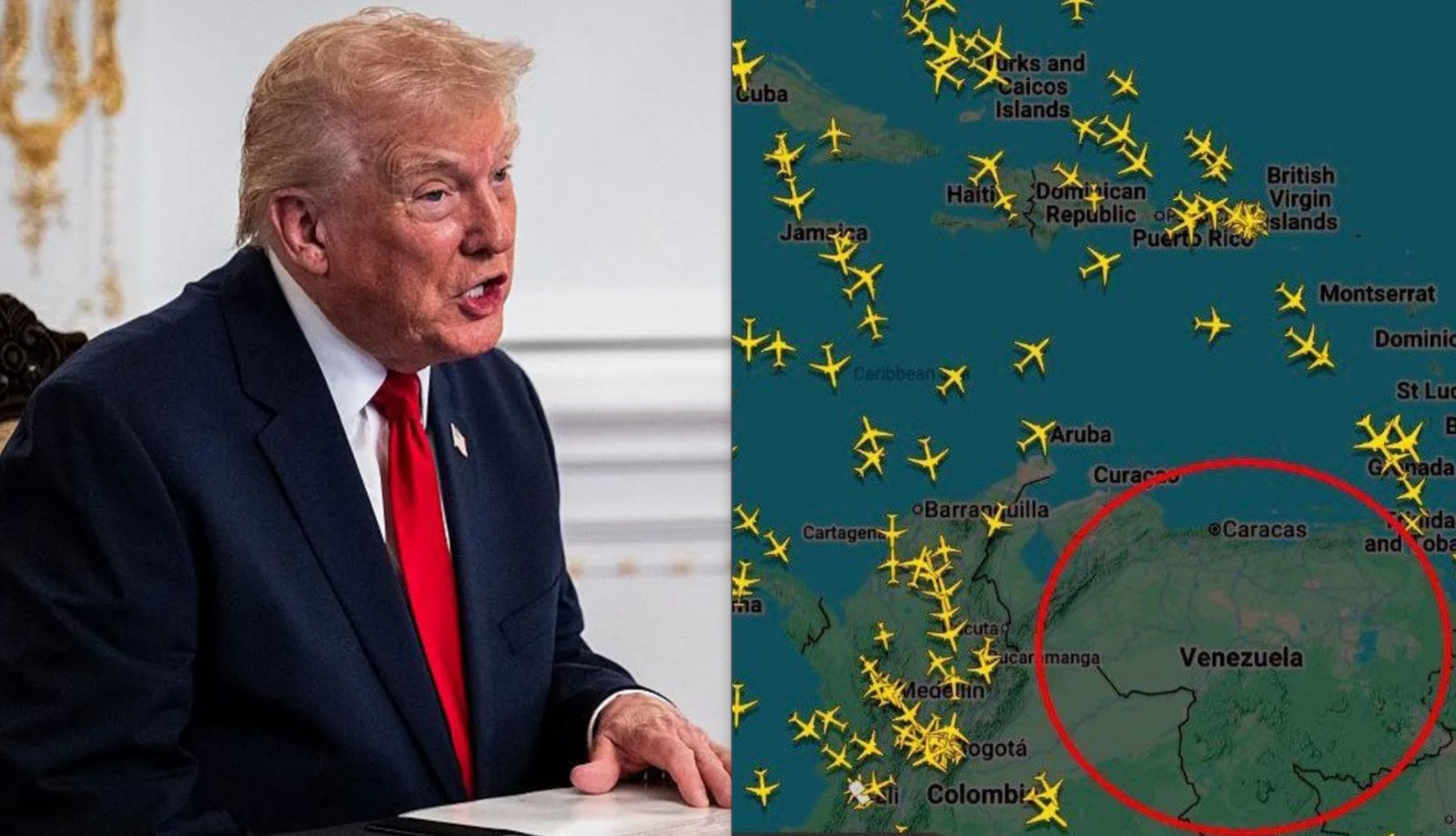
WASHINGTON: President Donald Trump declared on Saturday, November 29, 2025, that airspace above and surrounding Venezuela should be considered “closed in its entirety,” marking a dramatic escalation in U.S.-Venezuela tensions. The announcement, posted on Truth Social and directed at “all Airlines, Pilots, Drug Dealers, and Human Traffickers,” came without elaboration or details regarding enforcement mechanisms.
“To all Airlines, Pilots, Drug Dealers, and Human Traffickers, please consider THE AIRSPACE ABOVE AND SURROUNDING VENEZUELA TO BE CLOSED IN ITS ENTIRETY,” Trump wrote, leaving critical implementation details undefined.
The declaration sparked immediate confusion and concern. U.S. officials contacted by WNN were surprised at the announcement and acknowledged being unaware of any ongoing military operations to enforce an airspace closure. The Pentagon declined to respond, and the White House provided no further explanation, leaving the scope and mechanics of enforcement entirely unclear.
Venezuela’s government swiftly condemned the announcement, characterizing it as a “colonialist threat” to national sovereignty and a violation of international law. Venezuelan officials accused Trump of threatening the country’s sovereignty, with the country’s foreign minister calling Trump’s post “another extravagant, illegal and unjustified aggression against the Venezuelan people.” The government’s statement described Trump’s declaration as “a hostile, unilateral and arbitrary act, incompatible with the principles of international law.”
Iran, a Venezuelan ally previously targeted by U.S. military action, also denounced the declaration as “a serious breach of international law and a threat to global aviation safety,” according to Iranian state news agency IRNA.
The airspace closure announcement represents the latest phase in escalating U.S. pressure on President Nicolas Maduro’s government. Earlier in the week, Trump told military service members the U.S. would “very soon” begin land operations against suspected Venezuelan drug traffickers. The Trump administration has conducted nearly three months of strikes on suspected drug boats off Venezuela’s coast following a massive military buildup in the Caribbean. The administration is reportedly weighing options including attempted regime change, with reports indicating the U.S. military is positioned for a new operational phase and Trump has authorized covert CIA operations in Venezuela.
The Federal Aviation Administration had warned airlines one week prior of a “worsening security situation” in the area, stating that “threats could pose a potential risk to aircraft at all altitudes, including during overflight, the arrival and departure phases of flight, and/or airports and aircraft on the ground.”
The FAA advisory requested airlines provide at least 72-hour advance notice before operating in the Maiquetia flight information region. Some international airlines subsequently canceled flights through the region.
Retired Lieutenant General David Deptula, who commanded a no-fly zone over northern Iraq in 1998-1999, cautioned that Trump’s announcement raises more questions than answers, noting that enforcing such a closure could require significant resources and planning. “The devil’s in the details,” Deptula observed.
The declaration has immediate consequences for Venezuelan citizens and bilateral relations. The airspace closure effectively suspends migrant deportation flights on which nearly 14,000 Venezuelans have recently returned home from the U.S., flights that had been occurring twice weekly amid the Trump administration’s immigration crackdown. Caracas residents expressed concern about travel restrictions affecting work, business, and family visits, with residents worried about being unable to visit families outside Venezuela during the holiday season.
Venezuela subsequently revoked operating rights for six major international airlines that had suspended flights following the FAA warning, escalating tit-for-tat tensions. GPS signals in Venezuela have also been disrupted in recent weeks amid heightened U.S. military presence, and surveillance by Venezuelan authorities in remote northeastern regions has intensified, creating fear among local populations.
The Trump administration frames its Venezuela policy as focused on combating illegal drug trafficking, claiming President Maduro’s government supplies narcotics responsible for American deaths. Maduro has consistently denied any involvement in the drug trade and contends that Trump seeks regime change, asserting that Venezuelan citizens and the military will resist such attempts.
Trump Declares Venezuelan Airspace ‘Closed in Its Entirety’, Escalating U.S.-Venezuela Tensions
WASHINGTON: President Donald Trump declared on Saturday, November 29, 2025, that airspace above and surrounding Venezuela should be considered “closed in its entirety,” marking a dramatic escalation in U.S.-Venezuela tensions. The announcement, posted on Truth Social and directed at “all Airlines, Pilots, Drug Dealers, and Human Traffickers,” came without elaboration or details regarding enforcement mechanisms.
“To all Airlines, Pilots, Drug Dealers, and Human Traffickers, please consider THE AIRSPACE ABOVE AND SURROUNDING VENEZUELA TO BE CLOSED IN ITS ENTIRETY,” Trump wrote, leaving critical implementation details undefined.
The declaration sparked immediate confusion and concern. U.S. officials contacted by WNN were surprised at the announcement and acknowledged being unaware of any ongoing military operations to enforce an airspace closure. The Pentagon declined to respond, and the White House provided no further explanation, leaving the scope and mechanics of enforcement entirely unclear.
Venezuela’s government swiftly condemned the announcement, characterizing it as a “colonialist threat” to national sovereignty and a violation of international law. Venezuelan officials accused Trump of threatening the country’s sovereignty, with the country’s foreign minister calling Trump’s post “another extravagant, illegal and unjustified aggression against the Venezuelan people.” The government’s statement described Trump’s declaration as “a hostile, unilateral and arbitrary act, incompatible with the principles of international law.”
Iran, a Venezuelan ally previously targeted by U.S. military action, also denounced the declaration as “a serious breach of international law and a threat to global aviation safety,” according to Iranian state news agency IRNA.
The airspace closure announcement represents the latest phase in escalating U.S. pressure on President Nicolas Maduro’s government. Earlier in the week, Trump told military service members the U.S. would “very soon” begin land operations against suspected Venezuelan drug traffickers. The Trump administration has conducted nearly three months of strikes on suspected drug boats off Venezuela’s coast following a massive military buildup in the Caribbean. The administration is reportedly weighing options including attempted regime change, with reports indicating the U.S. military is positioned for a new operational phase and Trump has authorized covert CIA operations in Venezuela.
The Federal Aviation Administration had warned airlines one week prior of a “worsening security situation” in the area, stating that “threats could pose a potential risk to aircraft at all altitudes, including during overflight, the arrival and departure phases of flight, and/or airports and aircraft on the ground.”
The FAA advisory requested airlines provide at least 72-hour advance notice before operating in the Maiquetia flight information region. Some international airlines subsequently canceled flights through the region.
Retired Lieutenant General David Deptula, who commanded a no-fly zone over northern Iraq in 1998-1999, cautioned that Trump’s announcement raises more questions than answers, noting that enforcing such a closure could require significant resources and planning. “The devil’s in the details,” Deptula observed.
The declaration has immediate consequences for Venezuelan citizens and bilateral relations. The airspace closure effectively suspends migrant deportation flights on which nearly 14,000 Venezuelans have recently returned home from the U.S., flights that had been occurring twice weekly amid the Trump administration’s immigration crackdown. Caracas residents expressed concern about travel restrictions affecting work, business, and family visits, with residents worried about being unable to visit families outside Venezuela during the holiday season.
Venezuela subsequently revoked operating rights for six major international airlines that had suspended flights following the FAA warning, escalating tit-for-tat tensions. GPS signals in Venezuela have also been disrupted in recent weeks amid heightened U.S. military presence, and surveillance by Venezuelan authorities in remote northeastern regions has intensified, creating fear among local populations.
The Trump administration frames its Venezuela policy as focused on combating illegal drug trafficking, claiming President Maduro’s government supplies narcotics responsible for American deaths. Maduro has consistently denied any involvement in the drug trade and contends that Trump seeks regime change, asserting that Venezuelan citizens and the military will resist such attempts.
-Raphael Stewart