



NEW DELHI, India: The political significance of India’s student protests is no longer confined to leaked examination papers or demands for administrative accountability. What began as a campaign against alleged irregularities in the National Eligibility-cum-Entrance Test (NEET) has rapidly evolved into the most consequential youth movement since Narendra Modi returned to power for a third term. In the process, it has unexpectedly given Rahul Gandhi what has eluded him for over a decade: ownership of a national political narrative driven by India’s young generation.
The Modi government appears to have recognised the gravity of the moment. After weeks of maintaining a defensive posture, Education Minister Dharmendra Pradhan publicly committed to parliamentary debate, examination reforms, and greater accountability. Prime Minister Narendra Modi also broke his silence by promising stringent action against those responsible for paper leaks and calling for a foolproof examination system. The government has additionally initiated dialogue with representatives of the student-led Cockroach Janta Party (CJP), signalling that the protests can no longer be dismissed as isolated demonstrations.
The timing is politically significant. Governments rarely concede the need for institutional reform unless they believe public anger has acquired broader political consequences. That is precisely what has happened.
The CJP movement emerged from frustration over repeated examination failures and alleged corruption in India’s recruitment and testing systems. However, the protests have expanded because they speak to a much deeper structural crisis confronting India’s youth.
India today possesses one of the world’s youngest populations, yet it is simultaneously experiencing persistent anxiety over graduate unemployment, competitive examinations, shrinking opportunities in public-sector recruitment, and rising educational costs. For millions of families, examinations represent the only credible pathway to economic mobility. When that system itself appears compromised, it undermines confidence not only in educational institutions but also in the promise of meritocracy.
This explains why the movement has spread well beyond students directly affected by NEET.
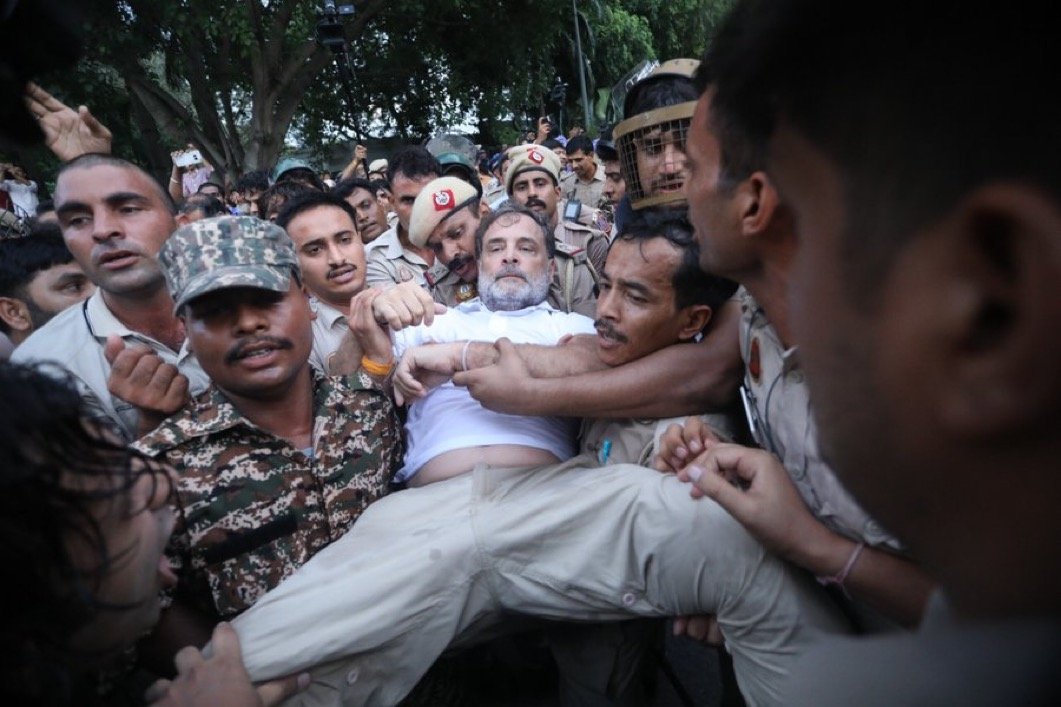
The police crackdown on demonstrators in New Delhi proved to be a political turning point. Images of students being dispersed with tear gas and baton charges circulated widely across digital platforms, transforming what had been viewed as an education controversy into a broader debate about democratic accountability and the state’s response to peaceful dissent. Reports indicate that nearly 180 people were injured during the confrontations, further intensifying public scrutiny of the government’s handling of the protests.
Rahul Gandhi recognised the political opening faster than any other opposition leader. His decision to stage a sit-in near the Prime Minister’s residence, accompanied by Priyanka Gandhi Vadra and senior Congress leaders, fundamentally altered the optics of the movement. Their subsequent detention reinforced the image of an opposition willing to physically align itself with students rather than merely issue statements from Parliament. The symbolism matters because Indian politics increasingly rewards visibility over rhetoric.
For years, Rahul Gandhi has struggled to define himself against Modi’s dominant political narrative. Campaigns centred on inequality, caste census, inflation, or constitutional values have yielded mixed electoral dividends. The student movement offers something different. It is rooted not in ideology but in aspiration. It speaks to merit, opportunity, fairness, and institutional credibility, issues capable of cutting across caste, religion, and regional identities.
Equally significant is the demographic reality.

Young Indians below the age of thirty constitute more than half of the country’s population and will remain the single most influential electoral bloc heading into the next general election. While the BJP has traditionally enjoyed strong support among first-time voters through its development narrative, unemployment and education have steadily emerged as areas of growing dissatisfaction.
Rahul Gandhi’s intervention therefore represents more than opposition politics. It is an attempt to redefine Congress as the political vehicle of India’s aspirational middle class and first-generation graduates who increasingly question whether the country’s institutions still reward merit over influence.
The government’s response reflects awareness of that risk.
Dharmendra Pradhan’s assurance that Parliament will debate NEET reforms, combined with the Prime Minister’s commitment to overhaul examination systems, indicates that New Delhi now recognises education governance as a political vulnerability rather than merely an administrative issue. Yet both sides face important strategic challenges.
For the Modi government, promises of reform must quickly translate into institutional credibility. India’s examination system has faced repeated controversies in recent years, and public confidence cannot be restored through announcements alone. Transparent investigations, technological safeguards, accountability mechanisms, and recruitment reforms will determine whether this crisis subsides or deepens.
For Rahul Gandhi, the challenge is equally demanding. Political symbolism creates momentum, but sustained leadership requires policy alternatives. If Congress hopes to retain the confidence of young voters, it must move beyond demanding resignations and articulate a comprehensive agenda covering examination reforms, university governance, skill development, digital education, and employment generation.
The student movement itself also confronts a delicate balancing act. Its legitimacy derives from remaining independent of party politics. While support from opposition parties broadens national attention and offers organisational resources, excessive political ownership risks diluting the movement’s original demands and alienating students who reject partisan mobilisation.
India’s politics has repeatedly been reshaped by youth-led movements—from the anti-corruption protests of 2011 to the citizenship demonstrations and farmers’ mobilisation. Each altered political discourse, but not all transformed electoral outcomes.
Whether the current student uprising becomes another transient protest or the beginning of a broader political realignment will depend on one central question: can India’s political class convince young citizens that merit, opportunity, and institutional integrity still define the republic’s future?
At this moment, Rahul Gandhi has succeeded in becoming the most visible political face of that question. Whether he becomes the enduring voice of young India will ultimately depend less on protests than on whether he can convert public anger into credible policy, sustained political organisation, and electoral trust.
The battle over NEET may have begun as an education crisis. It is now evolving into a referendum on governance, accountability, and the political imagination of the world’s largest democracy.
-Dr. M Shahid Siddiqui