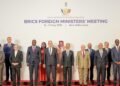



NEW DELHI, India: Iranian Foreign Minister Abbas Araghchi used his visit to New Delhi to deliver one of Tehran’s clearest geopolitical messages in recent months: Iran remains open to diplomacy with the United States, but decades of mistrust continue to define its strategic calculations. Speaking to journalists in Delhi before departing India after attending the BRICS Foreign Ministers’ Meeting, Araghchi acknowledged that Tehran had received messages from the administration of President Donald Trump indicating openness to renewed negotiations aimed at reducing regional tensions and preventing further escalation. Yet he made it equally clear that Iran does not believe diplomacy can move forward without serious confidence-building measures and credible commitments from Washington.
Araghchi repeatedly emphasized that “distrust” remains the biggest obstacle between Tehran and Washington. His remarks reflected Iran’s long-standing frustration over the collapse of previous agreements, especially after the United States withdrew from the nuclear deal and reimposed sanctions. He stated that Iran would negotiate “only if the other side is serious,” underscoring Tehran’s belief that contradictory signals from Washington have undermined the possibility of sustainable diplomacy.
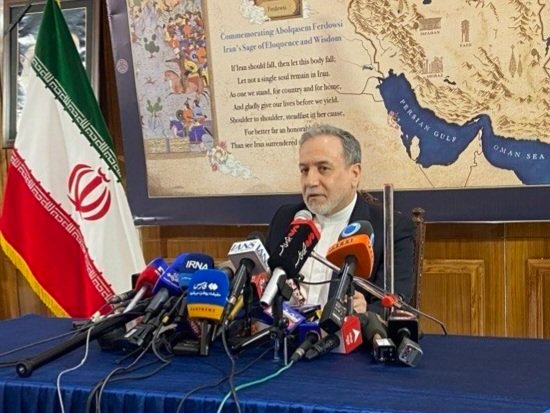
During the interaction, Araghchi openly acknowledged that negotiations remain stalled over Iran’s stockpile of enriched uranium, describing the issue as a “deadlock.” According to him, the dispute over enriched uranium remains one of the most sensitive points in any future nuclear understanding between Iran and the West. However, he hinted that discussions surrounding Iran’s enriched material could potentially be postponed to later stages of negotiations in order to keep broader diplomatic engagement alive.
His remarks suggested that Tehran may now be pursuing a more incremental diplomatic strategy rather than insisting on resolving all disputes simultaneously. Iran appears to believe that gradual confidence-building measures, including sanctions relief and regional de-escalation, could create conditions for future compromise on nuclear issues. At the same time, Tehran also sees its nuclear capabilities as a strategic deterrent in an increasingly unstable regional environment.
Araghchi also addressed the wider geopolitical crisis unfolding across West Asia, stressing that regional instability cannot be solved through military pressure or confrontation. He reiterated Iran’s position that dialogue remains the only viable path toward sustainable peace and warned against policies that could further inflame tensions. Referring to ongoing security concerns in the Gulf and surrounding regions, he maintained that there is “no military solution” involving Iran and called for serious negotiations instead of coercive approaches.
The Iranian Foreign Minister also spoke about maritime security and the strategic importance of the Strait of Hormuz, one of the world’s most critical energy corridors through which nearly one-fifth of global oil trade passes. By emphasizing Iran’s role in ensuring regional maritime stability, Tehran signaled that any escalation in the region could carry global economic consequences.
Beyond the immediate tensions with the United States, Araghchi used the Delhi platform to advocate for a more multipolar international order. He highlighted the growing role of BRICS and argued that emerging global platforms are becoming increasingly important in balancing what Tehran sees as Western dominance over international institutions. At the BRICS meeting, Araghchi criticized unilateral sanctions, geopolitical pressure, and what he described as Western “bullying,” portraying Iran’s struggle as part of a broader global challenge against unequal power structures.
However, the meetings in Delhi also revealed the limitations within BRICS itself. Reports indicated that the grouping failed to issue a unified statement on the Iran-related crisis because of differences among member states. The development exposed the reality that although BRICS represents growing dissatisfaction with the Western-led order, it is still far from functioning as a fully cohesive geopolitical bloc.
Araghchi also placed significant emphasis on India-Iran relations, describing ties with India as historically deep and strategically important. He highlighted cooperation in connectivity, trade, diplomacy, and regional stability while suggesting that India could play a greater role in promoting peace across West Asia. Tehran increasingly views New Delhi as an important balancing power capable of maintaining communication with multiple geopolitical camps simultaneously, including both Washington and Tehran.
For India, the visit reinforced its growing role as a diplomatic bridge in an increasingly fragmented world order. New Delhi today maintains strategic partnerships with the United States while also preserving historically important ties with Iran, particularly in areas involving energy security, regional connectivity, and access to Central Asia. Araghchi’s outreach in Delhi reflected Tehran’s broader strategy of strengthening relations with influential middle powers amid intensifying geopolitical polarization.
Ultimately, Araghchi’s Delhi interaction revealed a broader transformation underway in global geopolitics. Iran is attempting to navigate an era defined by uncertainty, shifting alliances, economic pressure, and intensifying great-power competition. Tehran’s current strategy appears to rest on three pillars: maintaining strategic deterrence, avoiding uncontrollable military escalation, and expanding diplomatic engagement through emerging multipolar platforms such as BRICS.
The repeated references to “mutual respect,” “confidence-building,” and “serious negotiations” were not accidental. They reflected Iran’s attempt to signal openness to diplomacy without appearing strategically vulnerable. Whether Washington is prepared to engage under those conditions remains uncertain. But Araghchi’s remarks in Delhi made one point unmistakably clear: diplomacy may still be possible, yet the politics of distrust continue to shape every conversation between Tehran and Washington.
-Dr. M Shahid Siddiqui