


WASHINGTON: U.S. President Donald Trump has postponed his planned visit to China as the escalating conflict involving Iran continues to reshape Washington’s foreign policy priorities, according to WNN.
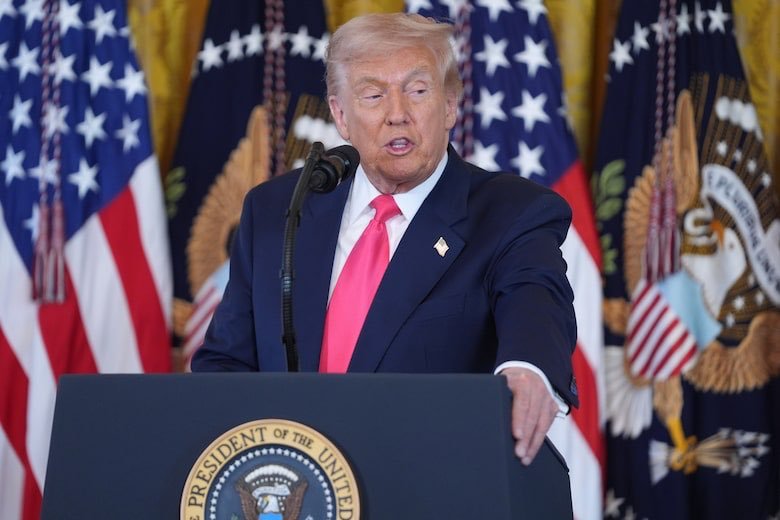
Speaking during a meeting with Irish Prime Minister Micheál Martin in the Oval Office on Tuesday, Trump said his trip to Beijing would now take place in about five or six weeks instead of later this month. The visit, which includes talks with Chinese President Xi Jinping, had been planned for months but was delayed as the White House focuses on developments in the Middle East.
“We’re working with China, they were fine with it,” Trump said. “I look forward to seeing President Xi. He looks forward to seeing me, I think.”
The planned trip is widely viewed as an opportunity to reinforce a fragile trade truce between the United States and China. However, it has become entangled with the administration’s efforts to address the ongoing war involving Iran and rising tensions in the Persian Gulf.
Over the weekend, Trump called on China and other global powers to help secure the Strait of Hormuz, a crucial maritime route for global oil shipments. The waterway handles roughly one-fifth of the world’s traded oil, making it one of the most strategically important energy corridors.
Trump suggested that the timing of his China visit could be influenced by Beijing’s willingness to assist in protecting the strait. In an interview with the Financial Times on Sunday, he said he wanted to know whether China would contribute to efforts to secure the passage before traveling to Beijing for the summit that had originally been scheduled for late March.
On Monday, Trump told reporters that the demands of the war could push the visit back by about a month.
“I think it’s important that I be here,” Trump said. “So it could be that we delay a little bit — not much.”
Despite speculation that the delay could be intended to pressure Beijing, U.S. Treasury Secretary Scott Bessent dismissed that interpretation. After meeting Chinese Vice Premier He Lifeng in Paris this week for a new round of economic discussions aimed at preparing for Trump’s visit, Bessent said any scheduling changes were logistical rather than strategic.
The Strait of Hormuz has become a central focus of the current crisis. Trump has urged countries that rely heavily on Middle Eastern oil to help safeguard the route, arguing that they should share responsibility for protecting global energy flows.
China has been a particular focus of those appeals because a significant portion of its oil imports passes through the strait, while the United States imports comparatively little from that route. Trump has also called on Japan, South Korea, Britain and France to contribute to maritime security operations in the region.
“We strongly encourage other nations whose economies depend on the strait far more than ours,” Trump said earlier this week. “We want them to come and help us with the strait.”
So far, however, there has been little indication that major powers are prepared to deploy forces for such a mission. Several governments have expressed reservations, while China has responded cautiously without committing to any specific role.
Trump has framed the war involving Iran as an effort led by the United States and Israel to protect broader international stability, particularly the security of global energy supplies. He has argued that nations benefiting from secure oil shipments should contribute more actively to safeguarding maritime routes.
Some world leaders have rejected that framing and criticized Washington’s reliance on military pressure in dealing with Tehran, warning that the conflict could further destabilize the region.
The postponed China visit nonetheless remains a key diplomatic moment. Relations between Washington and Beijing have remained delicate after years of economic rivalry and a trade dispute that resulted in steep tariffs on both sides.
The two governments agreed to a one-year trade truce last fall, easing some tensions and opening the door for renewed diplomatic engagement. Trump later accepted an invitation for a state visit to Beijing, following his earlier trip to China during his first term in 2017.
Chinese officials have signaled interest in maintaining constructive ties. China’s foreign minister said last week that Beijing hopes the coming year will be a “landmark” period in relations with the United States. He also stressed that China’s approach has remained “positive and open,” while noting that meaningful progress would require the United States to meet China halfway.
Meanwhile, the war involving Iran has shifted the White House’s immediate priorities. The conflict has sent oil prices sharply higher, raising concerns about inflation and economic pressure at a politically sensitive moment in the United States.
To help stabilize energy markets, the administration has released oil from the U.S. strategic petroleum reserve and moved to ease sanctions on Russian oil exports decisions aimed at offsetting potential supply disruptions from the Middle East.
With the Gulf crisis continuing to unfold, Trump’s diplomatic schedule is being reshaped by events far beyond Washington. While he still plans to visit Beijing, the timing of the trip will likely depend on how the conflict and global responses to it evolve in the coming weeks.
-Alex Richardson.