


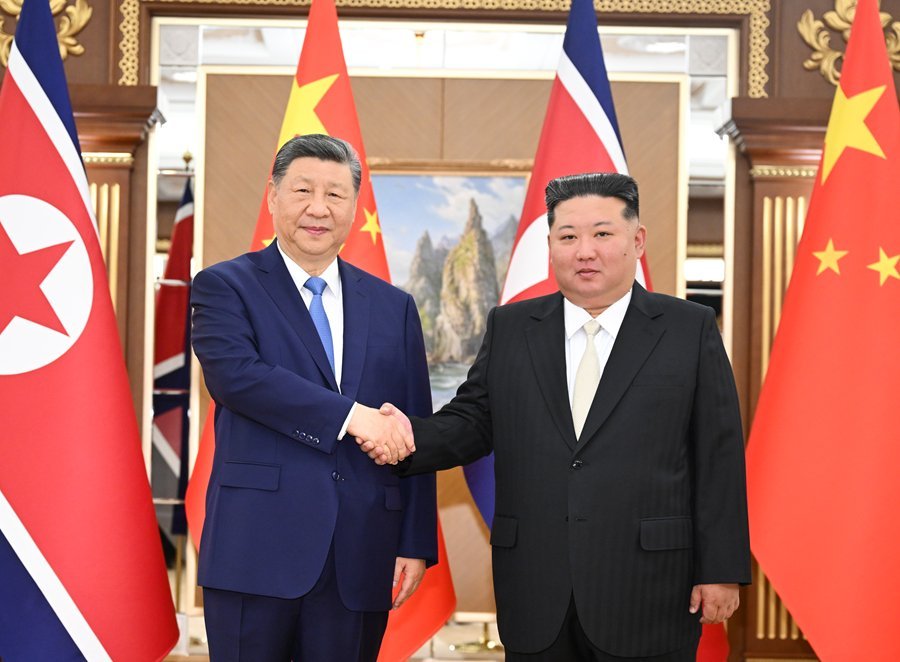
SEOUL/BEIJING: Chinese President Xi Jinping has delivered a strong message of continuity and strategic alignment during a rare visit to Pyongyang, pledging that Beijing’s support for North Korean leader Kim Jong Un will remain firm despite shifting global dynamics.
Meeting Kim during a two-day state visit his first to North Korea in seven years, Xi underscored China’s commitment to deepening ties with its long-time ally. According to an official Chinese summary, he emphasized that Beijing would not “swerve” from safeguarding shared interests or weaken its backing of Pyongyang’s leadership.
“No matter how the international landscape evolves, China will continue to value and advance its traditional friendship with North Korea,” Xi said, reaffirming political support for Kim’s leadership and the country’s socialist trajectory.
The visit comes at a moment when North Korea appears increasingly emboldened. Strengthened economic and military cooperation with Russia, alongside the gradual reopening of cross-border exchanges with China following the pandemic, has improved Pyongyang’s strategic position.
Xi’s arrival in the North Korean capital was marked by elaborate state ceremony. Kim Jong Un and his wife Ri Sol Ju personally welcomed the Chinese leader and First Lady Peng Liyuan, with a guard of honour, a 21-gun salute, and crowds gathered in Kim Il Sung Square, a powerful symbol of state authority and unity.
Beyond symbolism, the talks focused on expanding cooperation across a wide range of sectors, including diplomacy, defense, trade, agriculture, and technology. Xi described bilateral relations as entering a “new historical starting point,” urging both sides to strengthen coordination and exchanges at all levels.
During a state banquet hosted by Kim, both leaders confirmed that “important consensus” had been reached, signaling alignment on both regional security and economic collaboration.
Xi also used the visit to deliver a broader geopolitical message, calling on both nations to jointly oppose what he described as hegemonic forces and destabilizing efforts in the region. Analysts view this rhetoric as a veiled reference to U.S. influence and its alliances in East Asia.
Experts suggest the summit reinforces North Korea’s role in China’s strategic calculus. “Beijing continues to see Pyongyang as a valuable geopolitical asset,” said analysts, noting that both countries along with Russia and Iran share an interest in counterbalancing U.S. power.
Recent developments indicate growing momentum in regional alignments. North Korea has resumed cross-border activity with China, while Air China reinstated flights between the two capitals earlier this year. These moves reflect a broader effort to normalize ties after years of pandemic isolation.
At the same time, Pyongyang signaled its military ambitions on the eve of Xi’s arrival, unveiling plans for a new 10,000-ton naval destroyer and reiterating its status as a nuclear-armed state.
According to recent estimates, North Korea’s nuclear arsenal has expanded to approximately 60 warheads, with ongoing production of fissile material potentially enabling further growth.
Observers warn that the strengthening ties between China, North Korea, and Russia could reshape regional dynamics, potentially allowing Kim to maintain a more defiant stance toward Washington and Seoul.
As Xi’s visit concludes, it leaves behind a clear message: despite global uncertainty, the China–North Korea partnership remains resilient and increasingly consequential.
-Kim Lee and Jack Goh