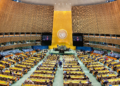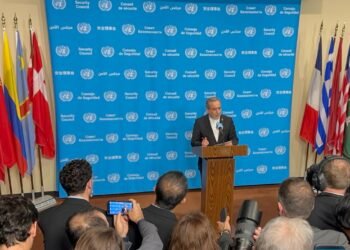



NEW YORK, USA: The 81st United Nations General Assembly opened with an ambitious promise, “Restoring Trust, Managing Transformation: A United Nations That Delivers for All.” Yet as presidents and prime ministers took the podium in New York, it became evident that trust has become the world’s scarcest strategic commodity. The General Assembly was no longer simply a forum for diplomacy; it became a global arena where competing powers defended their military actions, challenged international law, sought institutional reform, and attempted to redefine the rules of the emerging multipolar order.
From Washington’s renewed language of deterrence to India’s uncompromising position on terrorism, from Israel’s defence of its military campaign to Africa’s collective demand for a more equitable United Nations, the Assembly revealed a profound truth: the future of global influence will belong less to the states with the loudest rhetoric than to those capable of projecting credible ideas with strategic consistency.
Perhaps the clearest example of that consistency came from India. The diplomatic confrontation with Pakistan was not merely another exchange over Kashmir; it represented a fundamental disagreement over how the international community should understand terrorism. Pakistan’s Prime Minister Shehbaz Sharif used the UN podium to revive the Kashmir dispute, praise U.S. President Donald Trump for what he described as a “timely intervention” during the 2025 conflict, and once again argue for international involvement in South Asian affairs. It was an attempt to shift the conversation from terrorism to territorial politics.
India refused to accept that framing. External Affairs Minister S. Jaishankar delivered a response that was notable not for emotional language, but for legal and diplomatic precision. Addressing the Assembly, he declared: “Yesterday, a serial practitioner of terrorism misrepresented facts before this Assembly. Arguments were invoked to normalize terrorism and claim immunity from its consequences. That will not stand.” He then articulated India’s most important strategic principle: “Our right to defend ourselves against terrorism will be exercised.”
Those two sentences effectively summarized India’s post-2025 foreign policy doctrine. Since the Pahalgam terrorist attack, which claimed 26 civilian lives, and the subsequent launch of Operation Sindoor against terrorist infrastructure in Pakistan and Pakistan-occupied Kashmir, New Delhi has consistently argued that terrorism cannot be separated from state responsibility. Jaishankar expanded that argument further by stating that “friendship and goodwill cannot co-exist with the scourge” of terrorism, making it clear that political dialogue cannot substitute for credible action against cross-border violence.
Importantly, India did not limit its intervention to Pakistan alone. Jaishankar coupled his hard security message with a broader appeal for stronger multilateralism, warning that the global order is under unprecedented stress from conflict, geopolitical competition, disrupted supply chains, maritime insecurity, and the weaponization of technology. By simultaneously advocating accountability against terrorism and reform of international institutions, India positioned itself as both a security actor and a defender of a more representative global order.
If India’s speech demonstrated strategic clarity, Israel’s address exposed the deep moral polarization surrounding the Gaza conflict. Prime Minister Benjamin Netanyahu entered the General Assembly while thousands protested outside the United Nations and dozens of diplomats walked out as he began speaking. Rather than moderate his position, he intensified it. Netanyahu dismissed allegations of genocide as “the biggest lie of the century,” defended Israel’s military operations against Iran alongside the United States, and insisted, “If we hadn’t done it, we’d all be dead.” Turning toward the departing delegates, he called them “moral cowards,” arguing that history would ultimately vindicate Israel’s decisions.
The response illustrated why UNGA 81 became as much a battle over legitimacy as over security. Iceland’s Foreign Minister Þorgerður Katrín Gunnarsdóttir rejected Netanyahu’s characterization, arguing that the real moral cowardice belongs to leaders who repeatedly disregard international law, deny humanitarian access, and refuse meaningful negotiations. Her intervention reflected the growing determination of smaller democracies to defend international legal norms at a time when major powers increasingly justify exceptional military action through national security.
President Donald Trump added another layer to this changing diplomatic vocabulary. His address blended optimism with unmistakable coercion. Offering Iran what he described as “a bright new future,” he immediately warned that the alternative was that he could “annihilate Iran and send the country to hell.” Such language is exceptionally rare within the General Assembly, traditionally a space for restraint rather than ultimatums. Whether viewed as strategic deterrence or maximum-pressure diplomacy, Trump’s remarks confirmed that military leverage has once again become central to the conduct of great-power diplomacy.
Yet while headlines were dominated by confrontation among major powers, Africa quietly produced the Assembly’s most coherent long-term vision.
Across speeches delivered by Kenya, Ghana, South Africa, Namibia, Sierra Leone, and Egypt, a remarkable pattern emerged. Rather than competing for geopolitical advantage, African leaders consistently argued that the greatest crisis facing the international system is institutional inequality. Kenya’s President William Ruto warned that today’s global challenges cannot be addressed by yesterday’s institutions and called for multilateralism that genuinely reflects contemporary political and economic realities. Namibia’s President Netumbo Nandi-Ndaitwah emphasized sovereign equality and cautioned against the selective application of international law, arguing that rules lose legitimacy when they are applied differently to different nations. Sierra Leone renewed Africa’s demand for permanent representation on the Security Council, insisting that a continent of over 1.4 billion people cannot remain excluded from the UN’s highest decision-making body.
South Africa broadened that conversation by arguing that peace cannot be separated from justice. Its delegation linked armed conflict with economic inequality, climate vulnerability, migration, and unequal access to global finance, emphasizing that sustainable stability requires structural reform rather than transactional crisis management. Pretoria’s intervention reflected a longstanding South African conviction that political legitimacy and economic inclusion are inseparable pillars of international security.
Egypt, meanwhile, positioned itself as a stabilizing regional power. Cairo emphasized humanitarian access in Gaza, the urgency of preventing wider Middle Eastern escalation, and the necessity of preserving a rules-based regional security architecture. Its diplomacy demonstrated how regional influence increasingly depends upon balancing security imperatives with humanitarian responsibility rather than choosing between them.
Ghana introduced perhaps the Assembly’s most morally compelling argument. President John Dramani Mahama urged the international community to recognize the transatlantic slave trade as “the gravest crime against humanity,” insisting that genuine global reconciliation requires confronting historical injustice alongside contemporary conflict. His intervention expanded the debate beyond war and security, reminding delegates that credibility in international affairs also depends upon acknowledging unfinished historical responsibilities.
Binding these diverse perspectives together was Secretary-General António Guterres. In what is widely regarded as his final General Assembly address after a decade leading the United Nations, Guterres warned that humanity faces a defining choice between fragmentation and interdependence. He argued that no superpower, alliance, or regional bloc can independently solve climate change, pandemics, conflict, technological disruption, or economic instability. His strongest institutional appeal concerned Africa’s continued exclusion from permanent Security Council membership, describing reform not as charity but as essential to the legitimacy of the United Nations itself.
It is precisely against this backdrop that Nigeria’s diplomatic performance deserves thoughtful reflection.
Nigeria remains Africa’s demographic giant, one of its largest economies, a cultural superpower, and historically one of the continent’s most influential diplomatic actors. Its contributions to UN peacekeeping, ECOWAS mediation, regional security, and African integration have earned it substantial international respect. Few African nations possess comparable geopolitical weight or soft power.
Yet UNGA 81 exposed the widening gap between potential and agenda-setting influence.
While Kenya articulated institutional reform, Ghana reshaped the conversation on historical justice, South Africa connected governance with economic equity, Egypt projected regional stabilization, and India transformed counterterrorism into a global accountability doctrine, Nigeria did not produce a defining diplomatic narrative of similar international resonance. Vice President Kashim Shettima represented the country with dignity, but the broader Nigerian message struggled to distinguish itself within a week dominated by bold strategic ideas.
This observation is not an indictment of Nigeria’s diplomacy; it is a reflection on unrealized leadership. In the twenty-first century, influence is no longer determined solely by population, GDP, or military capacity. It is increasingly measured by a nation’s ability to frame global debates, build intellectual coalitions, and consistently project solutions that others are willing to follow. Demography creates relevance, but ideas create leadership.
The most enduring lesson of UNGA 81 is therefore larger than any individual speech. The United States defended deterrence. India argued that terrorism must never be normalized. Israel justified security through military necessity. African nations demanded justice through institutional reform. The United Nations appealed for interdependence over rivalry.
The countries that emerged stronger were not necessarily those facing fewer crises; they were those that articulated a coherent vision of the international order they wished to build. For Nigeria, that remains the defining opportunity. Africa’s largest nation already possesses the resources, diplomatic tradition, and human capital to lead the continent’s voice in global affairs. What it now needs is greater strategic clarity, the confidence to transform its immense potential into consistent international authority.
Because in a fragmented world, credibility has become the highest currency of power, and the nations that shape the future will be those whose principles are as persuasive as their ambitions.
-Dr. M Shahid Siddiqui From UNGA, Newyork, USA