

ANTALYA, Turkiye: The world has arrived at another climate summit with ambitious declarations, mounting scientific warnings and an increasingly uncomfortable question: how much longer can governments promise climate action while continuing policies that deepen dependence on fossil fuels?
The opening of the 31st United Nations Climate Change Conference (COP31) in Antalya, Türkiye, on November 9 has brought this contradiction into sharp focus. Over the next two weeks, nearly 200 nations will confront the challenge of accelerating the global energy transition against a backdrop of geopolitical conflict, economic uncertainty, rising electricity consumption and increasingly destructive climate-related disasters.
The message from the opening session was unmistakable: the world must move faster.
UN Climate Change Executive Secretary Simon Stiell delivered a strong warning in his opening address, declaring, “The urgency of this moment must drive us forward.” He cautioned that existing progress was “nowhere near fast enough”, reflecting growing international concern that climate commitments are advancing considerably faster on paper than they are being implemented on the ground.
The scientific warnings reinforce his message. A United Nations Environment Programme report published in October indicated that the world remains on course to exceed the Paris Agreement’s 1.5°C warming threshold, even under relatively optimistic assumptions. Meanwhile, 2026 is expected to rank among the four warmest years ever recorded, according to the World Meteorological Organization.
Extreme heatwaves across Western Europe and the devastating glacier-related flooding in Nepal, which killed more than 1,450 people, demonstrate how climate risks are increasingly translating into humanitarian and economic crises. The consequences are no longer confined to environmental discussions. Food security, public health, infrastructure, migration, industrial competitiveness and national security are becoming inseparable from the climate debate.
At the centre of Türkiye’s COP31 presidency is an ambitious proposal to increase electricity’s share of global final energy consumption from approximately 20% today to 35% by 2035. The 35-by-35 Global Electrification Pledge seeks to accelerate the transition across transportation, buildings and industrial operations, encouraging the replacement of fossil-fuel-powered vehicles, heating systems, industrial equipment and other conventional technologies with electricity-based alternatives.
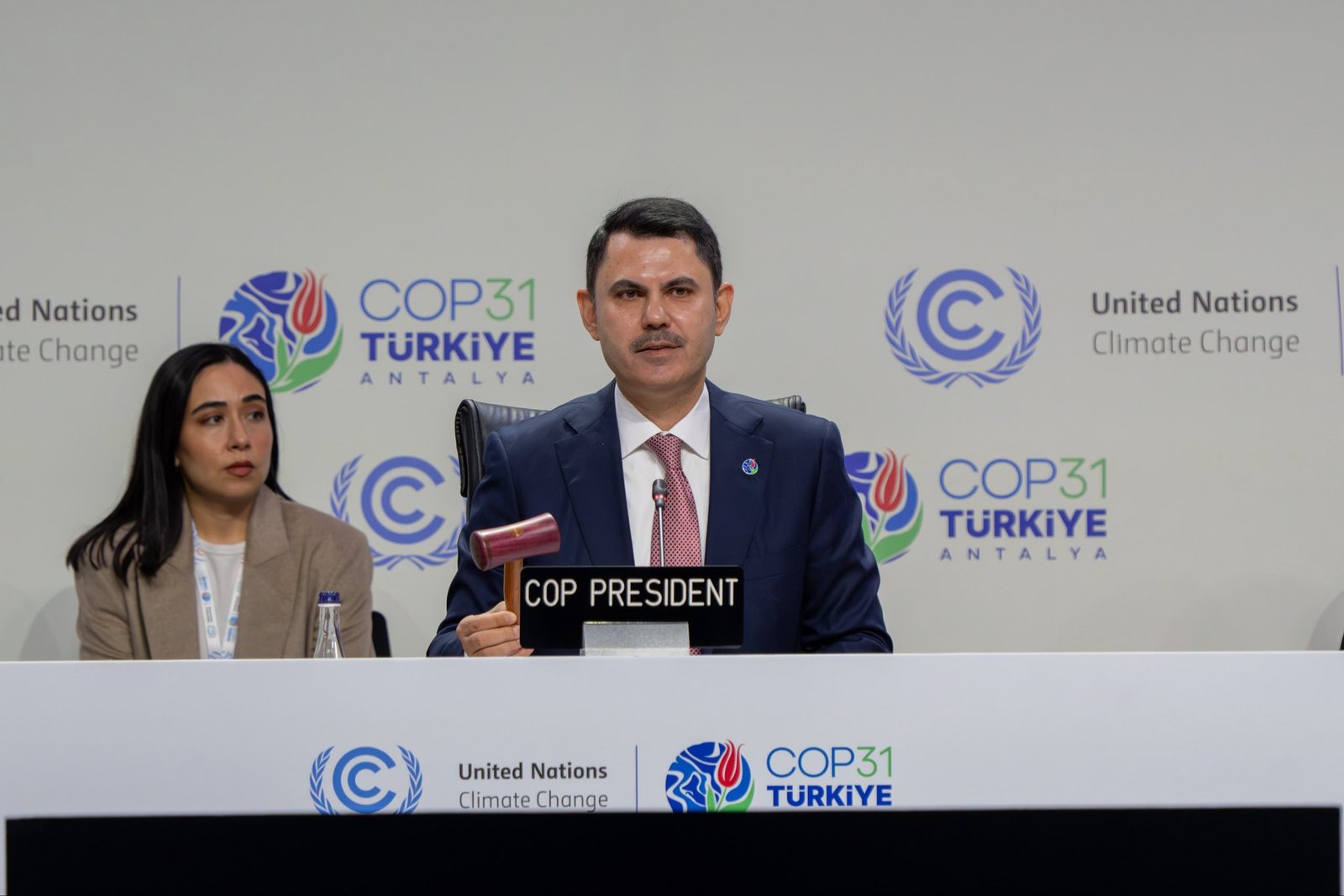
COP31 President Murat Kurum has presented electrification as an essential response to both climate change and international energy insecurity. In his opening remarks, he said, “We want people to feel the results of climate talks in daily life: in buildings that use less energy, in clean public transport, in energy they can afford and in new jobs.”
His argument reflects the growing recognition that climate policy must deliver tangible economic and social benefits rather than remain confined to international declarations.
However, electrification alone cannot guarantee decarbonisation. If additional electricity comes from coal-fired power plants or other carbon-intensive sources, shifting consumption from petroleum and gas to electricity may simply transfer emissions from one sector to another. The credibility of the 35-by-35 initiative will therefore be tested by whether it is accompanied by accelerated renewable energy deployment, modern electricity grids, battery storage, flexible power markets and investment in low-carbon generation.
The geopolitical environment makes this challenge considerably more complicated. The Iran war has severely disrupted petroleum shipments through the Strait of Hormuz, sending shockwaves through international fuel markets and forcing governments to reconsider their energy procurement strategies. Russia’s continuing war against Ukraine and restrictions on Russian energy exports have further demonstrated how dependence on concentrated fossil-fuel supply chains can expose national economies to geopolitical pressure.
These developments have strengthened arguments for domestic energy production, but they have also encouraged some governments to increase reliance on coal, oil and natural gas to protect short-term energy supplies. The United States, under President Donald Trump, is staying away from international climate negotiations for the second consecutive year while promoting increased domestic production of fossil fuels. Several Asian economies, including India, South Korea and Thailand, have also taken steps to increase or maintain coal-fired electricity generation amid concerns about energy availability and affordability.
This creates a fundamental contradiction in the global climate response. Governments recognise the long-term dangers of fossil-fuel dependence, yet geopolitical instability continues to reinforce its immediate economic and strategic importance.
Nevertheless, the same crisis is strengthening the case for renewable energy. Expanding solar, wind and storage capacity can reduce exposure to international fuel-price fluctuations and improve domestic energy resilience. Stiell argued that renewable energy offers a clear route towards greater energy security, warning that “This year’s fossil fuel cost chaos has delivered a global shockwave, hitting households hard and spreading inflation like a cancer.”
He also highlighted the economic benefits of renewable energy deployment, arguing that the expansion of clean power has already generated substantial savings for the global economy.
Another emerging challenge confronting COP31 is the rapidly expanding electricity consumption associated with artificial intelligence. The global expansion of data centres, advanced computing infrastructure and AI applications is creating additional pressure on electricity systems. Technology companies are competing to secure reliable power supplies, while governments are increasingly concerned about whether existing electricity infrastructure can accommodate future demand.
The climate implications are significant. If the additional electricity required by AI infrastructure is generated predominantly through fossil fuels, technological advancement could contribute to higher greenhouse gas emissions. Türkiye is therefore promoting the Antalya AI Pledge, intended to encourage more responsible and sustainable AI development.
Artificial intelligence can improve electricity forecasting, optimise renewable energy distribution, strengthen industrial efficiency and support early-warning systems for extreme weather events. However, its environmental benefits will depend on how responsibly the technology is developed and powered. The world cannot claim to be building a sustainable digital economy while overlooking the energy requirements of its technological expansion.
Perhaps the most uncomfortable challenge for Türkiye’s COP31 presidency is unfolding hundreds of kilometres away from the conference venue. In southwestern Türkiye, villagers around the Akbelen forest and İkizköy are demanding that international leaders visit their communities and witness the consequences of expanding lignite mining.
Local representative Nejla Işık has urged world leaders attending COP31 to travel beyond Antalya and see how decades of coal extraction have affected forests, agricultural land, olive groves and surrounding communities. Her appeal exposes a difficult contradiction in Türkiye’s energy transition.
Coal generated approximately 34% of the country’s electricity in 2025, making Türkiye Europe’s largest coal-fired electricity producer, according to energy think tank Ember. The mines around Akbelen supply nearby power plants, while local residents argue that mining expansion threatens their livelihoods and environment.
The protests have also carried significant personal consequences. Işık’s daughter, Esra, spent 42 days in pretrial detention following a protest against planned land expropriation for mining. She was subsequently sentenced to two years in prison for resisting public officials and remains free pending an appeal.
Their struggle raises a question that extends well beyond Türkiye: can governments credibly advocate a clean energy transition internationally while communities at home continue to experience the environmental and social consequences of fossil-fuel extraction?
A genuine energy transition cannot be measured exclusively through electricity targets and investment announcements. It must also account for environmental protection, community participation, workers’ livelihoods and the rights of people affected by industrial transformation. This is precisely where the principle of a just transition becomes essential.
Beyond energy technology and national commitments, climate finance remains one of the most difficult issues confronting international negotiations. Developing countries face mounting costs associated with climate adaptation, disaster preparedness, resilient infrastructure and the transition towards cleaner energy systems. Many have contributed relatively little to historical greenhouse gas emissions but face disproportionate exposure to rising temperatures, extreme weather, coastal flooding and agricultural disruption.

Without predictable financial support, affordable technology and access to international investment, developing economies will struggle to reconcile development priorities with emissions-reduction commitments. The challenge for developed countries is therefore not simply to demand higher climate ambitions but to help make those ambitions financially achievable.
Australia’s Chris Bowen, who is presiding over the COP31 negotiations, has emphasised the importance of preserving international cooperation and translating the Paris Agreement into practical results. Expressing confidence in the multilateral climate framework, he stated: “Paris is working. But we must move faster.”
His message captures the central dilemma of the conference. Multilateralism remains necessary, but diplomatic consensus must produce measurable outcomes.
COP31 will continue until November 20, with the Antalya Leaders’ Summit scheduled for November 11–12. The negotiations will address emissions reduction, adaptation, climate finance, renewable energy, industrial transformation and the implementation of existing national commitments.
Yet the significance of this summit will not be determined by the number of declarations signed or the ambition of speeches delivered from its conference halls. It will depend on whether governments can establish credible pathways towards cleaner electricity, accelerate renewable energy investment, strengthen grids, reduce fossil-fuel dependence and mobilise the financial resources required by developing countries.
The 35-by-35 ambition could provide an important framework for accelerating electrification. But its success must be measured against the carbon intensity of the electricity being generated, not simply the growing share of electricity in the global energy mix. Similarly, the promise of artificial intelligence must be balanced against its expanding energy footprint, while energy security must no longer become an automatic justification for postponing the transition away from fossil fuels.
The world is approaching a critical climate threshold, and the consequences of delayed action are becoming increasingly visible.
COP31 has opened with a clear appeal to move faster. The real test is whether nearly 200 nations are prepared to move beyond political assurances and confront the difficult choices that climate action demands.
The question facing Antalya is no longer whether the world needs an energy transition. It is whether governments have the political courage, financial commitment and strategic consistency to deliver one before the costs of delay become irreversible.
–Dr. M Shahid Siddiqui from Antalya, Turkiye
READ THE FULL E-MAGAZINE | WorldAffairs: For Decision-Makers Who Need More Than Headlines