


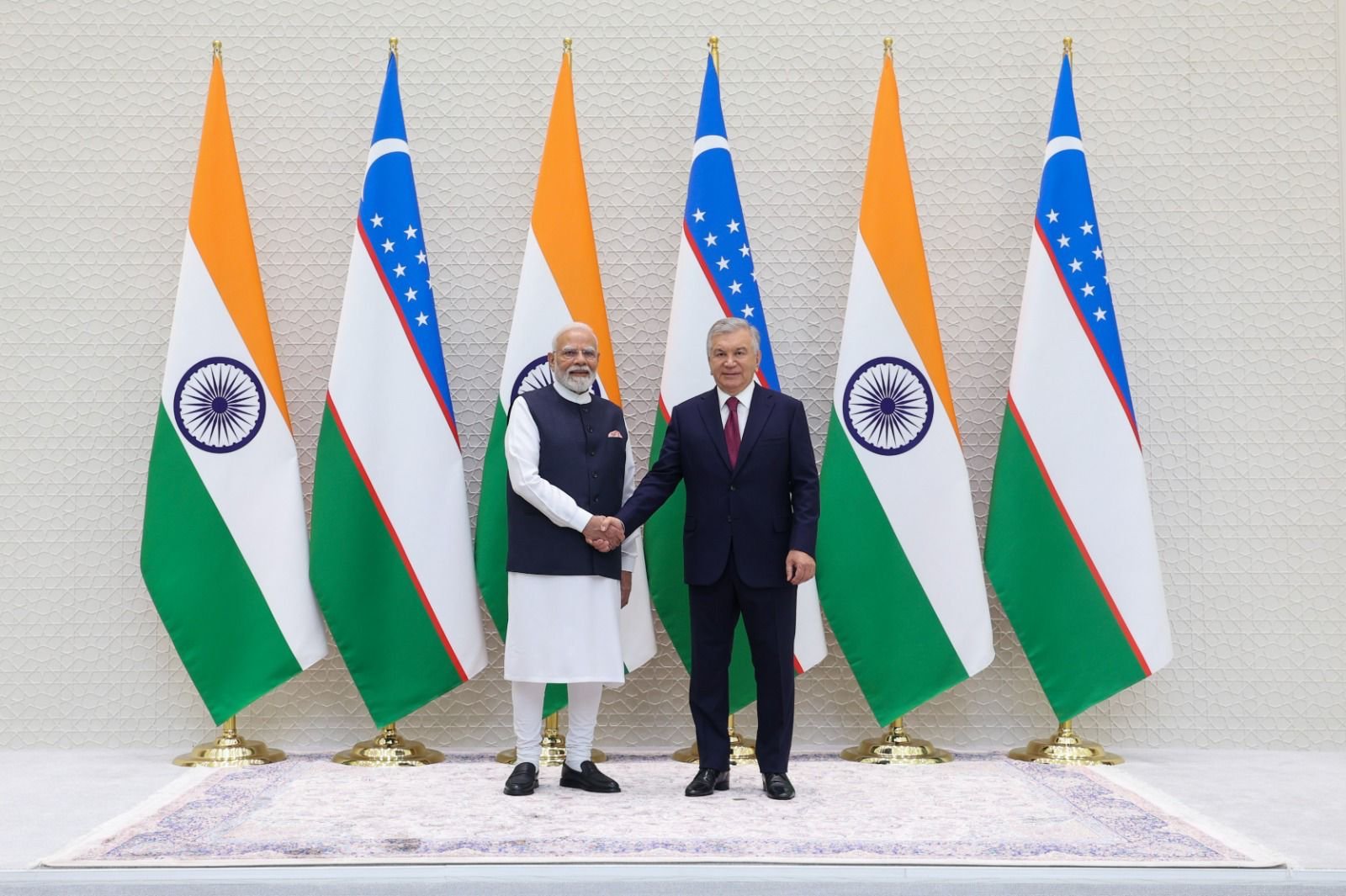
TASHKENT, Uzbekistan: India’s decision to elevate relations with Uzbekistan to a Comprehensive Strategic Partnership is being presented through the familiar language of trade, energy, connectivity and people-to-people ties. But the geopolitical meaning is harder and more consequential. New Delhi is attempting to solve a strategic problem that has constrained its continental ambitions for decades: how can India become a serious Eurasian power when geography limits its physical access to Eurasia?
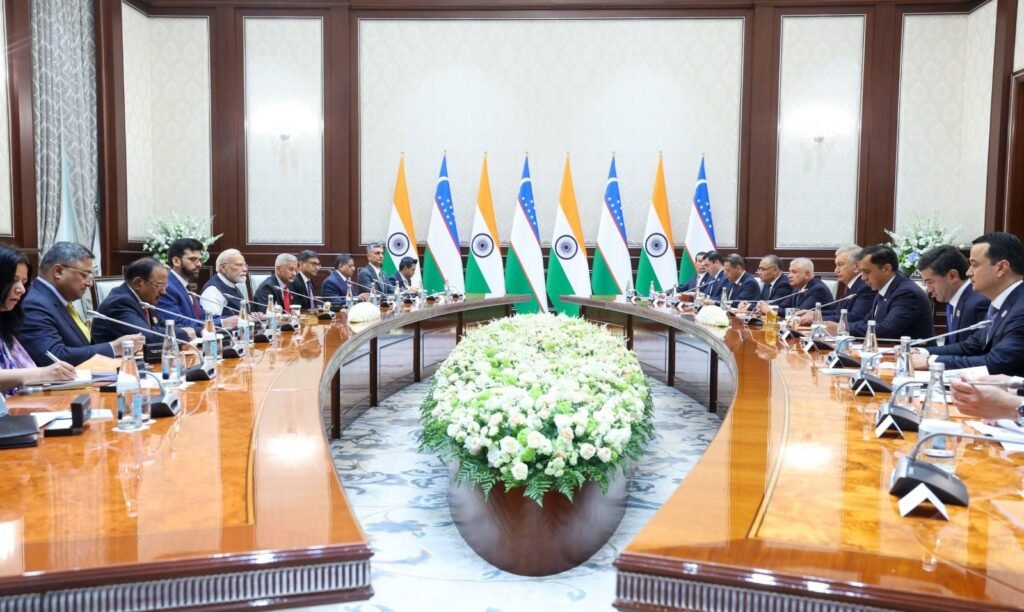
Prime Minister Narendra Modi’s August 30 visit to Tashkent produced a $5 billion bilateral trade target for 2030 and expanded cooperation in uranium, critical minerals, defence, digital payments, transport and investment. These agreements are important individually. Together, however, they reveal a wider Indian strategy: acquiring strategic depth beyond South Asia by building political, economic and technological access to Central Asia.
This is not a contest India can afford to ignore.
Central Asia has become one of the world’s most important geopolitical crossroads. China is expanding its economic and transport presence across the region. Russia remains deeply embedded in its security and political architecture. Europe and the United States are looking increasingly towards Central Asia for critical minerals, alternative supply chains and new connectivity routes. Türkiye and the Gulf states are expanding their own strategic and commercial roles. Central Asian governments, meanwhile, are using this competition to widen their room for manoeuvre.
For India, Uzbekistan is especially important because it is not simply a market. It is a strategic entry point into this increasingly contested geography. The problem is that India arrives with a structural disadvantage. It does not possess China’s direct continental connectivity or Russia’s historical depth across Central Asia. Geography and regional politics have left India politically engaged but commercially constrained. This is the weakness behind much of New Delhi’s Eurasian strategy: diplomatic relationships can be established faster than physical routes can be built. That makes connectivity the decisive test.
The $5 billion trade target by 2030 is ambitious, particularly after bilateral trade reportedly rose by 33% to $1.3 billion last year. But trade figures do not move independently of geography. India and Uzbekistan need commercially viable transport corridors, predictable transit arrangements, stronger banking links and functioning logistics networks. Without them, the Comprehensive Strategic Partnership could remain strategically impressive but economically limited.
For New Delhi, this is a wider geopolitical challenge. Power in Eurasia is increasingly shaped by corridors. Whoever provides the routes through which energy, goods, data and capital move acquires influence over the strategic map itself. India cannot simply participate in Eurasia through diplomatic declarations. It needs access. The long-term success of its Central Asia policy will therefore depend less on the number of summits it attends than on whether Indian commerce can move reliably across the region.
The proposed uranium cooperation demonstrates why Uzbekistan matters beyond connectivity. India signed a long-term agreement in 2019 for the supply of 1,100 metric tonnes of natural uranium concentrate between 2022 and 2026. A new framework for longer-term cooperation would support India’s broader energy-security strategy as New Delhi pursues a major expansion of nuclear capacity towards 100 GW by 2047.
This is not merely an energy transaction. In an increasingly fragmented world, secure access to strategic resources has become a geopolitical necessity. India is attempting to diversify supply relationships precisely because dependence creates vulnerability. Uzbekistan offers a source of uranium outside some of the traditional centres of global energy and resource power. The wider cooperation on mining and geological resources suggests that the relationship could increasingly extend into critical minerals. Here lies the next great geopolitical competition.
The twenty-first century will not be organised around oil alone. Critical minerals, semiconductor materials, batteries, electricity networks and advanced manufacturing are becoming central to national power. Countries that control extraction possess leverage. Countries that control processing possess greater leverage. Countries that control technology and manufacturing possess the greatest leverage of all.
For India, therefore, access to Central Asia’s resources is only the first stage of a strategic calculation. The more important question is whether New Delhi can integrate resource access into domestic industrial capacity. India has little interest in replacing one dependency with another. Its objective is to build resilient supply chains that strengthen its technological and manufacturing base.
The digital dimension of the India-Uzbekistan partnership is also geopolitically significant. The proposed cooperation involving NPCI International Payments Limited and Uzbekistan’s National Interbank Processing Centre could eventually enable UPI-based transactions for Indian visitors. That might appear peripheral to hard power, but payment infrastructure is becoming part of the architecture of geopolitical influence.
The great-power competition of the coming decades will not be fought only through military bases and naval deployments. It will also be fought through technological standards, digital platforms, payment systems and data networks. India has identified digital public infrastructure as one of its most exportable strategic assets. The question is whether it can turn technological capability into sustained geopolitical presence.
Defence cooperation completes the picture. India and Uzbekistan have expanded their security relationship through counter-terrorism cooperation, defence engagement and the Dustlik military exercise. Yet New Delhi should remain realistic about its position. Central Asia is not a strategic vacuum. Russia retains substantial influence. China has major economic and growing security interests. Other powers are increasing their engagement.
India cannot outspend China across Central Asian infrastructure or replicate Russia’s geographical and historical position.
Its alternative is strategic diversification. New Delhi can become valuable precisely because it offers Central Asian states another major partnership. India does not require Uzbekistan to choose between Moscow and Beijing. It does not need Tashkent to become part of an Indian geopolitical bloc. Instead, India can offer trade, technology, defence training, pharmaceuticals, education, digital infrastructure and access to the wider Indian economy.
This is a different form of hard power: the power to provide options.
For the Global South, that distinction is increasingly important. The emerging world order is not dividing neatly into Western and non-Western blocs. Countries such as Uzbekistan want multiple partnerships because dependence on one power can rapidly become a strategic liability. India’s own foreign policy operates according to the same principle. New Delhi works with the United States while maintaining ties with Russia, participates in BRICS while strengthening Indo-Pacific partnerships, and builds relationships across the Gulf, Africa, Europe and Central Asia. The India-Uzbekistan partnership fits directly into this wider architecture.
But the strategy carries a risk. India’s geopolitical ambitions are expanding faster than its continental connectivity. New Delhi can articulate a powerful vision of strategic autonomy and multipolarity, but power requires infrastructure. Roads, ports, railways, energy contracts, digital systems, investment networks and supply chains ultimately determine whether diplomacy becomes influence.
The Tashkent agreements are therefore best understood as an opening move rather than a strategic breakthrough.
India has identified Central Asia as a critical frontier in its search for greater strategic depth. Uzbekistan provides a politically important and economically promising anchor. But the contest has already begun, and other powers possess advantages India does not. The real question is whether New Delhi can convert strategic intent into permanent presence. In Eurasia, influence is rarely granted. It is built and increasingly, it is built through the corridors that connect power to markets.
-Dr. M Shahid Siddiqui from Tashkent