


NEW DELHI, India: The most important message delivered during U.S. Secretary of State Marco Rubio’s India visit was not about trade, technology, defence cooperation, or even the Quad. It was about Iran, the Strait of Hormuz, and Washington’s growing realization that military escalation in West Asia has reached dangerous geopolitical and economic limits.
Rubio arrived in India at one of the most volatile moments in recent Middle Eastern history. The United States and Iran remain locked in fragile negotiations after months of war, regional instability, naval confrontation, and severe disruption to global energy markets. Yet Rubio’s carefully calibrated remarks in New Delhi revealed that Washington’s priorities are rapidly shifting from military pressure toward crisis containment.
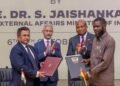
Standing beside India’s External Affairs Minister Subrahmanyam Jaishankar, Rubio acknowledged that “significant progress” had been made in negotiations with Iran. More importantly, he openly stated that the American objective was the restoration of “completely open straits, and I mean open straits without tolls.”
That statement was far more revealing than President Donald Trump’s own public declarations from Washington.
Trump continues insisting there is “no rush” for an agreement with Tehran and has maintained that the U.S. naval blockade on Iranian shipping will remain “in full force and effect until an agreement is reached, certified, and signed.” Publicly, the administration still frames its position around nuclear non-proliferation and preventing Iran from developing nuclear weapons.
But Rubio’s remarks in New Delhi exposed the deeper strategic reality driving current American diplomacy: the urgent need to reopen the Strait of Hormuz, stabilize energy markets, reassure allies, and prevent the conflict from spiraling into a prolonged geopolitical and economic crisis.
The Strait of Hormuz has now become the central battlefield of the confrontation.
Before the war erupted, nearly one-fifth of global oil and liquefied natural gas shipments passed through the narrow maritime corridor linking the Persian Gulf to the world economy. Since the outbreak of hostilities following joint U.S.-Israeli strikes against Iran on February 28, maritime traffic has been severely disrupted.
Iran has used its strategic position in Hormuz as leverage in negotiations with Washington. Iranian Revolutionary Guard-linked reports claim that only a fraction of pre-war shipping traffic has resumed, despite the fragile ceasefire currently in place. The economic consequences have been global: rising fuel prices, soaring shipping costs, higher insurance premiums, and increased pressure on food and fertilizer markets.
For India, the crisis is especially serious.
India imports more than 80% of its energy requirements, and nearly half of its crude oil imports normally pass through the Strait of Hormuz. The disruption has intensified concerns over inflation, energy security, and economic stability. This explains why Rubio’s conversations with Prime Minister Narendra Modi focused heavily on West Asia, maritime security, and global stability alongside bilateral cooperation in defence, trade, strategic technologies, and energy security.
After meeting Rubio in New Delhi, Modi stated that India and the United States would continue working closely “for the global good.” He added that discussions covered “sustained progress in the India-U.S. Comprehensive Global Strategic Partnership and issues related to regional and global peace and security.”
The significance of Rubio’s visit extends far beyond symbolic diplomacy.
Washington increasingly recognizes that India is no longer merely an observer in Gulf geopolitics. As one of the world’s largest energy consumers and a country maintaining strategic ties with both the United States and Iran, India has become a critical stakeholder in any future regional stability framework. Rubio’s India visit therefore served multiple purposes simultaneously: reassuring New Delhi about energy security, strengthening broader strategic ties, reinforcing Quad coordination, and signaling to Asian economies that Washington understands the dangers of prolonged instability in West Asia.
The invitation extended by Rubio on behalf of President Trump for Modi to visit the White House in the “near future” further underlined Washington’s strategic priority of keeping India closely aligned amid intensifying global geopolitical competition. Yet the deeper story behind Rubio’s diplomacy is Washington’s gradual retreat from earlier maximalist objectives regarding Iran.
When the conflict began, the Trump administration demanded sweeping concessions, including the dismantling of Iran’s enrichment infrastructure and broad limitations on Tehran’s regional influence. Trump repeatedly warned that Iran would “never have a nuclear weapon,” while senior American officials signaled support for sustained military pressure.
Today, however, the emerging negotiations reveal a much more pragmatic American position. Senior administration officials now acknowledge that Tehran has agreed “in principle” to reopening the Strait of Hormuz in exchange for easing the U.S. naval blockade and entering broader negotiations regarding its stockpile of highly enriched uranium. The proposed framework reportedly includes phased negotiations lasting approximately 60 days, during which detailed arrangements over uranium disposal, sanctions relief, and verification mechanisms would be discussed.
Washington is no longer publicly insisting on the total elimination of Iran’s nuclear infrastructure. Instead, officials are discussing dilution mechanisms, international supervision, and long-term suspension formulas.
This shift reflects an uncomfortable reality confronting the United States.
Despite months of military pressure and extensive U.S.-Israeli strikes, Iran’s political system survived. Its regional influence remains significant. Its nuclear program was weakened but not eliminated. Most importantly, Tehran demonstrated that it retained the capacity to disrupt one of the world’s most critical maritime chokepoints. That realization has forced a strategic recalculation in Washington.
The war produced consequences far beyond the battlefield. Global energy markets were shaken. Gulf Arab states became increasingly anxious about long-term instability. Asian economies dependent on Gulf energy faced growing pressure. International shipping and insurance sectors absorbed major financial shocks.
Even some of Washington’s closest Gulf allies reportedly urged restraint, fearing catastrophic regional escalation. Trump himself acknowledged canceling planned military operations after appeals from Gulf states concerned about the broader economic fallout. Rubio’s New Delhi remarks therefore reflected realism more than triumphalism. His message indicated that Washington’s immediate objective is no longer strategic victory over Iran but strategic stabilization of the region.
This evolving position has triggered fierce criticism inside the United States.
Former Secretary of State Mike Pompeo and several Republican hawks argue that the emerging framework resembles the very type of negotiated compromise Trump once condemned when he withdrew from the 2015 Iran nuclear deal negotiated during the presidency of Barack Obama.
Democratic critics have also questioned the administration’s strategy. Senator Chris Van Hollen described the emerging arrangement as little more than a return to the “pre-war status quo” after enormous geopolitical and economic costs.
At the same time, Tehran is attempting to frame the negotiations as proof of Iranian resilience and strategic victory.
In a strongly worded statement issued by the Embassy of the Islamic Republic of Iran in India, Tehran rejected Rubio’s accusations and accused the United States and Israel of destabilizing regional maritime security and global energy markets. The Iranian embassy argued that American sanctions had “held the global energy market hostage” and described decades of U.S. pressure as unlawful economic warfare against the Iranian people. The statement also criticized sanctions affecting access to medicines and medical equipment. Most significantly, Tehran declared that the Iranian nation had emerged as “the true victor of this unequal war.”
According to the statement, the United States and Israel launched military aggression against Iran with the objective of changing the political system of the Islamic Republic but ultimately failed and were “compelled, following a clear and humiliating defeat, to seek a ceasefire.”
Iran further insisted that its nuclear program remains entirely peaceful and under the supervision of the International Atomic Energy Agency, while emphasizing that peaceful nuclear technology is an “inalienable right” protected under the Nuclear Non-Proliferation Treaty.
These competing narratives now define the diplomatic battlefield.
Washington seeks to portray negotiations as a responsible effort to restore regional stability and prevent nuclear escalation. Tehran seeks to present the talks as evidence that military pressure failed to break Iranian resistance.
Rubio’s diplomacy in New Delhi must therefore be understood within a much larger geopolitical struggle involving energy security, maritime stability, regional influence, and global perceptions of power.
The broader implications are profound.
The crisis has exposed growing limits to traditional American military leverage in West Asia. It has also highlighted the increasing importance of Asian powers particularly India, in shaping the future geopolitical balance of the region.
Rubio’s wider itinerary, including visits to Agra and Jaipur before returning to Delhi for the Quad Foreign Ministers’ Meeting, further underscores Washington’s effort to strengthen Indo-Pacific partnerships while simultaneously managing escalating instability in the Middle East.
Ultimately, the current negotiations reveal a deeper truth: none of the principal actors achieved their maximal objectives.
The United States failed to force unconditional Iranian capitulation. Iran failed to secure immediate sanctions removal and unrestricted regional influence. Israel failed to fundamentally reshape the regional strategic balance in its favor.
Instead, all sides now appear engaged in a reluctant search for equilibrium after months of dangerous escalation.
Trump’s claim that there is “no rush” for a deal increasingly appears less like confidence and more like political positioning designed to preserve leverage while concealing strategic urgency.
Rubio’s New Delhi statement, by contrast, revealed the true priority driving Washington’s diplomacy: reopening Hormuz, calming global energy markets, preventing wider regional destabilization, and avoiding a prolonged geopolitical crisis that could accelerate alternative strategic alignments involving China, Russia, and Iran.
The military phase of the confrontation may be slowing. But the geopolitical struggle over narrative, influence, energy, and regional order has only entered a more complex and decisive stage.
-Dr. M Shahid Siddiqui