


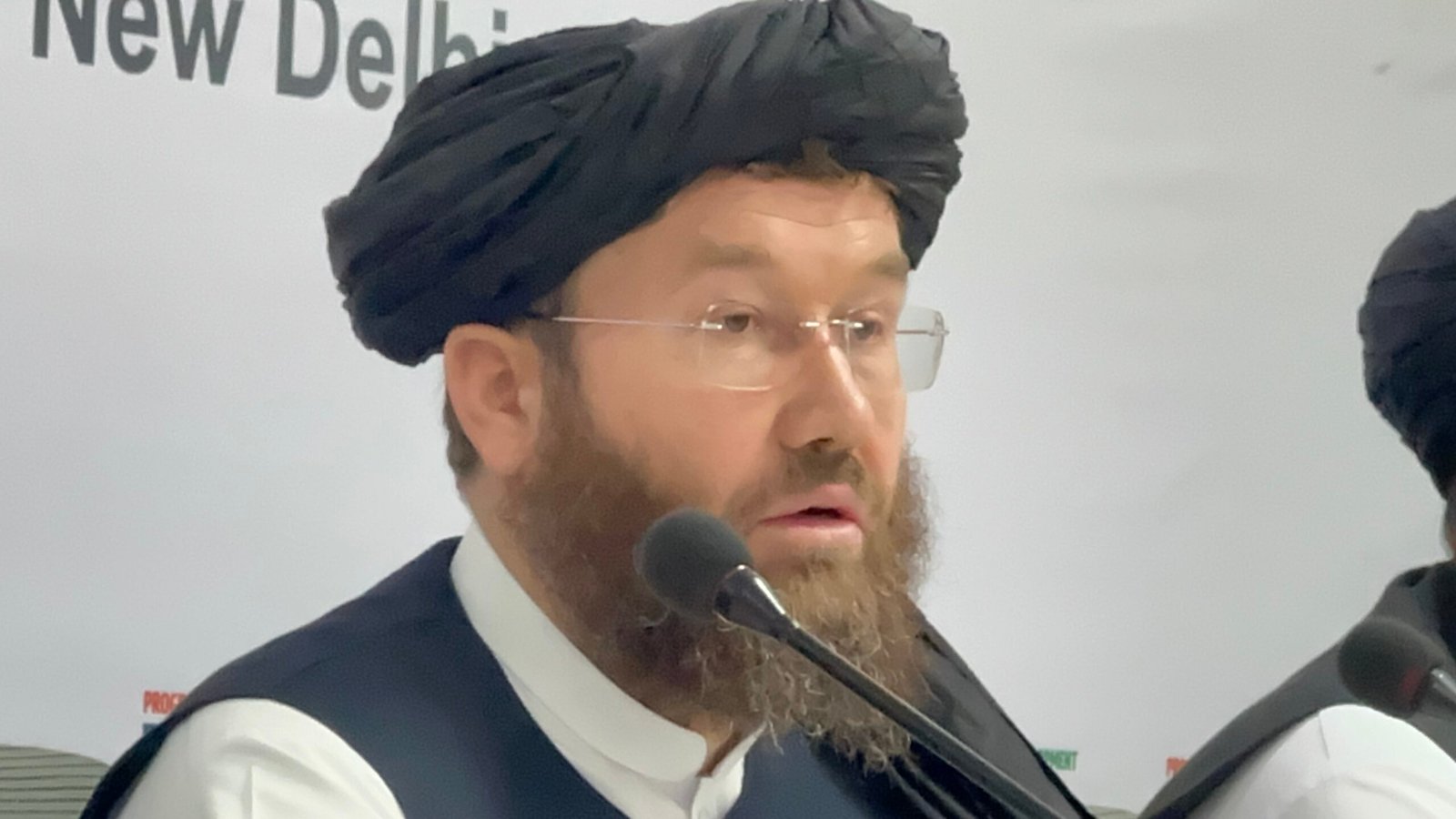
NEW DELHI: The visit of Afghanistan’s Minister of Agriculture, Irrigation and Livestock, Mawlawi Attaullah Omari, to New Delhi may not have attracted the attention usually reserved for high-profile diplomatic summits, yet it could prove to be one of the most significant developments in India–Afghanistan relations since the Taliban returned to power in August 2021. While the immediate agenda revolved around agriculture, irrigation, organic fertilizers and trade, the visit reflected something much larger: the emergence of economic diplomacy as the principal channel of engagement between New Delhi and Kabul amid continuing political uncertainty.
Omari is the fourth minister from the Taliban administration to visit India, signalling a gradual but unmistakable expansion of official engagement. India continues to maintain that it has not formally recognised the Taliban government. At the same time, it has steadily widened contacts through humanitarian assistance, diplomatic dialogue and cooperation in sectors that directly benefit the Afghan people. This calibrated policy reflects a broader shift in international diplomacy, where practical engagement increasingly complements political positioning.
The significance of the visit became evident even before Omari addressed Indian industry. A day earlier, he met Union Minister of Agriculture and Farmers’ Welfare Shivraj Singh Chouhan, where the two sides discussed cooperation in agriculture, horticulture, irrigation, seed development, capacity building and food security. No major agreements emerged from the meeting, but the symbolism was important. It demonstrated that agriculture has become one of the few areas where meaningful cooperation can continue despite the absence of formal diplomatic recognition.
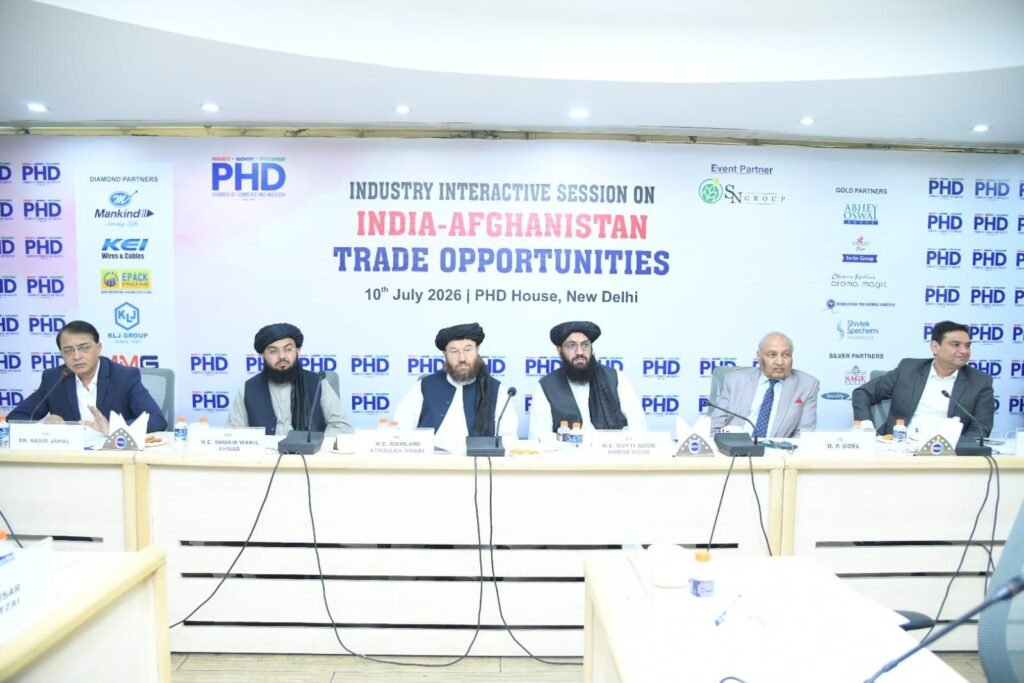
The visit gathered further momentum during a high-level dialogue hosted by the PHD Chamber of Commerce and Industry (PHDCCI), which brought together senior government officials, diplomats, policymakers and business leaders from both countries. More than a trade forum, the interaction reflected a shared commitment to deepen economic engagement through cooperation in agriculture, food processing, irrigation, renewable energy, technology transfer, logistics and value-chain development. The presence of senior representatives from India’s Ministry of External Affairs, the Afghan diplomatic mission and key ministries underscored that economic engagement is steadily emerging as an important pillar of bilateral relations.
That agriculture has become the centrepiece of this engagement is hardly surprising. Nearly 80 percent of Afghanistan’s population depends on agriculture, irrigation and livestock for their livelihoods. Decades of conflict, prolonged droughts, damaged infrastructure and economic isolation have severely weakened the sector, making agricultural recovery essential not only for food security but also for employment, poverty reduction and long-term economic stability.
Against this backdrop, Omari delivered a remarkably practical message. Rather than seeking financial assistance alone, he invited India to become a long-term partner in rebuilding Afghanistan’s rural economy. He outlined opportunities in farm mechanisation, irrigation systems, certified seeds, livestock development, food processing, cold-chain infrastructure, renewable energy, packaging and agricultural technology. His message reflected a recognition that sustainable agricultural growth depends as much on technology, innovation and skills as it does on capital.
Among the most noteworthy proposals was Afghanistan’s ambition to gradually replace chemical fertilizers with organic alternatives. Acknowledging that Afghanistan currently lacks sufficient manufacturing capacity, Omari invited Indian companies to establish facilities producing both liquid and solid organic fertilizers. He assured potential investors that the Afghan government would facilitate such projects through technology transfer, farmer training, extension services and investment support.
The proposal is significant on several levels. It aligns with the global transition towards sustainable agriculture while addressing Afghanistan’s need to improve soil health, reduce dependence on imported inputs and strengthen domestic manufacturing. For India, whose expertise in organic farming, agricultural research and rural development has expanded considerably over the past decade, the proposal presents an opportunity to contribute meaningfully to Afghanistan’s economic recovery while opening new avenues for commercial cooperation.
India’s comparative advantage extends well beyond fertilizers. Its experience in agricultural research, irrigation management, seed technology, dairy development, food processing, farm mechanisation, digital agriculture and rural entrepreneurship offers practical solutions that can be adapted to Afghanistan’s conditions. During the discussions, Indian stakeholders also highlighted opportunities in precision farming, satellite mapping, drone-based crop monitoring, renewable energy solutions, organic waste-to-manure conversion, agricultural traceability systems and cold-chain logistics. These technologies have the potential to improve productivity, reduce post-harvest losses, strengthen food security and increase rural incomes while making agriculture more resilient to climate change.
The emphasis on renewable energy deserves particular attention. Reliable energy remains one of the biggest constraints on agricultural productivity in Afghanistan. Renewable energy solutions integrated with irrigation, storage and food processing could significantly improve rural livelihoods while reducing operational costs and promoting environmental sustainability. Combined with digital technologies, these innovations could reshape Afghanistan’s agricultural landscape over the coming decade.
The visit also highlights the gradual evolution of India’s Afghanistan policy. Following the Taliban’s return to power in 2021, New Delhi adopted a cautious approach while maintaining humanitarian assistance and limited diplomatic engagement. Over time, however, India has increasingly embraced a strategy of engagement without formal recognition. By expanding cooperation in agriculture, healthcare, education, capacity building and humanitarian assistance, India has sought to safeguard its strategic interests while continuing to support the Afghan people.
This approach reflects geopolitical realities. Afghanistan occupies a strategic location linking South Asia, Central Asia and the wider Eurasian region. Stability in Afghanistan has implications for regional connectivity, energy security, counter-terrorism and economic integration. Maintaining constructive engagement enables India to preserve its relevance in a country where regional powers continue to compete for influence.

Economic diplomacy also offers advantages that conventional political diplomacy often cannot. Trade creates shared interests. Technology transfer builds institutional trust. Agricultural cooperation strengthens food security, generates employment and reduces economic vulnerability. Development partnerships produce tangible benefits that political declarations alone rarely achieve.
Nevertheless, important challenges remain. Direct overland trade between India and Afghanistan continues to be constrained by the absence of transit access through Pakistan. Consequently, alternative connectivity initiatives such as Iran’s Chabahar Port and the International North–South Transport Corridor (INSTC) assume even greater strategic importance. Unless connectivity, banking channels, investment protection and regulatory mechanisms improve, many of the opportunities discussed during the visit may remain unrealised.
Yet the direction of travel is becoming increasingly clear. The discussions in New Delhi demonstrated that both countries are prepared to focus on sectors where mutual interests outweigh political differences. Agriculture, because it directly affects livelihoods, climate resilience, food security and sustainable development, provides perhaps the strongest foundation for such cooperation.
For Afghanistan, attracting Indian expertise, investment and technology offers an opportunity to modernise one of its most critical economic sectors while creating employment and improving food security. For India, supporting Afghanistan’s agricultural transformation reinforces decades of developmental goodwill, strengthens regional engagement and positions Indian businesses, agri-tech companies and renewable energy firms in an emerging market with significant long-term potential.
It would be premature to describe Omari’s visit as a diplomatic breakthrough. Political complexities remain, and formal recognition continues to be a separate issue. Yet it would be equally mistaken to dismiss it as a routine ministerial engagement. The visit signals a gradual but meaningful shift in the way India and Afghanistan are approaching one another placing practical cooperation above political symbolism and shared development above diplomatic deadlock.
History often celebrates dramatic peace agreements and headline-making summits. But enduring partnerships are usually built more quietly through trade, technology, investment, innovation and the exchange of knowledge. In that sense, Attaullah Omari’s visit was about far more than agriculture. It marked another step in the gradual transformation of India–Afghanistan relations, where economic cooperation is increasingly becoming the bridge across political divides. Whether that bridge ultimately reshapes the broader diplomatic relationship remains uncertain. What is already evident, however, is that the conversation between New Delhi and Kabul is steadily moving from recognition to results and from geopolitics to shared prosperity.
-Dr. M Shahid Siddiqui