


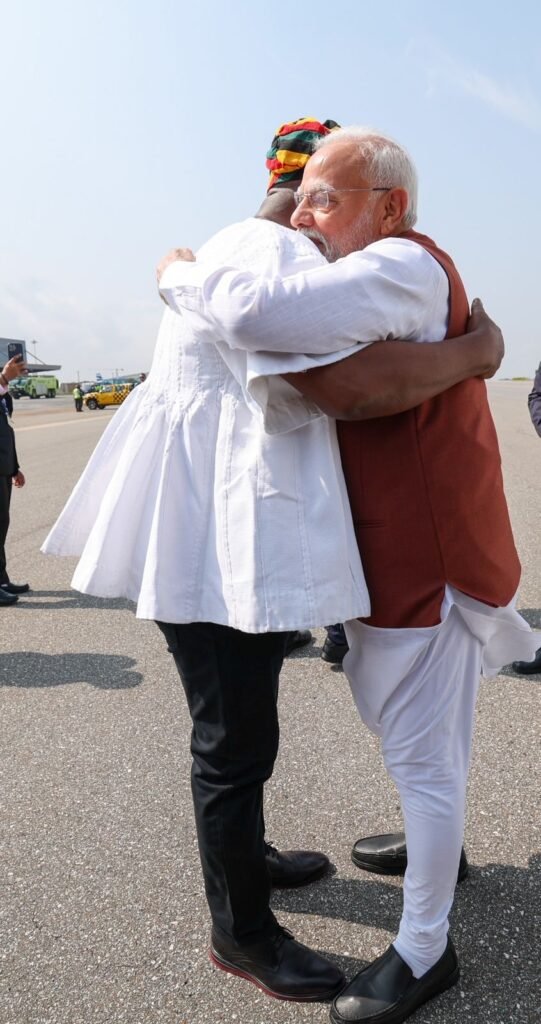
ACCRA/ NEW DELHI: Prime Minister Narendra Modi’s July 2025 visit to Ghana marks a watershed moment in India’s Africa engagement, signaling a deliberate and strategic recalibration of New Delhi’s approach to the continent amid intensifying global competition. As the first Indian Prime Minister to visit Ghana in three decades, Modi’s trip is more than symbolic; it is a high-stakes test of India’s ability to translate intent into impactful action in a region where every major power is vying for influence.
India’s relationship with Africa has evolved from anti-colonial solidarity to a multi-layered partnership anchored in trade, investment, technology, and security. Ghana’s consistent democratic governance, economic reforms, and its role as host of the African Continental Free Trade Area (AfCFTA) secretariat make it an ideal collaborator for India’s new model of South-South co-production. The visit produced a suite of tangible outcomes: the announcement of a West Africa-wide vaccine manufacturing hub, the establishment of a permanent Ghana–India Joint Commission, and new agreements in defence, agriculture, digital standards, and traditional medicine. The vaccine hub, in particular, is a strategic response to Africa’s chronic dependence on imported vaccines and aims to position Ghana as a regional biopharma leader by 2031, enhancing both health security and regional resilience.
India’s economic commitment to Ghana is substantial, with over $1.2 billion invested across sectors such as agro-processing, mining, and ICT infrastructure. These investments are underpinned by concessional credit lines and grants totaling $450 million, supporting flagship projects like the Tema–Mpakadan railway and the Kofi Annan Centre of Excellence in ICT. Trade between the two countries has rebounded to approximately $3 billion, with India now the largest buyer of Ghanaian gold and a significant exporter of pharmaceuticals, motorcycles, and agri-machinery. This investment strategy is not only about economic returns but also about building sustainable development, local capacity, and long-term partnerships—an approach that stands in contrast to China’s debt-driven, contractor-led Belt and Road projects.
The integration of India’s Unified Payments Interface (UPI) with Ghana’s GHIPSS system is poised to create West Africa’s first cross-border real-time payments rail outside the franc-CFA zone. If successfully implemented, this digital corridor will deepen financial inclusion, set new standards for ECOWAS, and expand India’s digital soft power across the region. Security cooperation has also been elevated, with a new defence pact focused on maritime security and joint naval training, reinforcing India’s “Necklace of Diamonds” strategy to protect sea lanes from the Indian Ocean to the Atlantic. This aligns with Ghana’s leadership in regional peacekeeping and counterterrorism, positioning both countries to counter threats such as piracy in the Gulf of Guinea and violent extremism in the Sahel.
Ghana’s strategic value for India is amplified by its geographic location as a coastal gateway to ECOWAS a market of over 400 million people—and its credibility within both ECOWAS and the African Union. India’s deep historical ties with Ghana, robust people-to-people connections including a well-established Indian diaspora – and extensive technical cooperation have created a foundation of trust and mutual benefit. Over 1,100 Ghanaian officials have been trained under India’s ITEC program, and Indian-backed projects in digital infrastructure and healthcare have positioned Ghana as a model for India’s development diplomacy in Africa.
However, opportunity is matched by risk. Recent history cautions against triumphalism: the Tema–Mpakadan railway, financed by India’s Exim Bank for $447 million, remains idle six months after inauguration, hampered by vandalism and operational delays. Ghana’s recent $2.8 billion in bilateral debt relief means every new Indian credit line must pass IMF scrutiny and domestic tests of fiscal sustainability. The success of the vaccine hub and other marquee projects will depend on India’s willingness to pair technology transfer with blended finance structures that do not trigger new solvency concerns for Ghana. More broadly, India’s ability to deliver on its promises , especially in infrastructure and project execution will be closely watched, as past initiatives have sometimes stalled due to local bottlenecks and bureaucratic inertia.
Modi’s Ghana visit is the opening leg of a broader diplomatic outreach that includes Trinidad & Tobago, Argentina, Brazil (for the BRICS Summit), and Namibia. Each stop is designed to reinforce India’s “Global South, Shared Solutions” mantra, project leadership among emerging economies, and expand its influence in multilateral forums. But the lesson from Accra is clear: intent and optics are no longer enough. India must publish clear project milestones, deploy on-site management teams, blend equity with credit, and report quarterly progress through the new Joint Commission. Outcomes, not announcements must be the yardstick.
If New Delhi delivers, Ghana could become India’s anchor on the Atlantic Rim, setting a precedent for pragmatic, mutually beneficial South-South partnerships that move beyond nostalgia to strategic relevance. Should India fall short, the vacuum will be filled by rivals eager to capitalize on Africa’s rising agency and global realignments. The contest for influence, resources, and ideas across Africa is now fully joined. Accra is not the end of a journey, but the starting gate of a race India cannot afford to lose—and cannot win on promises alone.
– Dr. Shahid Siddiqui; Follow via X @shahidsiddiqui
WATCH, LIKE & SUBSCRIBE CHANNEL FOR REGULAR UPDATES: