



NEW DELHI: When Singapore’s Prime Minister Lawrence Wong landed in New Delhi, the setting seemed familiar: motorcades through the capital, ceremonial welcomes at Hyderabad House, the usual headlines about “strengthening ties.” But this visit quickly moved beyond the script of routine diplomacy. What unfolded was less about ceremony and more about strategy, two countries bound by history, sketching a shared future at a moment when global politics is anything but predictable.
Prime Minister Narendra Modi set the tone with a striking statement: “Today, we have charted a detailed roadmap for the future of our partnership. Our cooperation will not remain confined to traditional areas. In keeping with the needs of changing times, advanced manufacturing, green shipping, skilling, civil nuclear energy, and urban water management will also emerge as focus points of our collaboration.”
It was not the language of symbolic friendship; it was the language of a plan.
One of the most consequential outcomes was Singapore’s nod to India’s participation in coordinated patrols of the Malacca Straits. For most readers, the Straits may sound distant, even abstract. But think about it this way: nearly a third of all global trade passes through this narrow stretch of water. Oil tankers bound for China, Japan, and South Korea all squeeze through this maritime bottleneck. For India, with the Andaman and Nicobar Islands sitting right at its western gate, stepping up security here is both natural and necessary. Singapore’s willingness to bring India in marks a quiet but profound shift—it acknowledges that the Indo-Pacific’s future balance cannot be secured without New Delhi.
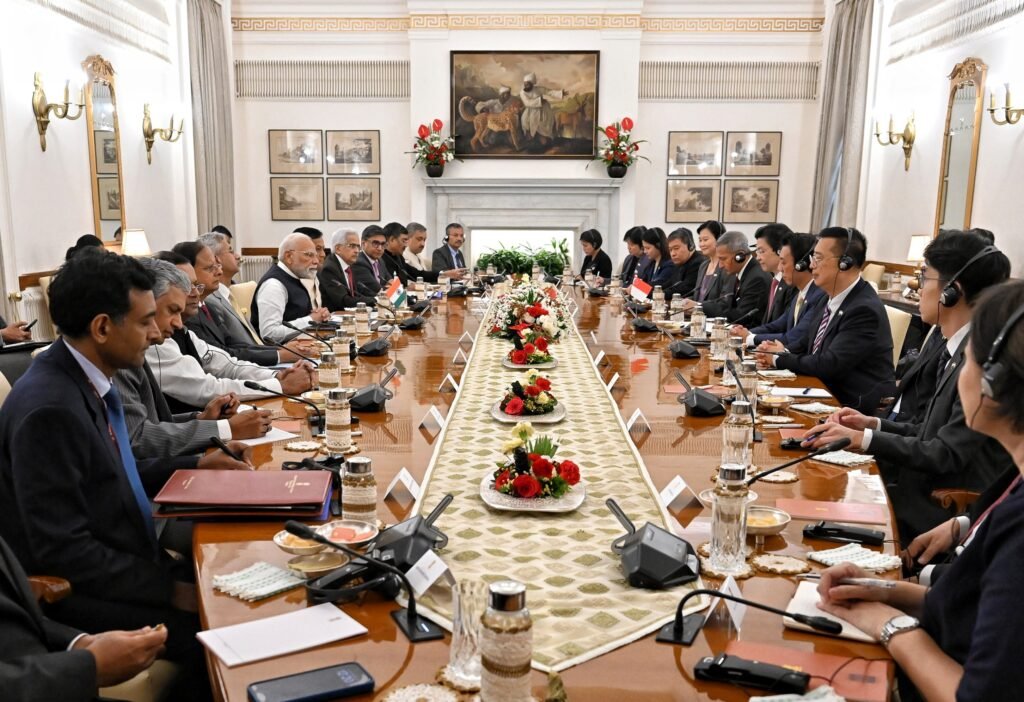
Secretary (East) P. Kumaran put it plainly: “As a contiguous state next to the Malacca Straits, India expects coordination to ensure synergy among the current members of the patrol and itself.” Behind that carefully chosen language lies a reality: India is no longer content with being a bystander in its own neighborhood.
But the visit was not only about the seas. It was also about ports, trade, energy, and above all, trust. At Navi Mumbai, the second phase of the Bharat Mumbai Container Terminal was inaugurated, a gleaming symbol of what the India–Singapore partnership can build together. For Modi, it was more than infrastructure: it was, in his words, “a gateway to future supply chain resilience.” In an era of fragile supply chains, that phrase carries weight.
Energy was another recurring theme. The two sides agreed to create corridors for clean fuels and green hydrogen. For Singapore, an island nation deeply exposed to climate change, this is survival. For India, aspiring to become a renewable energy hub, it is an opportunity. In that overlap lies a powerful logic: survival meets ambition.
Technology, too, loomed large. In today’s world, semiconductors are as strategic as oil once was. Recognizing this, Singapore and India put chips and fabrication ecosystems at the center of their dialogue. Singapore expressed interest in investments, while India, hungry to break into global supply chains that are moving away from China, welcomed the chance.
Digital finance was another piece of the puzzle. With India experimenting with its digital rupee and Singapore pushing fintech innovation, the agreement on digital assets was about more than technology. It was about trust ensuring that the financial architecture of tomorrow is transparent, interoperable, and resilient.
Skills may sound like a softer subject compared to geopolitics or green hydrogen, but here too the two countries spoke of the future. Wong captured it simply: “In an uncertain world, the India–Singapore partnership gains greater significance, rooted in shared values and trust. Together, we can build the skills of the future, whether in advanced manufacturing, aviation, or semiconductors, that will define our economic resilience.”
This was not empty rhetoric. Singapore agreed to co-establish a National Centre of Excellence for Skilling in Advanced Manufacturing in Chennai. For a country where millions of young people enter the job market every year, India’s partnership with a global leader in training and upskilling is more than symbolic- it is vital.
Of course, the conversation did not ignore hard security. Modi thanked Singapore for its condolences after the Pahalgam attack, underscoring terrorism as a shared threat. Both sides reaffirmed their commitment to choking off terror financing through the Financial Action Task Force (FATF). This matters: Singapore is a financial hub, and India has long argued that terrorism is not only fought with soldiers but also with accountants and regulators.
The subtext of the visit is clear. The Indo-Pacific is no longer an abstract geopolitical term, it is where the world’s economic future, energy flows, and security anxieties converge. With the U.S. and China locked in a contest for dominance, countries like India and Singapore are choosing not to sit on the sidelines. Instead, they are weaving networks of cooperation on technology, shipping, climate, and security that give them agency in shaping the regional order.
Modi called Singapore “an important pillar of India’s Act East Policy.” Wong responded by pointing to investments in sustainable industrial parks, semiconductor supply chains, and digital connectivity. The symbolism was not hard to read: both leaders see the partnership not just as a bilateral affair, but as a model of how middle powers can shape the rules of tomorrow’s Indo-Pacific.
This visit matters not because of the number of MoUs signed six in total, but because of the intent they signal. In an age of turbulence, symbolism alone is insufficient. Infrastructure, innovation, skills, and security, these are the building blocks of resilience. And these are precisely the areas where India and Singapore have now chosen to invest together.
From the Straits of Malacca to Navi Mumbai’s container terminals, from Chennai’s skilling centers to the fight against terrorism financing, this partnership is moving beyond history and geography into the realm of shaping the future.
Between Modi’s roadmap and Wong’s reminder that trust anchors resilience lies the essence of this moment: India and Singapore are not just partners of circumstance; they are partners of choice. And in a world drifting toward fragmentation, that choice itself is strategic.
– Dr. Shahid Siddiqui; follow via X @shahidsiddiqui