



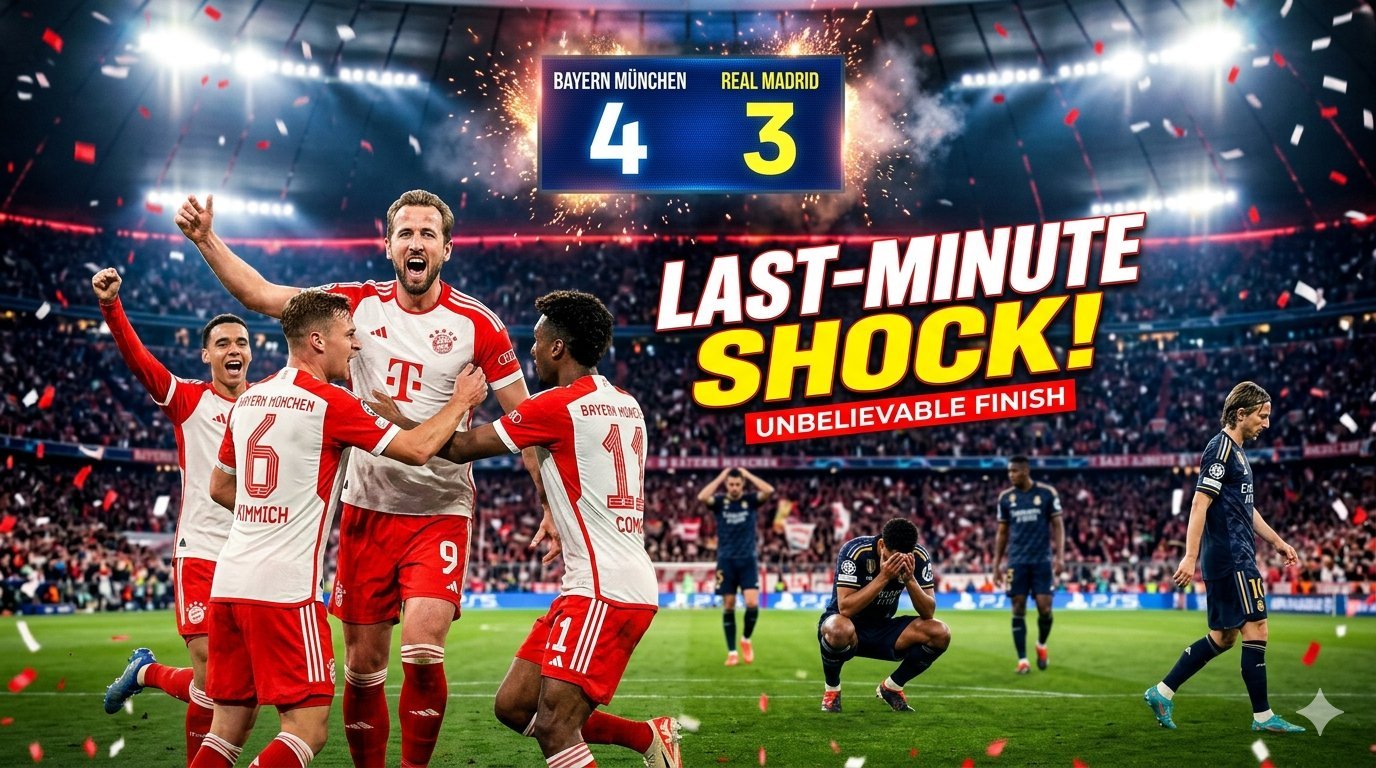
MUNICH, Germany: Bayern Munich delivered one of the most dramatic nights in recent European football, overturning repeated deficits to defeat Real Madrid 4-3 on the night and 6-4 on aggregate, a result that not only secured a Champions League semi-final berth but also highlighted shifting competitive dynamics at the top of European football.
The match evolved into a high-intensity tactical and psychological battle, where Bayern’s resilience ultimately outweighed Madrid’s clinical edge in key moments. Despite an early error from Manuel Neuer gifting a goal to Arda Güler within the opening minute, Bayern responded with composure rather than panic, an indicator of a squad increasingly shaped by structural discipline under Vincent Kompany.
Madrid’s approach leaned heavily on transitional efficiency, with Kylian Mbappé and Vinícius Júnior exploiting spaces behind Bayern’s advancing lines. Yet, while Madrid remained dangerous in bursts, their inability to maintain control in midfield phases became increasingly evident as the game progressed. Bayern, by contrast, showed greater cohesion, with sustained attacking pressure eventually exposing defensive vulnerabilities.
The game’s decisive phase arrived late, shaped as much by discipline as by tactics. The dismissal of Eduardo Camavingain the 86th minute proved a critical inflection point, tilting momentum firmly in Bayern’s favor. With numerical superiority, Bayern intensified their attacking tempo, and late strikes from Luis Díaz and Michael Olise completed a comeback that underscored both physical endurance and mental resolve.
Madrid’s late collapse, compounded by a second red card to Güler after the final whistle, reflected a broader issue of emotional control under pressure. For a club synonymous with Champions League composure, the loss exposed rare cracks in game management and discipline particularly in high-stakes knockout scenarios.
From a broader perspective, Bayern’s victory signals their re-emergence as a fully balanced European contender, blending attacking depth with tactical flexibility. Their progression to face Paris Saint-Germain in the semi-finals sets up a clash that could define the competition’s narrative this season, especially given PSG’s status as defending champions.
Historically, Bayern’s ability to recover from trailing multiple times places this match among the competition’s most remarkable comebacks, reinforcing the unpredictability that continues to define the Champions League. For Madrid, meanwhile, the defeat marks not just an exit but a missed opportunity to extend their record legacy, raising questions about squad evolution and tactical direction moving forward.
Ultimately, the tie illustrated a fundamental truth at elite level: marginal decisions, emotional discipline, and late-game execution often outweigh reputation. Bayern mastered all three when it mattered most.
-Karolos Kallas
READ THE FULL E-MAGAZINE | WorldAffairs: For Decision-Makers Who Need More Than Headlines