

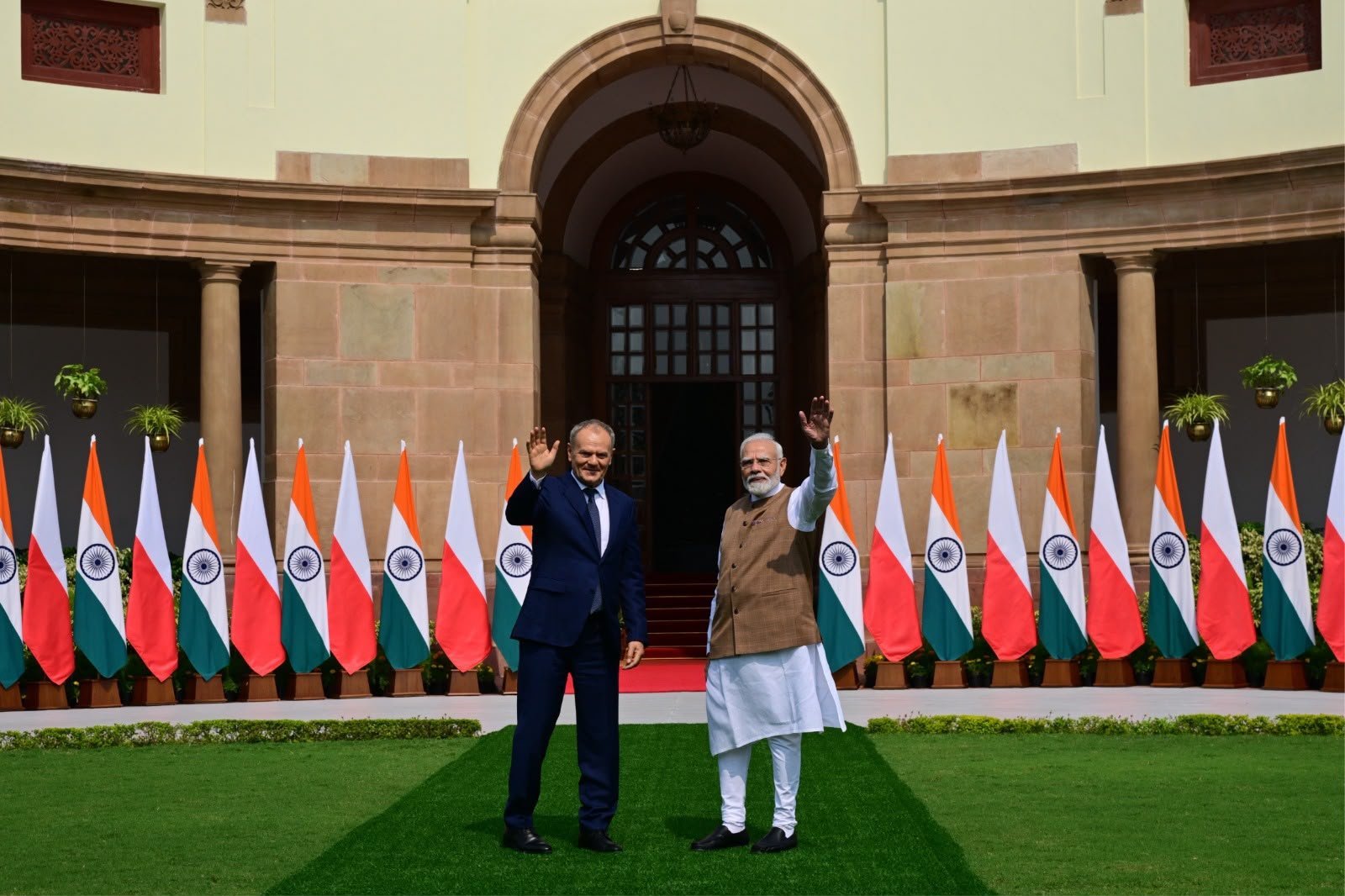
NEW DELHI, India: When Polish Prime Minister Donald Tusk declared that India and Poland have “no conflict of interest”, he offered more than a diplomatic expression of goodwill. His statement captured the central ambition behind the latest effort to strengthen bilateral relations: to build a strategic partnership capable of delivering economic and technological benefits despite differences in geography, security priorities and international alignments.
Prime Minister Narendra Modi and Tusk have agreed to deepen cooperation in defence, space, nuclear energy, critical technologies and industrial development, while setting a target of doubling bilateral trade by 2030. They have also reaffirmed their commitment to international law and peaceful efforts to resolve conflicts in Ukraine and West Asia.
Yet the significance of their meeting lies less in the number of areas identified for cooperation than in the strategic choices confronting both countries. Can India and Poland move beyond political understanding towards industrial integration? Can their partnership accommodate India’s close relationship with Russia and Poland’s security concerns over the war in Ukraine? And can economic cooperation translate into greater influence in a world where technological capabilities and supply-chain security increasingly shape geopolitical power?
The answers will determine whether this relationship becomes a meaningful strategic partnership or remains an ambitious diplomatic framework.
India and Poland elevated their relationship to a Strategic Partnership during Modi’s visit to Warsaw in August 2024, marking a new phase in bilateral engagement. The October 2026 meeting seeks to give that decision greater economic and security substance.
Modi described the next phase in direct terms: “Today we have agreed to deepen ties in defence, space and nuclear energy. We invite Polish companies to engage in co-development and co-production with India in all these strategic areas.”
The emphasis on co-development and co-production is important. India has long sought international partnerships that strengthen domestic manufacturing and technological capabilities rather than simply increase purchases from foreign suppliers. Poland, meanwhile, is looking to expand its commercial and industrial engagement with India, whose market offers opportunities across manufacturing, technology and infrastructure. The two governments therefore have a basis for cooperation that extends beyond conventional arms sales or diplomatic exchanges. Joint research, industrial partnerships and locally anchored production could create more durable economic relationships.
However, defence cooperation is among the most demanding forms of international partnership. It involves sensitive technology, intellectual property, procurement decisions, financing and long-term maintenance. India will seek arrangements that contribute to its domestic industrial capacity, while Poland must ensure that cooperation serves its own defence requirements and commercial interests.
The presence of common interests does not automatically eliminate these competing considerations. Their management will determine whether the partnership generates concrete industrial results.
Tusk’s assessment of the relationship was unusually direct. “Our discussions are very successful, not only because Poland and India are countries that share a lot, but we are divided by nothing, maybe by geographic distance. The synergies between Poland and India are quite simple. We have no conflict of interest.”
The statement reflects genuine areas of convergence, but it should not be interpreted as evidence that the two countries have identical strategic priorities. Poland’s security calculations are shaped by its position in Europe and Russia’s war against Ukraine. India, by contrast, seeks to maintain strategic autonomy and preserve relationships with multiple international powers, including Moscow.
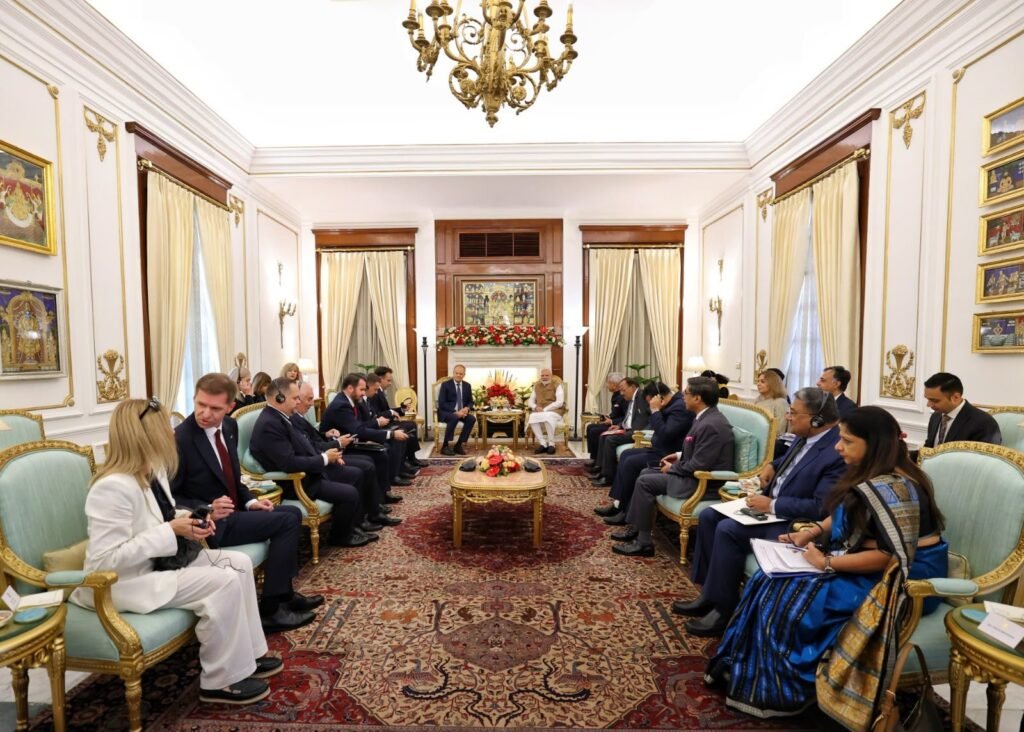
This distinction is central to understanding the partnership. Strategic alignment does not require complete agreement on every international question. It requires sufficient common ground to sustain cooperation when differences arise.
For Poland, closer relations with India provide an opportunity to engage more deeply with a major Asian power. For India, Poland can serve as a more substantial partner in Central and Eastern Europe and strengthen New Delhi’s wider engagement with the European Union. The relationship could therefore become valuable precisely because it allows both countries to pursue practical interests without demanding identical geopolitical positions.
Economic cooperation will provide the clearest test of whether this understanding can be sustained.
The two prime ministers have set a target of doubling bilateral trade by 2030. According to figures cited by the Embassy of India in Warsaw, bilateral trade reached approximately US$6.36 billion in 2025. Doubling that amount on the same basis would mean reaching approximately US$12.72 billion.
The target is ambitious, but it is not self-executing. Trade growth requires businesses to identify profitable opportunities, establish distribution networks, navigate regulations and invest in long-term commercial relationships. Government declarations can encourage these activities, but they cannot substitute for them.
Modi linked the economic opportunity to the changing global environment, observing: “Today, the world is going through a period of uncertainty and change. Even at this time, both India and Poland are emerging as important centres of growth, technology, and innovation.”
The argument has strategic significance. Economic strength can increase a country’s capacity to withstand external pressure, invest in advanced technologies and sustain its international commitments. For India and Poland, the opportunity is to connect their respective industrial capabilities and expand the commercial foundations of their relationship.
Modi also highlighted the potential contribution of the India–European Union free trade agreement, saying it would create new opportunities for Indian exports, including machinery, chemicals, plastics and engineering goods, while encouraging Polish investment in sectors such as railways, mobility, advanced manufacturing, food processing and biotechnology.
The potential benefits, however, depend on the agreement’s entry into force, its final provisions and effective implementation. Businesses will still have to compete on quality, price, productivity and regulatory compliance. Neither market access nor a political commitment guarantees commercial success.
The more consequential question is whether the two countries can build relationships that connect trade with investment, research and manufacturing. Such integration would make the partnership less vulnerable to short-term fluctuations in political attention.
Critical minerals and semiconductors offer another opportunity to pursue this objective. Rare earth elements and other strategic materials are essential to advanced electronics, batteries, clean-energy technologies and defence systems. Their availability and processing have become major concerns for governments seeking to reduce supply-chain vulnerabilities.
Tusk acknowledged the importance of this issue, saying: “We are very much aware of the political threats and the need to become independent as much as possible in the areas of critical resources, minerals and strategic resources of any country to make sure that Poland, India and Europe are independent in those…”
His remarks point to a shared concern about excessive dependence on concentrated sources of essential resources. Yet independence in critical materials is a relative objective, not something that can be achieved through a single bilateral agreement. Mining and processing require investment, technical expertise, environmental safeguards and commercially sustainable infrastructure. Semiconductor development demands specialised facilities, skilled workers and sustained research. Battery recycling offers opportunities to recover valuable materials, but its success depends on collection systems, technology and costs.
The proposed cooperation on geology, mining and critical minerals could provide a framework for advancing these interests. Its real value will depend on whether negotiations produce workable arrangements and whether companies are prepared to commit capital.
The same principle applies to space and nuclear energy. Both sectors can support long-term technological development, but they require careful regulatory coordination and clearly defined projects. The announcement of stronger cooperation should therefore be understood as the beginning of a process, not evidence that all intended outcomes have already been achieved.
The most difficult strategic question remains Ukraine.
Modi reiterated India’s position in unmistakable terms: “Be it Ukraine or West Asia, India will continue to support every meaningful effort towards peace.”
The statement reinforces India’s preference for diplomacy and negotiated outcomes. For Poland, however, the war in Ukraine is not a distant geopolitical crisis but a direct concern for European security. The two governments can agree on the desirability of peace while differing over the security calculations, political conditions and diplomatic approaches surrounding the conflict.
That difference does not make cooperation impossible. It makes sustained dialogue more important.
India’s strategic autonomy allows New Delhi to engage with different international actors, while Poland’s security outlook is closely connected to European institutions and the consequences of Russian military action. Neither government is likely to abandon its fundamental interests simply to accommodate the other.
A mature partnership must therefore be capable of functioning despite these differences. If defence, technology and trade cooperation can continue without requiring complete foreign-policy alignment, India and Poland will have demonstrated that bilateral relationships can remain productive in a divided international system.
The leaders’ support for a free, open and peaceful Indo-Pacific, respect for international law and peaceful dispute resolution provides another basis for engagement. India’s invitation to Poland to join the Indo-Pacific Oceans Initiative could widen Warsaw’s interest in Asian maritime and economic developments. But the practical value of this engagement will depend on Poland’s participation and the projects it is prepared to support.
There is also a deeper human dimension to the relationship. During the Second World War, the princely states of Jamnagar and Kolhapur sheltered Polish children and displaced families. Maharaja Jam Saheb Digvijaysinhji of Nawanagar remains remembered in Poland as the “Good Maharaja”.
Tusk described the significance of that legacy by recalling the practical assistance it represented, rather than treating it simply as a historical symbol. He also referred to Poland’s assistance in helping Indian students who remained in Ukraine during the Russian invasion in 2022.
These episodes illustrate how historical memory and contemporary cooperation can reinforce one another. They provide the relationship with a human foundation that extends beyond immediate economic interests and can support educational, cultural and people-to-people engagement.
The prime ministers have established a broad agenda, but its success will be determined by implementation. The trade target must translate into real commercial expansion. Defence cooperation must produce projects that serve both countries’ interests. Critical-minerals discussions must lead to practical arrangements, and diplomatic dialogue must remain constructive even when geopolitical priorities diverge.
Modi and Tusk have articulated a compelling vision of India–Poland relations. The next challenge is to turn that vision into measurable outcomes.The most important test will not be whether the two governments continue to describe each other as strategic partners. It will be whether they can build an economically productive, technologically capable and diplomatically resilient relationship that delivers benefits beyond the meeting rooms of New Delhi. In a period of global uncertainty, trust is valuable. But trust becomes strategic power only when it is converted into lasting capability.
– Kristina Komuves with Dr. M Shahid Siddiqui in New Delhi