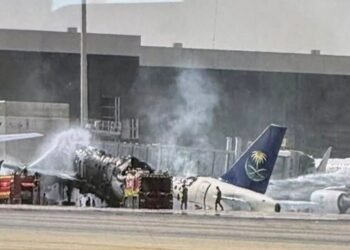




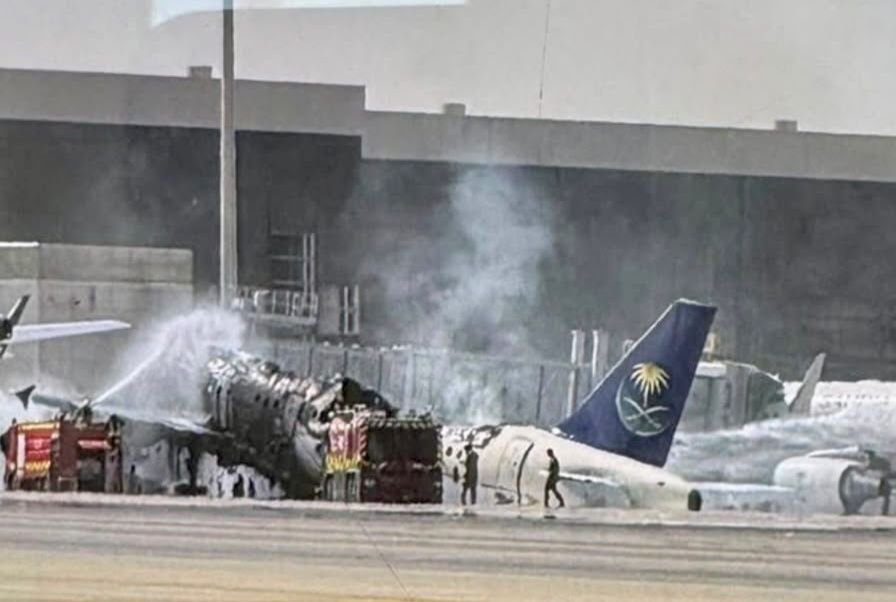
RIYADH: The sound of explosions over Riyadh on Thursday is more than another disturbing episode in the Middle East’s expanding cycle of violence. Reports of blasts near Saudi Arabia’s King Khalid International Airport, the deployment of emergency services, visible smoke and the disruption of flights have once again placed civilian infrastructure at the centre of a regional confrontation whose consequences can extend far beyond the battlefield. Yemen’s Houthi movement claimed responsibility, saying it had launched a ballistic missile toward Riyadh, although the group did not immediately provide evidence and Saudi authorities had not initially confirmed the claim. The uncertainty surrounding the precise circumstances makes independent verification essential, but the broader danger is already clear: the Gulf’s civilian infrastructure is increasingly exposed to a conflict that has repeatedly demonstrated its ability to cross borders.
Airports should represent connection, commerce and mobility. They should be places where diplomats arrive, families reunite and economies connect with the wider world. When an airport becomes a target or is forced to suspend operations because of missile threats, the consequences extend beyond the immediate security incident. Passengers are endangered, airlines face uncertainty, insurance costs rise and international confidence in regional connectivity begins to weaken. The reported evacuation of passengers and instructions to leave checked baggage behind at Riyadh airport underline the human consequences of a confrontation that is increasingly moving into spaces designed for civilians rather than combatants.
Saudi Arabia has seen this danger before. In 2019, Houthi attacks targeted Saudi airports, including Abha International Airport, where civilians were injured. Those attacks triggered condemnation from governments around the world and renewed warnings that the Yemen conflict could develop into a broader regional security crisis. Later that year, the September attacks against Saudi Arabia’s Abqaiq oil-processing facility and Khurais oil field produced an even more serious international reaction. The United Nations condemned the attacks and called for restraint, while France, Germany and Britain warned that the strikes represented a dangerous escalation and increased the risk of a wider conflict.
The message from those international reactions remains relevant today. Civilian infrastructure cannot become a bargaining chip in geopolitical confrontation. Whether the target is an airport, oil facility, port, power installation or residential area, attacks that place civilians at risk deepen instability rather than resolve the political disputes behind the conflict.
The current situation is particularly concerning because Saudi Arabia occupies a critical position in the global economic system. Its airports connect the Middle East with Asia, Europe, Africa and North America, while its energy infrastructure remains central to international markets. Any sustained disruption to Saudi aviation or energy facilities can therefore generate consequences far beyond the kingdom’s borders. A missile launched from Yemen may travel only hundreds of kilometres, but its geopolitical impact can travel across continents.
The aviation consequences are already being felt. Indian airlines have suspended or modified some services to Riyadh following the recent security incidents, illustrating how quickly a regional security crisis can affect ordinary passengers and international commerce. For businesses, migrant workers, diplomats and families who depend upon Gulf aviation networks, every disruption carries economic and personal costs. This is what makes the latest escalation so dangerous. The Middle East is no longer dealing with isolated conflicts. Yemen, the Red Sea, Iran, Israel and the Gulf security environment are increasingly interconnected. Developments on one front can trigger consequences on another. A missile attack can prompt airstrikes. Airstrikes can produce retaliation. Retaliation can bring shipping lanes under threat. Maritime insecurity can disrupt global trade. And disruptions to energy or transportation can eventually affect economies far beyond the region.
History has repeatedly demonstrated how quickly such chains of escalation can become difficult to control.
The international community has condemned attacks on Saudi territory before. In 2019, the UN Secretary-General called for maximum restraint following attacks against Saudi energy infrastructure. European leaders likewise warned that the strikes increased the danger of a major regional confrontation and emphasized the need for diplomacy. Those statements were not merely diplomatic expressions of concern; they reflected an understanding that the security of the Gulf is inseparable from international peace and economic stability.
That understanding is even more important now.
The Houthi movement has repeatedly justified attacks as part of its wider confrontation with Saudi Arabia and its regional allies, while Riyadh regards such missile and drone attacks as a direct threat to its national security. The regional dimension involving Iran adds another layer of complexity. Whatever the political justification offered by any side, civilians should not be made to pay the price for strategic calculations made far from the immediate danger zone.
World leaders including India unequivocally condemns attacks or attempted attacks against civilian aviation and critical infrastructure. There can be no acceptable justification for putting passengers, airport workers and ordinary citizens in the path of missiles. At the same time, military retaliation without a parallel diplomatic strategy risks creating precisely the wider war that regional and international leaders have repeatedly warned against.
Saudi Arabia has the right and responsibility to protect its population and territory. But protection cannot depend exclusively upon air-defence systems and retaliation. The deeper solution remains political. The Yemen conflict requires a sustainable diplomatic pathway, regional actors need channels for de-escalation, and the international community must work to prevent the Gulf from becoming a permanent theatre for long-range missile warfare.
The world has already witnessed what happens when attacks on Saudi infrastructure are treated as isolated incidents. Energy markets react, airlines reassess routes, governments issue security warnings and investors begin pricing geopolitical risk into their decisions. The consequences multiply.
The explosions heard in Riyadh should therefore not be dismissed as another headline in an already crowded Middle Eastern news cycle. They should be treated as a warning.
The Gulf cannot afford to become another battlefield where civilian airports, commercial routes and essential infrastructure are absorbed into an expanding cycle of retaliation. The Middle East has endured enough wars, enough displacement and enough diplomatic failures. What is needed now is not another escalation, but an urgent return to diplomacy.
Because when missiles begin threatening airports, the distance between a regional conflict and a global crisis becomes dangerously small.
⁃ With Input from Middle East WNN Desk