


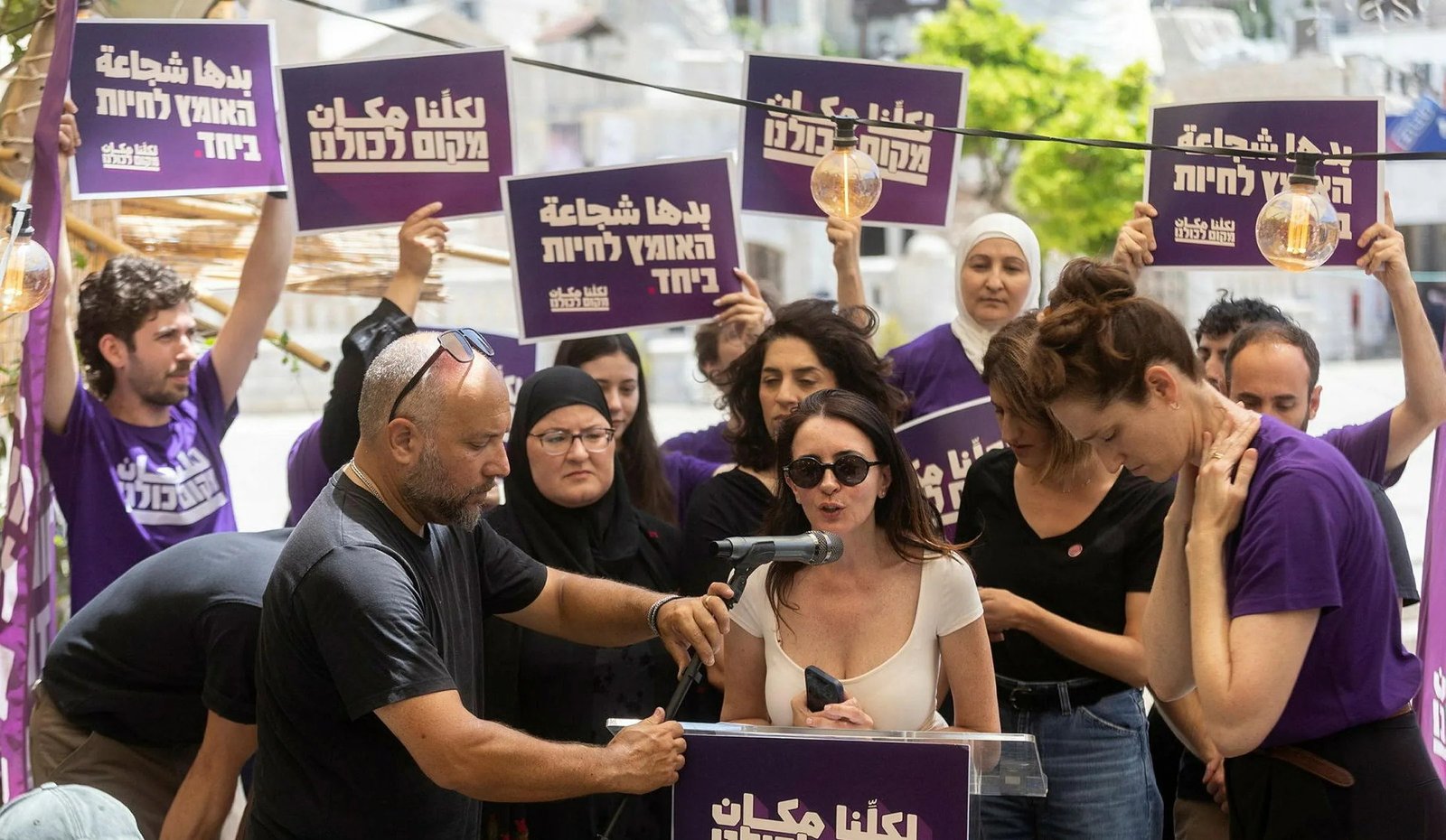
TEL AVIV: As Israel prepares for its October election, the political contest extends far beyond the question of whether Prime Minister Benjamin Netanyahu can secure another term. It has become a broader test of the country’s evolving democratic landscape, exposing the tensions between political pragmatism and the search for new forms of representation. At the heart of this debate is A Place for Us All, a newly formed Jewish-Arab political party that seeks to challenge conventional electoral politics by presenting a platform built on shared citizenship, equality, and cross-community cooperation.
The party enters the race at one of the most polarized moments in Israel’s recent history. The aftermath of the October 7 Hamas attacks, the prolonged war in Gaza, and the deepening mistrust between Jewish and Arab communities have transformed the country’s political discourse. Against this backdrop, the emergence of a movement advocating Jewish-Arab partnership represents both an ambitious political experiment and a significant electoral gamble.
Israel’s Arab citizens, who constitute roughly one-fifth of the country’s population, have historically participated in elections at lower rates than Jewish Israelis. Many within the community have long expressed frustration over unequal public investment, rising crime in Arab towns, and limited political influence despite their demographic significance. These concerns have intensified under Netanyahu’s current coalition, which includes several far-right figures whose rhetoric and policies have drawn criticism from Arab leaders and civil society groups.
Yet the central question surrounding the new party is not whether these grievances exist, but whether its strategy offers a viable path toward addressing them. Supporters argue that Israeli politics has reached an impasse in which traditional parties no longer inspire younger generations. Their objective is not simply to compete for existing Arab or left-wing voters but to mobilize citizens who have disengaged from electoral politics altogether. The movement’s leadership believes that expanding participation among first-time and disillusioned voters could reshape the political landscape without weakening existing opposition forces.
Critics remain unconvinced. Israel’s parliamentary system requires parties to surpass a 3.25 percent electoral threshold to enter the Knesset, making fragmentation a persistent concern. Parties that fail to cross this threshold receive no representation, effectively wasting votes that might otherwise contribute to broader opposition blocs. For many analysts, the risk is particularly acute within Israel’s Arab electorate, where political representation has already declined from previous election cycles.
The memory of the 2022 election continues to shape this debate. Arab voter turnout stood at just over half of eligible voters, significantly below participation among Jewish Israelis. The lower turnout coincided with Netanyahu’s return to office and the collapse of Israel’s first governing coalition to include an independent Arab party. Many established Arab political leaders therefore view unity, rather than experimentation, as the most effective strategy for maximizing political influence in an increasingly polarized environment.
Their concerns have only intensified as the four principal Arab parties once again seek to rebuild electoral cooperation in the hope of increasing turnout and consolidating representation. From this perspective, every vote diverted toward a new movement carries the possibility of weakening an already underrepresented political constituency. The debate is therefore less about ideological disagreement than about electoral arithmetic in a highly competitive parliamentary system.
The founders of A Place for Us All, however, reject the assumption that politics is a zero-sum contest. Their campaign emphasizes generational change, equal representation of women and men, and a political culture rooted in grassroots activism rather than established party structures. They argue that younger Israelis increasingly seek leadership capable of addressing economic opportunity, democratic governance, and social cohesion alongside questions of national security. In doing so, the party seeks to move beyond identity politics without dismissing the realities that continue to shape Israeli society.
Whether such an approach can gain traction remains uncertain. Political systems under strain often reward familiarity over innovation, particularly during periods marked by conflict and insecurity. Yet history also demonstrates that moments of national crisis can generate new political alignments capable of reshaping long-standing assumptions about representation and coalition building.
Ultimately, the significance of this election extends beyond Netanyahu’s political future or the electoral prospects of a single emerging party. It reflects a broader question confronting Israeli democracy: whether political renewal is more likely to emerge through established alliances seeking greater unity or through new movements attempting to redefine the boundaries of political participation. The answer will not only determine the composition of the next Knesset but may also offer an early indication of how Israel’s next generation envisions coexistence, democratic legitimacy, and the future of shared citizenship in one of the world’s most closely watched democracies.
-Andreea Raab