

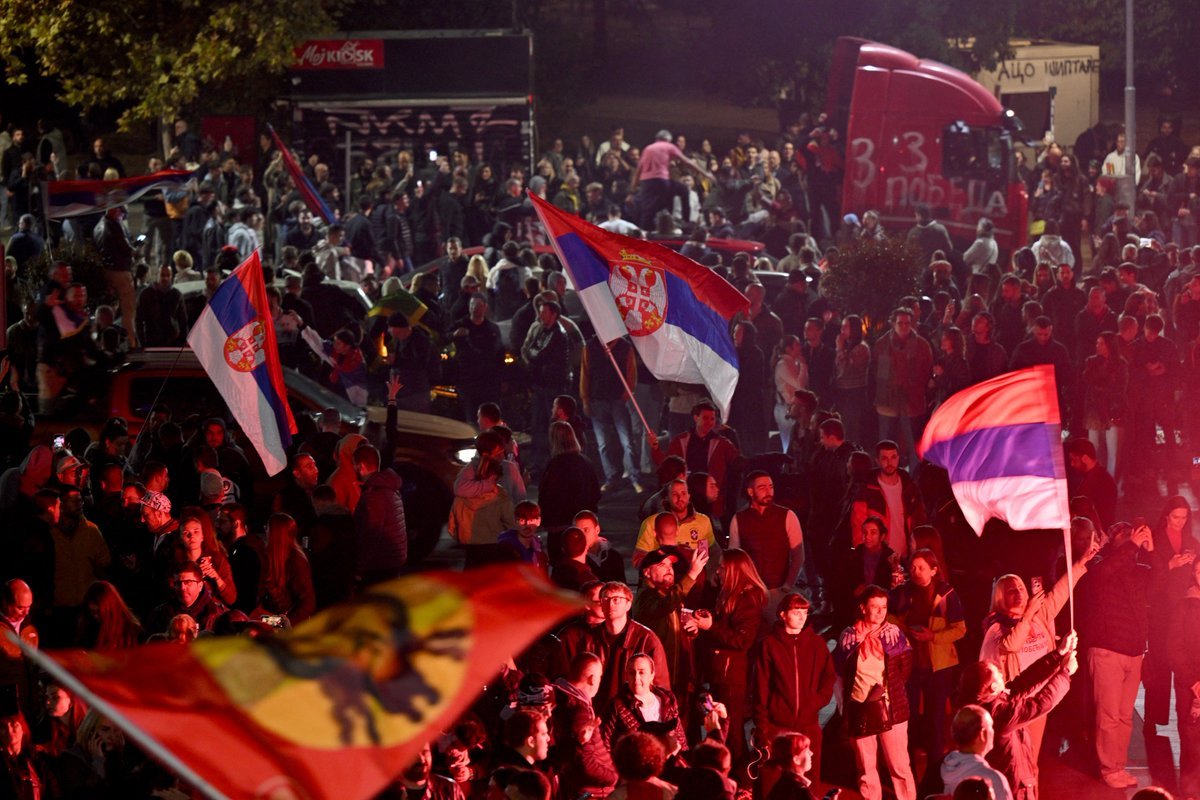
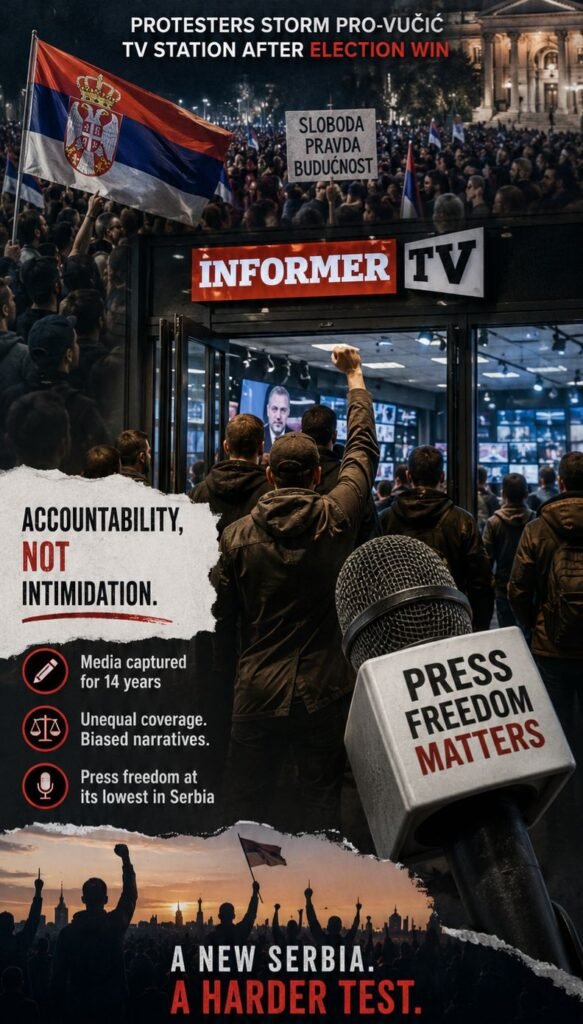
BELGRADE: Serbia’s historic political transition has exposed a defining contradiction of democratic change: defeating a dominant political establishment does not automatically dismantle the structures of influence that sustained it. The confrontation at Informer TV, a broadcaster supportive of Aleksandar Vučić, has brought this dilemma into sharp focus. As protesters entered its Belgrade newsroom, interrupted broadcasting and demanded the arrest of editor-in-chief and owner Dragan Vučićević, Serbia confronted an immediate question: can a movement elected on demands for accountability protect democratic freedoms when those freedoms benefit its political opponents?
The student-led Student List’s victory in the 25 October parliamentary election marks a watershed in Serbian politics. Preliminary estimates from the Centre for Research, Transparency and Accountability (CRTA) put the Student List at 52.45 per cent of the vote, compared with 39.2 per cent for the list associated with Vučić. CRTA projected approximately 138 seats for the Student List in the 250-member National Assembly, although the final allocation remained subject to the completion of the electoral process. The result followed years of student-led mobilisation against corruption and institutional failures.
The political significance extends beyond the defeat of Vučić’s camp. The movement has challenged an established system of political communication and authority, raising expectations of institutional reform. Yet its decentralised structure, rooted in student assemblies rather than conventional party leadership, presents a separate challenge: translating protest into coherent government while preserving internal accountability. The movement must now demonstrate that democratic participation can produce effective administration rather than merely electoral victory.
The events at Informer TV reveal why this transition will be difficult. Footage broadcast by the station showed approximately 30 people entering the newsroom on 26 October and surrounding Vučićević. Some called for his arrest. Vučić condemned the incident as an attack on freedom of speech and journalism, while Student List candidate Ilija Srdanović urged supporters to remain calm and reject violence. The episode demonstrated how quickly legitimate public anger can cross the boundary between accountability and intimidation.
Serbia’s media environment provides essential context. Reporters Without Borders ranked the country 104th among 180 states in its 2026 World Press Freedom Index, its lowest position recorded by the organisation. The Reuters Institute for the Study of Journalism has also documented a deteriorating media landscape, citing growing political and financial influence over the market and hostility towards independent outlets. These assessments point to structural weaknesses that cannot be corrected simply by changing political leadership.
CRTA’s monitoring of the 2026 campaign offers more specific evidence. Its assessment found that government representatives received almost three-quarters of political airtime on nationally available broadcasters towards the end of the campaign. The Student List was portrayed negatively in more than 80 per cent of the coverage devoted to it. On public broadcaster RTS, representatives of the authorities received as much as 94 per cent of political airtime in regular programming during the monitored period.
Such disparities do not prove that every report was inaccurate or that voters were incapable of independent judgement. They do, however, raise serious questions about the conditions under which political preferences are formed. Elections require more than access to ballot boxes; citizens need meaningful opportunities to hear competing arguments, scrutinise officials and evaluate alternative programmes. When one political camp enjoys disproportionate visibility, formal electoral competition can coexist with a deeply unequal public debate.
The implications extend beyond Serbia. Political power increasingly operates through the ability to influence the information citizens receive. Governments can weaken democratic accountability without abolishing elections by shaping access to broadcasters, public-service media and the economic resources on which journalism depends. Serbia’s experience demonstrates how media imbalance can become an institutional problem, undermining confidence in both political competition and the credibility of public information.
The Independent Association of Journalists of Serbia has announced plans to seek the revocation of Informer TV’s broadcasting licence, citing alleged systematic violations of legal and programming obligations. Such allegations require independent examination. The regulator must distinguish demonstrable legal breaches from editorial positions that a new political majority finds objectionable. Any sanction must follow transparent procedures, proportionate rules and meaningful opportunities for appeal. Otherwise, an initiative presented as media accountability could become an instrument of political retaliation.
Informer’s owner has characterised the proposed action as an attempt to ban the media. That claim should be tested against evidence rather than accepted or dismissed because of the station’s political alignment. Press freedom protects journalists and publishers from arbitrary interference, but it does not exempt broadcasters from generally applicable laws. The same standards must govern outlets friendly to the government, hostile to it or critical of both.
A revealing development came from public broadcaster RTV in Vojvodina, which opened an evening news bulletin with an apology for uncritical, one-sided reporting. The acknowledgement suggests recognition of a wider institutional failure. Yet an apology cannot restore trust without lasting changes: independent editorial leadership, balanced coverage, transparent corrections and safeguards against political interference. Public broadcasters must serve citizens, not the party occupying government offices.
Serbia therefore needs structural reform rather than a redistribution of media influence. Transparent ownership, fair advertising practices, independent broadcasting regulation and effective protection against threats to journalists are essential. Allegations of regulatory misconduct must be investigated impartially, while intimidation of journalists must be condemned regardless of the political identity of those responsible. Accountability loses legitimacy when it becomes selective.
The Student List now faces its own test of democratic maturity. Its campaign drew strength from demands for anti-corruption measures and institutional accountability. Its credibility will depend on whether those commitments survive the realities of governing. A movement that permits intimidation or uses regulatory authority to silence critics would risk reproducing the practices it promised to end. Its mandate should be measured by institutional reforms, not the punishment of political adversaries.
Serbia’s election has created an opportunity for democratic renewal, but the outcome remains contingent on what follows. The country must resist both the continuation of media dominance associated with the previous political order and the temptation to impose a new partisan hierarchy. Democracy requires independent institutions capable of protecting unpopular voices as firmly as popular ones. The decisive test is not whether Serbia’s new political forces can defeat the old establishment, but whether they can establish rules that constrain their own power. Press freedom is not a reward granted by electoral victors; it is a democratic right that must survive every change of government.
-Aleksandar Hudson