


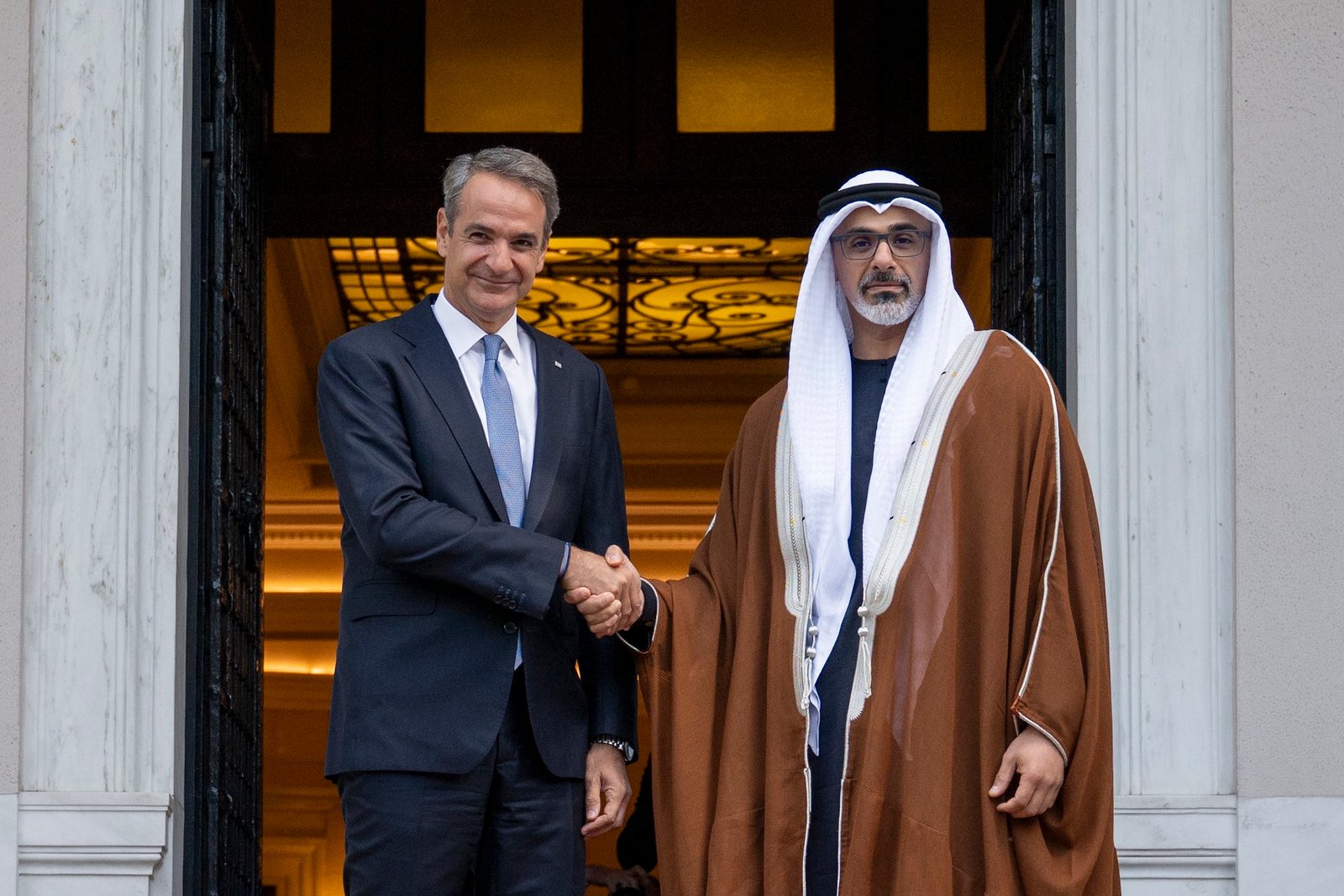
ATHENS: Greece has secured backing from Egypt, Bahrain and the United Arab Emirates in its dispute with Turkey over the Turkey–Libya maritime agreement, widening a contest over international law, regional influence and energy resources in the Eastern Mediterranean. The diplomatic alignment raises a larger question: can competing maritime claims be resolved through international law, or will they become instruments of geopolitical rivalry?
The Eastern Mediterranean is entering another phase of diplomatic tension after Greece and three Arab states jointly criticised the Turkey–Libya maritime accord, warning that it could undermine regional stability and the established international legal order.
In a joint statement delivered by Greek Foreign Minister George Gerapetritis at the United Nations in New York on October 26, Greece, Egypt, Bahrain and the UAE expressed serious concerns about the agreement. They cautioned against bilateral arrangements that could prejudice the rights of other states or establish precedents inconsistent with international law.
The statement followed the decision by Libya’s eastern parliament on October 20 to approve a maritime boundaries agreement originally signed by Turkey and Libya’s internationally recognised government in Tripoli in 2019. Greece and Cyprus have long opposed the accord, arguing that it disregards their maritime entitlements. Turkish President Recep Tayyip Erdoğan, however, has defended Ankara’s position, rejecting criticism from the European Union and other parties.
The latest diplomatic alignment matters because it broadens the dispute beyond the longstanding confrontation between Turkey, Greece and Cyprus. It also brings Arab partners into a regional debate with direct implications for maritime jurisdiction, offshore energy exploration and the strategic balance in the Mediterranean.
The Turkey–Libya agreement emerged in November 2019, when Ankara and the Tripoli-based government signed memorandums covering maritime jurisdiction and security cooperation. The maritime arrangement established a claimed boundary between the two countries across part of the Eastern Mediterranean.
Turkey views the agreement as a means of protecting its maritime interests and advancing its interpretation of the continental shelf and exclusive economic zone. Greece and Cyprus argue that the arrangement fails to account adequately for the maritime rights generated by Greek islands and other coastal territories.
The disagreement reflects a broader legal and geographical challenge: how should maritime zones be delimited when states have overlapping claims and different interpretations of international law?
Under the United Nations Convention on the Law of the Sea (UNCLOS), coastal states can exercise sovereign rights over resources within their exclusive economic zones, which may extend up to 200 nautical miles from their baselines, subject to the convention’s provisions. Where maritime entitlements overlap, delimitation generally requires agreement or an appropriate dispute-settlement process.
Turkey is not a party to UNCLOS and disputes aspects of the interpretation advanced by Greece and Cyprus. The legal and political disagreement therefore extends beyond the text of a single agreement to competing positions on maritime boundaries, island entitlements and the application of customary international law.
A bilateral agreement cannot automatically resolve the rights of third states. Equally, diplomatic opposition alone does not constitute a final legal determination of the competing claims. The dispute remains dependent on the relevant legal principles, geographical circumstances and prospects for negotiated settlement.
Egypt’s participation is particularly consequential because Cairo has substantial strategic and economic interests in the Eastern Mediterranean. Egypt signed an exclusive economic zone agreement with Greece in August 2020, reflecting the two countries’ efforts to coordinate their maritime interests. Both governments have opposed the Turkey–Libya arrangement, and their partnership has become an important component of the regional diplomatic landscape.
Cairo’s position is therefore not simply an expression of solidarity with Athens. It also reflects concerns about how competing maritime arrangements could affect Egypt’s own interests, regional energy cooperation and the legal framework governing offshore resources.
For Greece, Egyptian support strengthens its ability to present the dispute as a wider regional concern rather than an exclusively bilateral disagreement with Ankara. It also reinforces cooperation between two countries that have sought to deepen political, economic and energy ties.
Bahrain and the UAE add another dimension. Their participation expands the group of states backing Greece’s objections and signals that concerns over maritime agreements can intersect with broader diplomatic relationships across Europe and the Arab world. However, the alignment should not be interpreted as evidence that every participant shares identical objectives or legal arguments. States can support a common declaration while retaining different priorities regarding Turkey, Libya, energy security and regional stability.
For Ankara, the maritime agreement is part of a wider effort to establish and defend its interests in the Eastern Mediterranean. Turkey has consistently challenged maritime interpretations that it believes restrict its access to offshore areas and fail to reflect its understanding of the region’s geography. Its position is also linked to its wider engagement with Libya, where maritime claims, security cooperation and economic interests overlap.
The agreement with Tripoli was signed during Libya’s conflict, when Turkey provided crucial support to the internationally recognised government against the offensive launched by forces aligned with eastern military commander Khalifa Haftar.
Since then, Turkey’s relationship with eastern Libya has evolved. Turkish officials have maintained contacts with eastern authorities, including visits to Benghazi, while Turkish companies have pursued commercial opportunities in construction and other sectors.
The eastern parliament’s recent approval of the maritime accord is therefore notable. It suggests that Turkey’s engagement with Libya’s rival political centres may be creating new opportunities to reinforce the agreement’s domestic political support. Yet parliamentary approval in eastern Libya does not, by itself, eliminate international objections or resolve questions concerning Libya’s divided political institutions. Nor does it guarantee acceptance by neighbouring states. For Ankara, the challenge is to preserve its strategic position while avoiding an escalation that could damage relations with regional partners or discourage investment in the Eastern Mediterranean.
The dispute has become more consequential as Eastern Mediterranean states pursue offshore energy opportunities. Maritime boundaries determine where governments can grant exploration licences, regulate resource development and claim rights over offshore oil and gas. Unresolved jurisdictional disputes can complicate investment decisions, raise legal risks and delay projects requiring long-term capital commitments.
Greece has been advancing offshore exploration plans near Crete, including a licence involving a Chevron-led consortium. The prospect of identifying commercially viable gas resources adds economic weight to Athens’ efforts to establish clarity over its maritime jurisdiction.
For energy companies, the central concern is predictability. Offshore exploration requires substantial investment in surveys, equipment and infrastructure before commercial production can begin. Investors must therefore assess not only geological prospects but also regulatory certainty, political risk and the possibility of competing claims.
Turkey and Libya, meanwhile, have an interest in preserving the maritime framework they negotiated. Their positions could influence future exploration plans and the broader geography of regional energy cooperation. European energy security, regional infrastructure planning and potential investment partnerships could all be affected by whether states establish predictable arrangements for offshore development. However, exploration licences and geological prospects do not guarantee commercially recoverable resources or future production.
Libya’s fragmented political system further complicates the prospects for a durable settlement. The 2019 agreement was concluded by the government in Tripoli, while the eastern-based House of Representatives withheld its approval for years. Its recent endorsement marks a change in the domestic political context surrounding the agreement.
Libya continues to face the consequences of institutional division that followed the 2011 uprising and the overthrow of Muammar Gaddafi. Rival centres of political and military power have complicated national decision-making, economic governance and foreign relations. The maritime accord consequently raises questions beyond international boundaries: which Libyan institutions can provide lasting political legitimacy for agreements with long-term consequences, and how can the country reconcile competing regional interests?
A durable arrangement would benefit from broader Libyan political consensus and constructive engagement with neighbouring states. Without these elements, even agreements that gain additional domestic support may remain vulnerable to external objections and future political change. The joint position of Greece, Egypt, Bahrain and the UAE increases diplomatic pressure on Turkey and Libya, but pressure alone is unlikely to resolve the underlying legal dispute. The immediate opportunity lies in negotiations that address competing maritime entitlements without requiring states to abandon their broader strategic interests. Greece has indicated its willingness to pursue a separate maritime delimitation agreement with Libya, offering a possible channel for dialogue.
Such negotiations would need to account for applicable international law, the geographical circumstances of the relevant coastlines and the rights of affected states. Technical discussions, confidence-building measures and transparent legal processes could help reduce uncertainty.
A more confrontational path would carry costs. Continued diplomatic escalation could deepen regional divisions, complicate offshore energy development and make future compromises politically more difficult. It could also encourage states to rely increasingly on competing bilateral arrangements rather than pursue a more widely accepted regional framework.
For the European Union and Arab partners, the challenge is to translate diplomatic alignment into support for a workable settlement. For Turkey, constructive engagement with Greece, Cyprus, Egypt and Libya’s competing political institutions could help protect its interests while reducing the risks of prolonged confrontation.
The Turkey–Libya maritime dispute illustrates how geography, international law, energy security and political fragmentation can combine to reshape regional diplomacy. Greece’s support from Egypt, Bahrain and the UAE strengthens its diplomatic position and demonstrates that the controversy has acquired a wider regional dimension. But it does not settle the competing legal claims or guarantee a change in Ankara’s policy.
The decisive question is whether the emerging alignment encourages negotiations or hardens opposing camps. A settlement based on applicable international law and the rights of affected states would offer a more reliable foundation for investment, regional cooperation and long-term stability than a prolonged contest of competing agreements. For the Eastern Mediterranean, the stakes extend beyond who draws a maritime boundary. They concern whether regional powers can manage overlapping interests through negotiated rules while pursuing energy development without allowing strategic competition to dominate the future of the region.
-Sharon Schiefelbein