



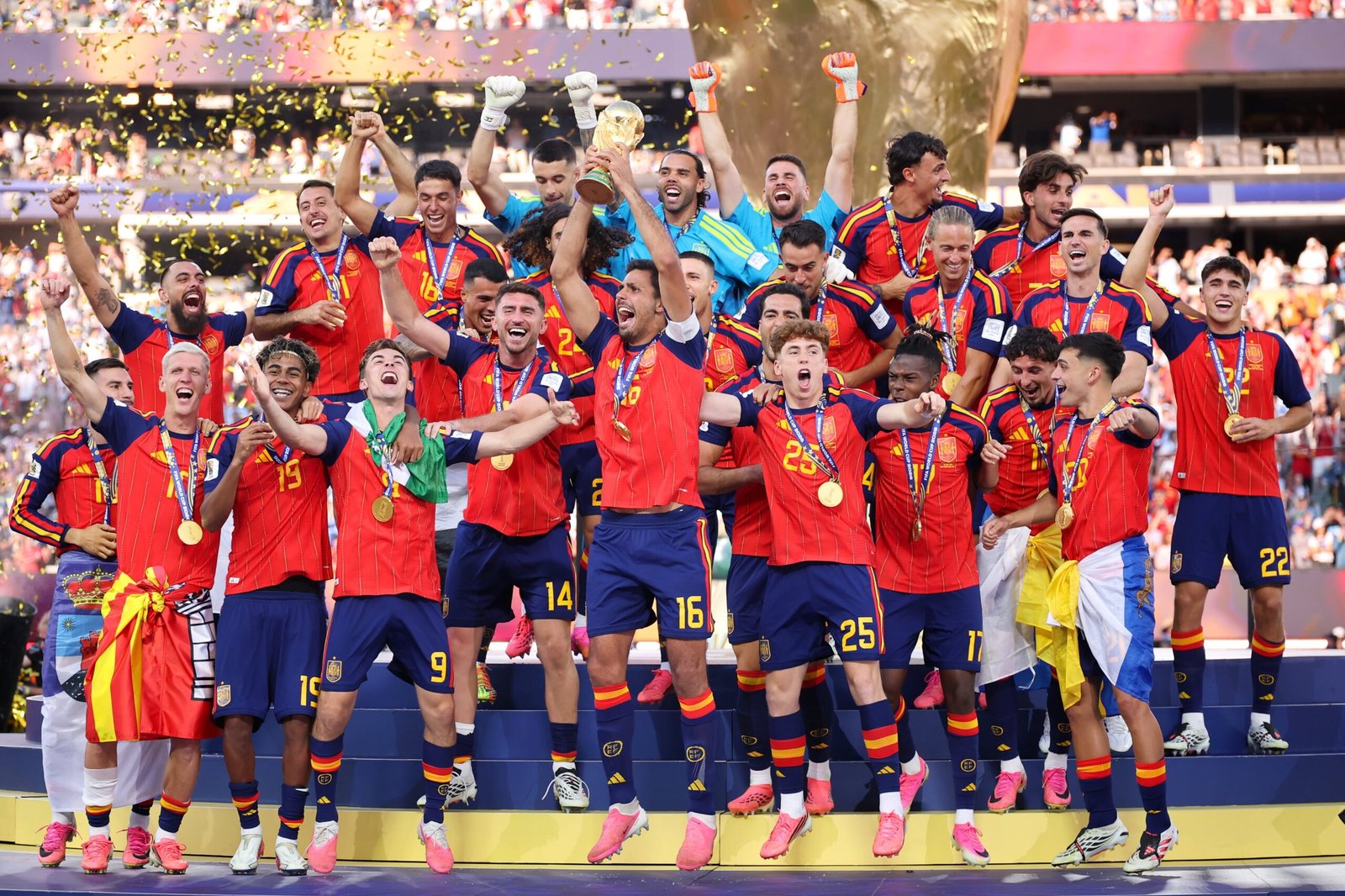
Spain are world champions once again. In a FIFA World Cup final that promised to be remembered as a clash of football’s greatest talents but instead unfolded as a tense tactical battle, substitute Ferran Torres delivered the decisive moment, scoring in the 106th minute to secure a 1-0 extra-time victory over defending champions Argentina.
The result crowned a remarkable Spanish generation under Luis de la Fuente, ending Argentina’s reign at the top of world football while extending Spain’s dominance in international football following their UEFA Euro 2024 triumph. It was a victory built on patience, discipline and tactical control rather than flair, proving once again that championships are often decided by resilience rather than spectacle.
For more than 100 minutes, the final was defined by caution instead of creativity. Spain monopolized possession, constantly probing Argentina’s defensive lines, yet struggled to convert territorial dominance into clear scoring opportunities. Argentina, meanwhile, adopted an unusually conservative approach, focusing on disrupting Spain’s rhythm rather than launching attacks of their own.
The defending champions produced one of the most statistically remarkable performances in World Cup history for all the wrong reasons. They failed to register a single genuine shot throughout regulation time, an extraordinary record for a team contesting a World Cup final. Lionel Messi, appearing in his third World Cup final, was largely neutralized and unable to influence the contest in the way that has defined his legendary career.
Spain’s highly anticipated teenage sensation Lamine Yamal also found little space to express himself, as Argentina’s disciplined defensive structure denied the young star any sustained influence. Instead, it was Spain’s bench that transformed the contest.
Luis de la Fuente’s substitutions proved decisive. Nico Williams injected pace and directness, while Ferran Torres finally broke the deadlock in extra time after Spain’s relentless pressure had produced 20 attempts on goal. His composed finish ended one of the most cagey World Cup finals in recent memory.
Torres later described the goal as belonging to the entire nation.
“It was a goal scored by 47 million people. It wasn’t mine alone. It was destined to happen.”
The closing moments reflected the tension that had built throughout the evening. Frustration boiled over after the final whistle as players from both sides became involved in heated confrontations. Argentina’s difficult afternoon had already worsened when Enzo Fernández received a late red card, symbolizing the defending champions’ inability to contain Spain’s relentless pressure.
The final itself divided opinion. While tactical enthusiasts admired Spain’s positional discipline and defensive organization, many neutral supporters expected a more entertaining spectacle after a tournament filled with attacking football and dramatic storylines. The halftime entertainment featuring global music icons generated almost as much excitement as the football itself, highlighting the contrast between the event’s grand production and the cautious action on the pitch.
Yet history rarely remembers how titles are won only who lifts the trophy.
Luis de la Fuente now cements his place among Spain’s greatest coaches. Having already guided La Roja to the European Championship, he has now added the FIFA World Cup, extending Spain’s unbeaten run to 38 matches across all competitions. At 65, he also becomes the oldest coach to win the FIFA World Cup.
“We’ve won everything,” an emotional De la Fuente declared after the match. “This generation has remained faithful to our philosophy and made it even stronger. They are exceptional footballers and extraordinary people.”
For Argentina, the defeat marks the end of an era rather than a failure. Lionel Scaloni’s side reached another World Cup final through determination and resilience, but they simply could not match Spain’s control on the biggest stage. Scaloni praised Lionel Messi after the match, insisting the captain remains “the best football player ever,” despite the heartbreaking defeat.
Spain’s triumph may not rank among the most entertaining World Cup finals, but it could prove one of the most significant. It signals the arrival of a new football dynasty built on tactical intelligence, squad depth and unwavering belief. In modern football, beauty is admired, but trophies belong to those who find a way to win.
-Nick Ferris