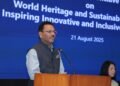
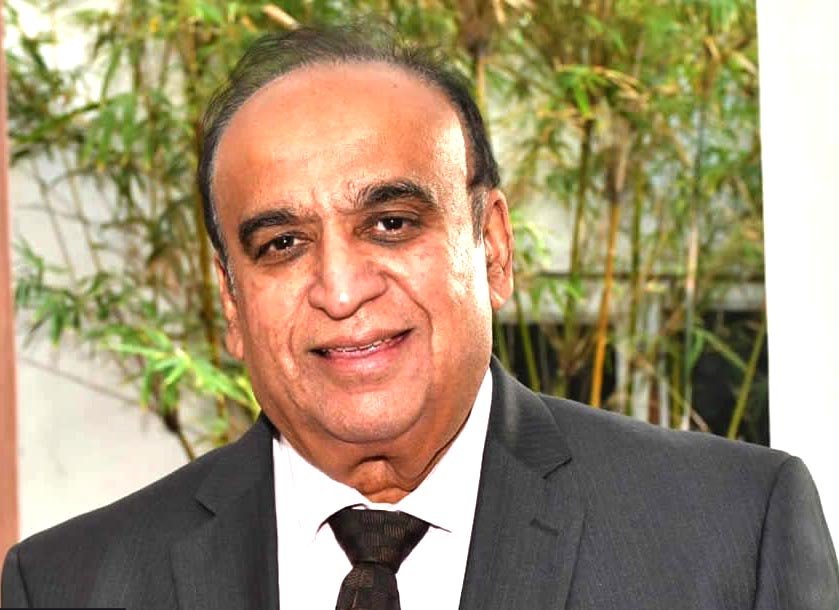
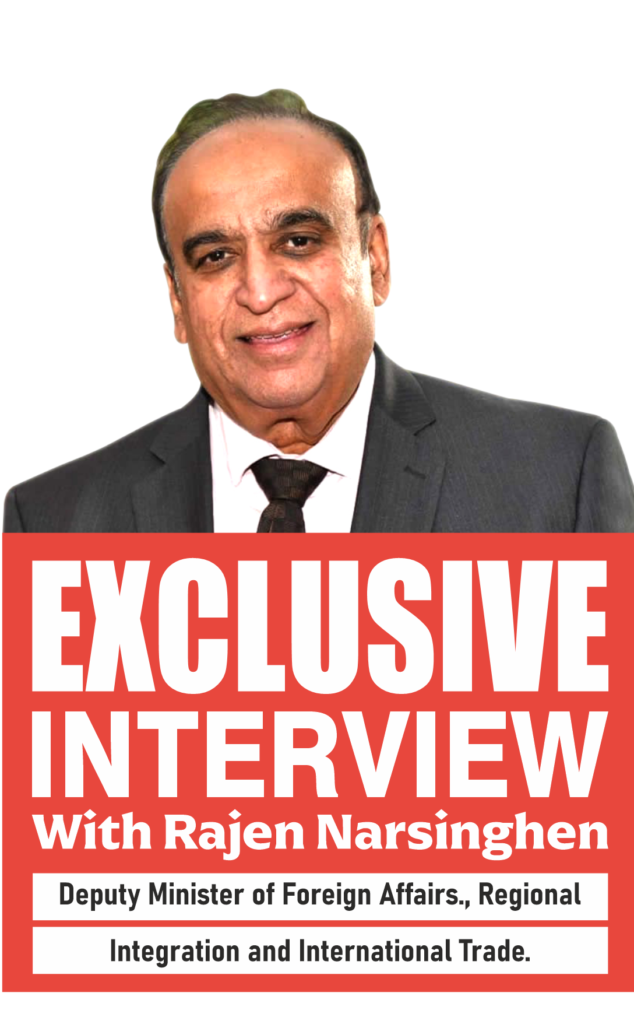
As geopolitical tensions reshape maritime trade routes across the Indian Ocean, disrupt energy corridors through the Gulf and the Red Sea, and intensify strategic competition between major powers, Mauritius is emerging as a diplomatic stabilizer and gateway linking Africa with the Indo-Pacific. In this WorldAffairs Exclusive Interview, the Deputy Minister of Foreign Affairs, Regional Integration, and International Trade, Rajen Narsinghen, outlines how Mauritius is advancing a strategy of neutrality, maritime resilience, diversified trade partnerships, and renewable energy transition, while positioning itself as a trusted connector between competing geopolitical centers in what many analysts increasingly describe as the Indian Ocean century.
This Interview was conducted by the Editor-in-Chief of WorldAffairs News Views & Analysis, Dr. M. Shahid Siddiqui.
WorldAffairs: How is Mauritius navigating its foreign policy priorities amid growing geopolitical fragmentation and rivalry among major powers?
H.E Rajen Narsinghen: As a Small Island Developing State (SIDS) and a Small and Vulnerable Economy (SVE), Mauritius has mastered the “Diplomacy of Equilibrium.” Our national identity is defined by a policy of strict neutrality and non-alignment, positioning our island not as a pawn in geopolitical rivalries, but as a proactive advocate for universal peace. We understand that for a nation of our scale, our greatest strength lies in being a “friend to all and an enemy to none.” This neutrality is the bedrock upon which we have built a sophisticated network of global alliances that span the West, the East, and the African continent. Our relationship with the West is a testament to our diplomatic maturity; despite a complex colonial past, we maintain excellent and non-acrimonious relations with both France and the United Kingdom. These ties have evolved into modern, strategic partnerships based on mutual respect and shared democratic values.
WorldAffairs: How is Mauritius preparing for potential shipping and energy disruptions arising from instability in the Middle East and Red Sea region?
H.E Rajen Narsinghen: The escalating tensions involving countries such as Iran and Israel, which affect the Red Sea and the Suez Canal, highlight our vulnerability as an island nation. To mitigate these risks, Mauritius is strengthening its role as a maritime “Safe Haven.” We believe in a careful balancing of powers to ensure freedom of navigation. For instance, while we remain steadfast in our pursuit of sovereignty over the Chagos Archipelago, we maintain a pragmatic relationship with the U.S. and the UK. We recognize the strategic necessity of the military base at Diego Garcia for regional and global maritime security and have expressed that its continued operation is not incompatible with our sovereign rights. We have given on firm undertaking to UK and US.Mauritius always honours its intetnational agreements.So US is fulky reassured. By collaborating with international partners, we ensure that the Indian Ocean remains a zone of peace and that our supply lines remain resilient against northern bottlenecks. The Indian Ocean once the key and star of the region can assume once more its strategic role and ensure safe passage of ships for smooth supply change.
WorldAffairs: What strategic role does Mauritius envision for itself within the evolving Indian Ocean security architecture?
H.E Rajen Narsinghen: Mauritius sees itself as the “Control Tower” of the Indian Ocean. Our role is to facilitate dialogue and cooperation rather than competition. We leverage our membership in the Indian Ocean Rim Association (IORA) and the Indian Ocean Commission (IOC) to promote the “Blue Economy” and maritime domain awareness. We rely heavily on our partnership with India, which provides technical and naval support to ensure the security of our Exclusive Economic Zone (EEZ). By acting as a neutral platform, we provide a space where major powers can cooperate on anti-piracy, disaster relief, and environmental protection, ensuring that the ocean remains a global common managed by international law.
WorldAffairs: How is Mauritius addressing supply-chain vulnerabilities linked to instability across key maritime corridors?
H.E Rajen Narsinghen: As a SIDS, we are highly sensitive to freight costs and supply delays caused by instability in key maritime corridors. Our diversification strategy is multifaceted. We are deepening our “Southern Corridor” trade, looking toward SADC and COMESA partners to reduce over-reliance on northern routes. Simultaneously, we maintain our privileged relations with the European Union forged through the historic Lomé and Cotonou Conventions and now the upcoming Epas and continue to benefit from the US AGOA. By spreading our trade across multiple legal frameworks and geographical routes, we ensure that our supply chains remain robust even when traditional corridors are compromised.
WorldAffairs: How can Mauritius position itself as a global trade and investment hub at a time of rising protectionism worldwide?
H.E Rajen Narsinghen: While some regions turn inward, Mauritius is opening further. We are uniquely positioned with a “Triple Crown” of trade agreements: a unique double membership in SADC and COMESA, now bolstered by the African Continental Free Trade Area (AfCFTA). We offer a stable, transparent, and tax-efficient jurisdiction that adheres to the highest international standards. This allows us to remain the preferred hub linking Africa, Asia, and Europe. We provide “France-Standard” legal security based on the Code Napoléon in the heart of the Afro-Asian growth corridor, making us the most competitive destination for substance-based investment.We are among the 5 or 6 best mixed law jurisdictions which is ideal to promote International Trade.
WorldAffairs: How does Mauritius leverage partnerships with India and China to strengthen its gateway role into Africa?
H.E Rajen Narsinghen:Our strategy is to transform Mauritius into the “Refinery and Control Tower” for Asian expansion into Africa. With India, we have the CECPA, the first and most comprehensive agreement of its kind in Africa, which offers a unique roadmap for trade and services. With China, our ancestral ties have culminated in a modern Free Trade Agreement. Indian and Chinese firms can use our 20+ African Investment Promotion and Protection Agreements (IPPAs) to mitigate political risks while utilizing our Freeport to add value to goods. Our new strategy specifically focuses on making Mauritius a hub for Indian business to “leapfrog” into Africa, allowing them to structure finance and operations here with 100% foreign ownership and full capital repatriation.
WorldAffairs: What steps is Mauritius taking to strengthen its energy security and accelerate the renewable transition?
H.E Rajen Narsinghen: Energy volatility driven by global tensions makes our transition to renewables an absolute priority. We are aggressively moving toward a “Green Economy” by leveraging our ocean and natural resources. We are exploring solar, biomass, and wave energy and also learning from India on Ammonia and other emerging sources to reduce our dependence on imported fossil fuels. Our goal is to transform our energy vulnerability into sustainable sovereignty, inviting international partners to use Mauritius as a “Living Lab” for clean technologies that can be scaled across the African mainland and other island nations.
WorldAffairs: How is Mauritius working with the United Nations system to address climate risks facing small island states?
H.E Rajen Narsinghen: As a SIDS, climate change is an existential threat. Mauritius works tirelessly with the UN and organizations like AOSIS to demand that major economies honor their climate financing commitments. We advocate for a “Multidimensional Vulnerability Index” (MVI) that recognizes our geographical and economic realities rather than just our GDP. Our neutrality allows us to be a credible moral voice on the international stage, preaching for climate solidarity and stronger commitments from the world’s largest emitters to protect the most vulnerable states.
WorldAffairs: What mechanisms does Mauritius support to safeguard maritime security and freedom of navigation in the Indian Ocean?
H.E Rajen Narsinghen:To ensure freedom of navigation amidst increased military competition, we believe in strengthening multilateral mechanisms like the UN Convention on the Law of the Sea (UNCLOS). Mauritius encourages a cooperative maritime security architecture where regional powers, supported by India’s maritime expertise and the strategic presence of our Western partners, work in tandem. Security should not be a “zero-sum game”; we advocate for joint surveillance and information sharing to ensure the Indian Ocean remains a zone of prosperity rather than a theater of confrontation.
WorldAffairs: What is Mauritius’ geopolitical and economic outlook for the coming decade?
H.E Rajen Narsinghen:The biggest opportunity for the next decade lies in the digital and green transformation of Africa, with Mauritius serving as its financial and logistical “brain.” We see a future where our ancestral ties with China, our technical collaboration with the successors of the USSR, and our burgeoning relations with Gulf states like the UAE and Saudi Arabia all converge on our shores. The primary risk remains the erosion of the rules-based international order. However, by remaining a sovereign, neutral bridge cherishing our ties with the West while deepening our partnership with India, we are confident that Mauritius will remain a beacon of stability and a vital hub for global trade in an uncertain world. While opening up to others we maintain excellent relations with EU and our traditional partners like UK, France and US.The latter is on the point of completing the biggest and modern embassies in the Indian Ocean and possibly Africa.This is a clear testimony of the excellent relations between US and Mauritius and the trust.